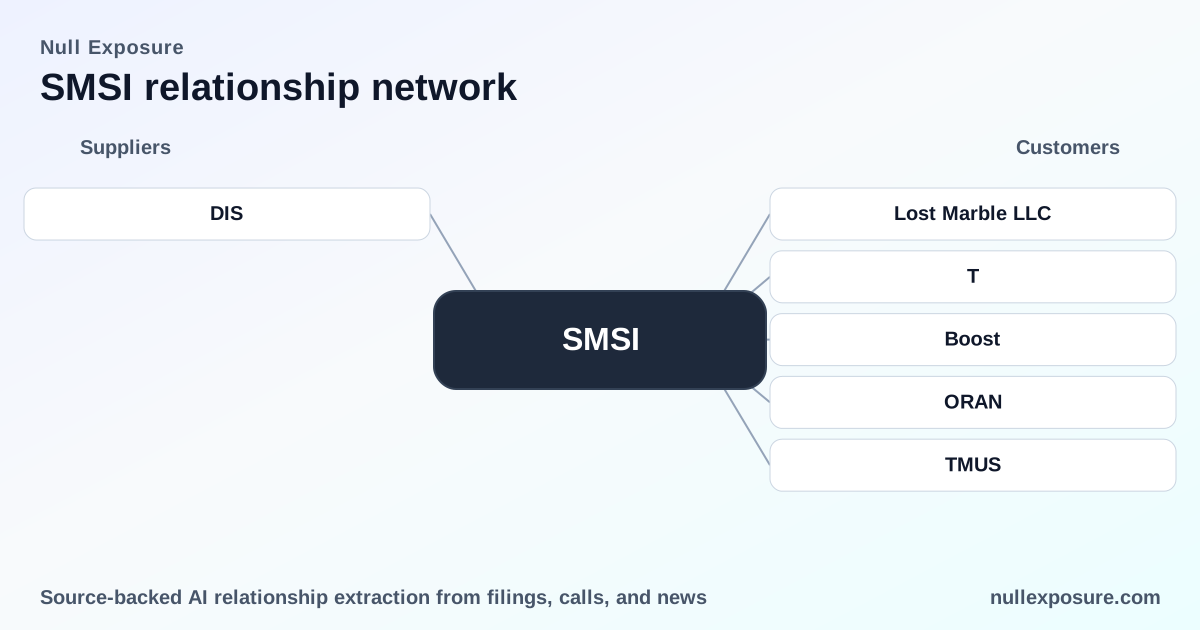
Smith Micro Software (SMSI): supplier relationships, concentration risks, and commercial posture
Smith Micro Software develops and sells application software designed to enhance the mobile experience for cable and wireless service providers, monetizing through product licensing, support contracts and professional services to a small set of communication carriers and content partners. The company operates as a niche, low‑scale vendor: revenue is modest (~$17.4M TTM) and profitability is negative, so commercial relationships and customer concentration determine near‑term financial outcomes. For more structured diligence and supplier mapping, visit https://nullexposure.com/.
How Smith Micro actually makes money — customer and product dynamics
Smith Micro’s stated market position is selling device and content‑delivery software to service providers worldwide, collecting revenue through license fees, maintenance, and integration work. Financials show limited scale (Revenue TTM ~$17.4M; Gross Profit ~$12.9M) and negative operating performance (EBITDA and EPS negative), which means each large contract has outsized impact on cash flow and valuation volatility. The small market capitalization (~$18.8M) and low institutional ownership (under 9%) reinforce that the business is run with concentrated counterparties rather than broad market distribution.
Concentration, contracting posture and commercial leverage
Smith Micro’s supplier/customer profile is concentrated and commercially sensitive. For the year ended December 31, 2024, three service providers accounted for purchases of 22%, 18% and 14%, and together those customers represented 35% of trade payables — a clear sign that the company operates with a narrow roster of large counterparties. This creates the following structural characteristics:
- High counterparty concentration: Material revenue and payable exposures tied to a handful of providers increase bargaining leverage for those customers and heighten renewal and payment timing risk.
- Customer-dependent contracting posture: Given negative operating metrics and small scale, Smith Micro’s negotiating position is defensive; the firm must protect renewals and services revenue to preserve liquidity.
- Operational criticality that is contextual: Products are mission‑important for specific use cases at service providers, but Smith Micro’s small footprint means the company is replaceable by larger vendors when diligence or integration scale tips the balance.
- Maturity profile: legacy product base with recurring service dependency: The business combines legacy software licensing with ongoing support revenue; stability depends on contract renewals rather than rapid newmarket penetration.
These are company‑level signals drawn from the fiscal disclosure of 2024 purchase concentrations and the public financial profile.
For prioritized supplier risk mapping and more supplier intelligence, see https://nullexposure.com/ — the data helps underwrite counterparties and payment exposure.
Relationship rundown: the reported partner footprint
Below is a concise treatment of every relationship captured in the available results.
- Pixar (DIS): Smith Micro integrated Pixar’s OpenSubdiv technology into its Poser product line, enabling more flexible subdivision control in artistic workflows; this partnership was disclosed in a 2013 product release on Computer Graphics World. (Source: CGW press release, 2013 — https://www.cgw.com/Press-Center/News/2013/Smith-Micro-Releases-Poser-10-Poser-Pro-2014.aspx)
That is the complete set of relationships surfaced in the supplier scope for SMSI in the provided results. The Pixar integration is product‑level and historic (FY2013) rather than a large commercial carrier contract, which contrasts with the 2024 concentration signal in the constraints section.
What the relationship map tells investors and procurement teams
The presence of a historical technology integration with Pixar indicates Smith Micro pursued interoperability and third‑party IP licensing in product development. However, the public relationship universe in the current scan is narrow — investors should treat legacy integrations as product features rather than recurring revenue drivers unless updated commercial agreements are disclosed.
Contrast that product integration with the 2024 concentration evidence: contract revenue and trade payable concentration — not product IP partnerships — drive current financial sensitivity. This duality gives Smith Micro limited pricing power; it sells differentiated software but depends on a few large customers for the majority of transactional volume.
Operational constraints and what they imply for supplier risk
The explicit constraint evidence — that three service providers accounted for 22%, 18% and 14% of purchases and together 35% of trade payables in 2024 — is a direct company‑level signal of exposure. From an operational and contracting perspective this results in:
- Tail risk to renewals and collections: Losing or having delayed payments from a top customer can materially stress cash and EBITDA.
- Supplier negotiation asymmetry: Major customers can demand concessions on pricing, contract length or payment terms with outsized effect.
- Due diligence focus requirements: Counterparty credit, contract duration, and service dependency should be top items in commercial and investment diligence.
These constraints are not tied to any single named partner in the available excerpts, so they operate as an overall indicator of SMSI’s business model fragility.
Investment implications — balanced, risk‑aware view
Smith Micro is a small software supplier with limited scale and concentrated counterparty exposures. The core investment thesis is straightforward: value will accrue either through stabilized contract renewals with existing service provider customers or through successful scaling of new license and support relationships to diversify revenue. Current financial metrics (negative EBITDA, negative EPS, market cap in the low‑tens of millions) reflect the risk of contraction; however, if management secures multi‑year renewals with top purchasers or materially diversifies the customer base, downside stabilizes and upside becomes credible.
Key risks to underwrite before committing capital:
- Renewal and payment risk from the handful of large customers.
- Limited liquidity and tight balance sheet headroom.
- Low institutional ownership and insider concentration that may limit market liquidity for exits.
For rigorous supplier risk scoring and contract prioritization, consult the tools at https://nullexposure.com/ to map counterparty concentration and exposure.
Bottom line and next steps
Smith Micro operates as a focused provider of device and content software with historical product integrations (e.g., Pixar’s OpenSubdiv in Poser) but current commercial sensitivity driven by concentrated customers. The investment case depends on contract durability and diversification; absent structural revenue growth or more balanced payables, valuation will remain vulnerable. For more supplier relationship research and actionable exposure maps, visit https://nullexposure.com/.
Note: the relationship evidence here is limited in scope and age; investors should augment this with the company’s latest filings, customer contracts, and management commentary before making capital allocations.