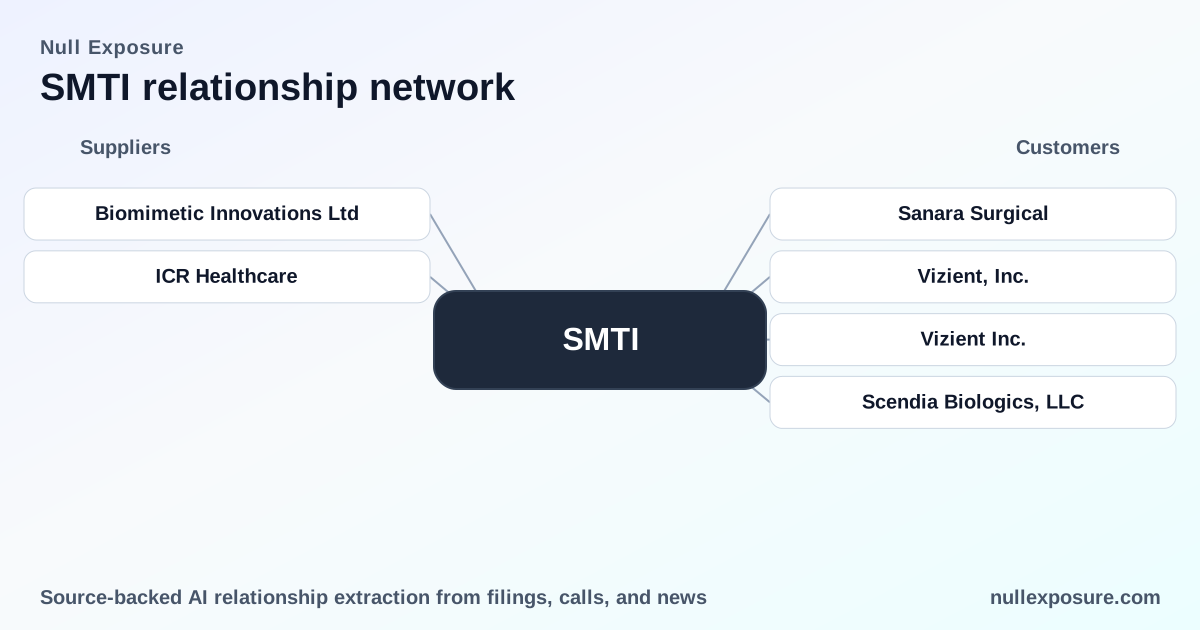
Sanara MedTech (SMTI) — Supplier relationships and operating constraints that matter to investors
Sanara MedTech develops, markets and distributes skin and wound care products to physicians, hospitals, clinics and post-acute care settings, monetizing through product sales and by securing exclusive licensing and distribution deals that expand its commercial footprint. The company operates largely as an asset-light medical device supplier that leverages contract manufacturing, targeted minority investments and commercial partnerships to grow revenue and broaden product offerings. For investors assessing supplier risk and strategic upside, the critical questions are supply continuity, manufacturing concentration, and how recent licensing deals change revenue optionality. Learn more about our supplier intelligence at https://nullexposure.com/.
How Sanara’s supplier posture shapes operational risk and upside
Sanara’s operating model is contract-manufacturer dependent and commercially partnership-driven. Company disclosures indicate Sanara does not own manufacturing plants and relies on contract manufacturers for its finished goods, with the firm’s principal revenue-producing products purchased from a single manufacturer. This structure creates both cost advantages (lower fixed capex, faster portfolio scale-up) and concentrated execution risk: if a primary contract manufacturer fails to deliver, Sanara’s business, operating results and financial condition can be materially affected.
In parallel, Sanara uses professional services arrangements to supplement internal R&D and product development capacity — a deliberate choice that keeps headcount light but embeds vendor dependency into core innovation processes. These are company-level characteristics that should be evaluated as part of any supplier diligence exercise rather than being attributed to a single named partner.
Key operational characteristics to price into any valuation:
- High supplier concentration: principal products sourced from one contract manufacturer increases disruption exposure.
- Asset-light manufacturing posture: limits capex but amplifies supply-chain and quality-control dependency.
- Outsourced R&D services: accelerates development cadence but ties IP transfer and timelines to vendor arrangements.
If you want a deeper supplier risk readout for portfolio monitoring, visit https://nullexposure.com/ for a tailored briefing.
Active relationships investors should know about
Sanara’s public disclosures and press releases name a small set of partners that change the company’s commercial profile. Below are the relationships in the record, each summarized plainly with source context.
Biomimetic Innovations Ltd — exclusive license, distribution agreement and minority investment
- Sanara executed an exclusive license and distribution agreement with Biomimetic Innovations Ltd, a privately held medical device company headquartered in Shannon, Ireland, expanding Sanara’s addressable surgical and wound-care product set. According to Sanara’s January 21, 2025 press release, the agreement includes distribution rights and a minority investment by Sanara to align incentives and accelerate commercialization.
- Sanara provided a program update on the licensed product OsStic in December 2025, indicating ongoing collaboration and development oversight with Biomimetic Innovations as the product progresses toward market readiness (Sanara press release, Dec 10, 2025). These steps convert a product-development pipeline item into a clear commercial avenue for future revenue.
ICR Healthcare — investor relations and communications provider
- Sanara uses ICR Healthcare for investor relations support; multiple recent press releases list ICR contacts as the company’s investor relations representatives, indicating an outsourced communications strategy to keep securities-market engagement consistent and professional (GlobeNewswire releases Feb 17, 2026 and Mar 3, 2026). This relationship signals active investor outreach rather than an operational supply dependency.
(Each of the above relationships is documented in Sanara’s press releases and public announcements; the Jan 21, 2025 announcement introduced the Biomimetic license/investment and subsequent releases provided updates and IR contact details.)
Why these relationships matter to procurement, operations and valuation
The Biomimetic deal is a commercial lever: licensing and distribution agreements accelerate route-to-market without adding manufacturing burden. For valuation models this translates into potential revenue growth that is capital-efficient but contingent on successful regulatory and commercial execution by the partner network. The minority investment aligns Sanara’s economics to the partner’s upside and reduces pure licensing risk.
The reliance on third-party manufacturers is a material operational constraint. Company statements explicitly warn that an inability of a supplier to deliver finished goods in a timely manner would materially harm results. That concentration is not a hypothetical; it is a central supply-chain risk factor that investors should price through scenario analysis (lost sales durations, cost of alternative sourcing, impact on gross margins).
Outsourced professional services for development create a repeatable, scalable approach to product innovation, but they also represent a counterparty and IP-handling risk that deserves contractual scrutiny during diligence. Investors should treat these service arrangements as a part of the company’s operating leverage rather than incidental vendor relationships.
Major takeaways for risk/return:
- Upside: Licensing and distribution agreements (e.g., Biomimetic) expand product breadth with low incremental capex.
- Downside: High supplier concentration and reliance on contract manufacturers present a tangible operational tail risk that can depress revenue and margins if disrupted.
- Governance/market-facing: Use of an IR firm demonstrates proactive market engagement, improving transparency around milestones and reducing information asymmetry.
If your portfolio requires continuous monitoring of supplier-concentration shifts and partner milestone tracking, our platform delivers tailored alerts and analysis — start here: https://nullexposure.com/.
Practical monitoring checklist for investors
Active monitoring should focus on a short list of signals that will change the risk profile quickly:
- Track manufacturing continuity disclosures and any statements about dual-sourcing or capacity expansion; these directly reduce concentration risk.
- Watch regulatory clearances, CE/FDA filings, or clinical updates for the Biomimetic OsStic program—those milestones convert the licensing agreement into revenue.
- Review contract terms disclosed in SEC filings for vendor termination clauses, lead times, and qualification requirements for contract manufacturers.
- Monitor insider and institutional ownership (insiders hold a majority stake in the shares outstanding) as governance decisions around capital allocation and partner concentration will flow from controlling owners.
Conclusion — what investors should do next
Sanara’s model is commercially scalable but operationally concentrated. The Biomimetic relationship is a clear growth vector; however, the company’s dependence on third-party manufacturers and outsourced R&D services is a persistent downside risk that requires active monitoring and scenario planning. For investor teams evaluating exposure to Sanara, focus diligence on supplier continuity plans, contract terms with manufacturers, and milestone cadence from license partners.
To receive a concise supplier-risk briefing or to integrate Sanara’s supplier signals into your investment workflow, visit https://nullexposure.com/ and request the supplier intelligence package.