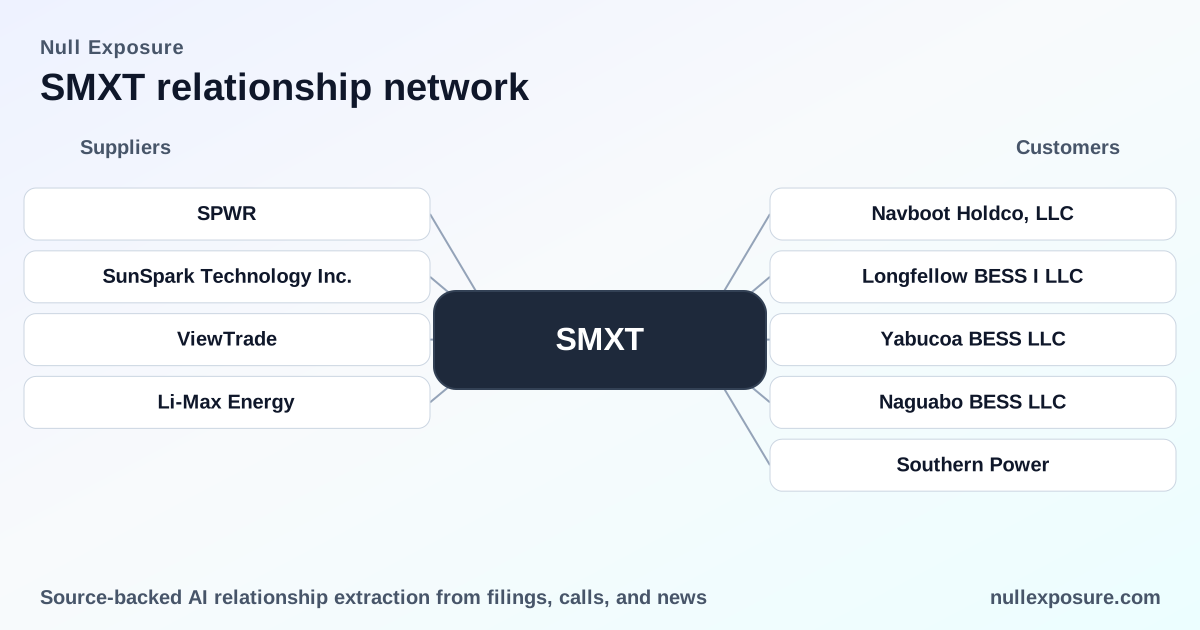
SolarMax Technology (SMXT): Supplier Landscape and Operational Implications
SolarMax Technology is an integrated solar energy company operating in the United States and China that designs, sources, and sells rooftop and storage systems under its SMX/SMAX brand. The company monetizes through hardware sales (SMX-branded modules and integrated energy storage), installation and after-sales services, and occasional capital markets activity to fund growth; its trailing twelve‑month revenue is roughly $50.9 million. Investors should evaluate SolarMax not as a pure software play but as a hardware-centric, supply‑chain dependent operator where supplier choices and service outsourcing directly shape margins and execution risk.
Explore a supplier-risk view for investment diligence at https://nullexposure.com/.
How supplier relationships drive the business: a concise framework
SolarMax runs a hybrid operating model: it sources commodity photovoltaic (PV) inputs and contracts out specialized services while keeping product branding and system integration in-house. From the company disclosures and public reporting we observe four practical characteristics that define the supplier posture:
- Concentration and spend profile: One U.S. supplier accounted for about $4.0 million, or ~12% of purchases in 2024, indicating a material single‑vendor exposure in the North American segment. This puts SolarMax in a mid‑concentration risk band where a disruption to a large supplier would be financially meaningful.
- Outsourced service model: Human resources/payroll and enterprise IT functions are outsourced to a PEO and a managed service provider (MSP), respectively, indicating reliance on third‑party operational controls rather than full internal capability.
- Buyer & manufacturer mix: SolarMax both purchases modules produced overseas for U.S. installations and engages OEM partners to produce branded panels, reflecting a mixed role as buyer and brand integrator rather than a high‑volume manufacturer.
- Spend maturity and criticality: The company’s documented supplier spend sits in the $1m–$10m band for its largest suppliers and the supplier relationships are active and operational, not exploratory.
These attributes combine into a profile of a capital‑light integrator that depends on stable supply and competent outsourced services to preserve gross margins and minimize service disruptions.
What this means for investors
- Upside: Vertical branding and proprietary system integration can command premium pricing on installed solutions if SolarMax sustains quality and distribution.
- Risk: Material supplier concentration and overseas manufacturing exposure create vulnerability to supply delays, price shocks, or quality incidents.
- Operational control: Outsourced HR and IT accelerate scalability but create third‑party dependence on security and compliance — both financial and reputational risk vectors.
For a deeper supplier map and benchmarking, visit https://nullexposure.com/.
Relationship roster: the four public supplier/partner links you need to know
SunPower — component supplier included in systems
SolarMax lists SunPower modules among the “high‑quality solar modules” used in its systems, indicating SolarMax combines its own SMAX panels with third‑party premium modules for some installations. This reflects a procurement strategy that mixes in-house SKUs with established branded panels to meet customer needs. (Source: PRWeb press release referencing FY2014.)
SunSpark Technology Inc. — OEM manufacturing partner
SolarMax disclosed that SMX‑branded panels are produced through an OEM partnership with SunSpark, which positions SunSpark as the manufacturing engine behind SolarMax’s own module SKU. This relationship is an explicit manufacturing outsourcing arrangement that enables SolarMax to brand and sell panels without running full-scale production. (Source: PV‑Magazine interview, FY2018.)
ViewTrade — capital markets / bookrunner relationship
ViewTrade served as the sole bookrunner on a SolarMax capital raise, underpinning the company’s access to public market financing and underwriting services. That relationship is a financial intermediation link rather than a supply chain tie, but it directly affects funding flexibility and balance‑sheet options. (Source: Renaissance Capital coverage of FY2022 financing activity.)
Li‑Max Energy — battery/system supplier for storage products
Li‑Max Energy designed a 5 kWh battery solution that SolarMax integrated into a household energy storage offering, indicating a supplier partnership for battery systems and energy storage hardware. This positions Li‑Max as a component supplier for SolarMax’s integrated energy storage products. (Source: SolarPowerWorld coverage, FY2016.)
Operational constraints and what they reveal about the business
The publicly available constraints and excerpts form a coherent company‑level signal about SolarMax’s operating model:
- Geographic focus: The supplier footprint for purchases is concentrated in North America, with one U.S. segment supplier accounting for roughly 12% of purchases in 2024. That creates regional supply‑chain sensitivity for the company’s U.S. projects.
- Material single‑vendor exposure: The single supplier that hits the ~12% threshold creates an economically material dependency that investors must monitor for continuity, pricing, and quality risk.
- Service outsourcing posture: The company uses a PEO for HR/payroll and an MSP for IT and security, which accelerates administrative scalability but places critical operational controls outside direct corporate staff.
- Buyer/Manufacturer dynamic: SolarMax purchases overseas‑manufactured panels for U.S. installations and relies on OEM partners to produce branded modules, confirming SolarMax’s role as systems integrator rather than a volume cell or wafer manufacturer.
- Active, mid‑size spend relationships: The evidence places largest supplier spend in the $1m–$10m band and classifies key third‑party ties as active — not exploratory — making near‑term supplier performance directly material to revenues and margins.
These constraints collectively imply SolarMax’s execution risk is concentrated in supplier continuity and outsourced operational controls, rather than in raw innovation or proprietary cell technology.
Investment implications: what to watch next
- Monitor supplier concentration metrics each quarter. A supplier representing ~12% of purchases is an active concentration risk; track whether that share falls or rises and whether substitutes are secured.
- Audit outsource governance. Given PEO and MSP reliance, investors should ask management for evidence of service‑level agreements, security incident history, and contingency plans.
- Track OEM and storage partnerships. Strength and stability of OEM contracts (SunSpark) and battery suppliers (Li‑Max, and references to Tesla/Enphase/LG as available options) determine product availability and margin flexibility.
- Evaluate capital access. Relationships with underwriters such as ViewTrade are meaningful for near‑term financing; watch for underwriting terms and follow‑on availability.
For a structured supplier‑risk review and scenario analysis, see our supplier intelligence hub at https://nullexposure.com/.
Bottom line
SolarMax is a brand‑led solar integrator whose economics depend on reliable third‑party manufacturing, a handful of material suppliers in North America, and outsourced operational services. The company’s opportunity lies in branded, integrated systems and storage; its core risk is concentrated supplier dependence and third‑party operational control. Investors evaluating SMXT should prioritize counterparty stability, contractual protections, and supply diversification when forming a conviction.