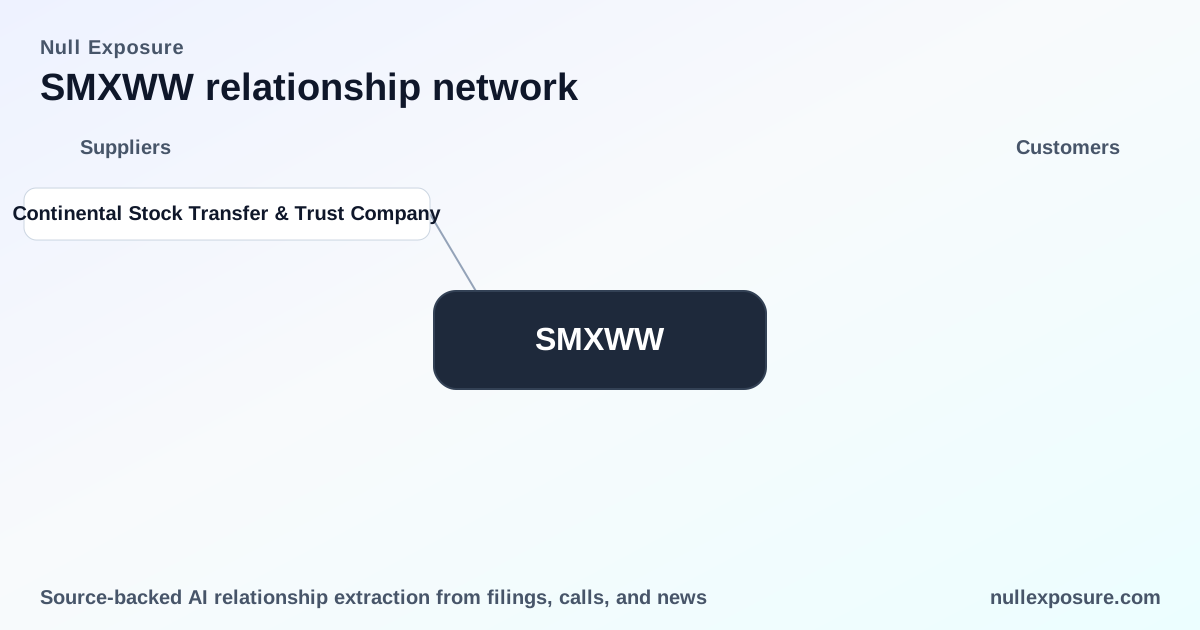
SMXWW (SMX Warrants) — Supplier Relationship Brief: Continental Stock Transfer & Trust Company
SMX develops and commercializes track-and-trace technologies for industrial customers in Australia and funds operations through equity instruments; SMXWW is a public warrant tied to that corporate capital structure. The company’s operating model relies on standard corporate service vendors for shareholder administration and corporate actions, which directly influence liquidity, recordkeeping and the operational execution of events such as reverse stock splits. For investors and operators, the supplier relationships that execute corporate actions are operationally critical and can materially affect warrant mechanics and investor outcomes.
Explore more supplier intelligence at https://nullexposure.com/.
Why the transfer agent relationship matters to warrant holders
A company’s transfer agent is the gatekeeper for share and warrant registers, certificate exchanges, and corporate-action execution. When a company announces a reverse stock split or other equity restructuring, the transfer agent coordinates certificate exchanges, updates registers and issues instructions to holders. That operational role makes the choice of transfer agent a high-consequence supplier decision for investors in illiquid or thinly traded instruments such as warrants.
The supplier in the SMXWW filings — Continental Stock Transfer & Trust Company — is listed as the exchange agent for the reverse stock split, which controls the mechanics and timing for converting certificates and updating records. This is not a back-office footnote; it is the entity that operationalizes the corporate action that changes outstanding security counts and potentially alters trading dynamics.
All supplier entries in the record (complete)
Below are every supplier relationship item surfaced in the available results. Each entry is treated as an independent mention drawn from public reporting.
-
Continental Stock Transfer & Trust Company — The company is acting as exchange agent for SMX’s reverse stock split and will send instructions to registered shareholders who hold physical certificates about how to exchange them. Source: Futunn news post describing the effective date of the reverse stock split (published March 10, 2026).
-
Continental Stock Transfer & Trust Company — A separate Futunn feed (Hong Kong edition) repeats that Continental Stock Transfer & Trust Company will perform the exchange-agent role and distribute certificate-exchange instructions to shareholders of record. Source: Futunn Hong Kong post on the same reverse stock split (published March 10, 2026).
What these relationships imply about SMX’s operating posture
Because the disclosed supplier mentions are exclusively transfer-agent related, they signal several company-level characteristics about SMX’s operating model:
-
Contracting posture: SMX uses established third-party corporate-service providers for critical equity-administration tasks rather than in-house processing. This indicates a standard vendor model where outsourced providers execute specialized, regulated workflows.
-
Concentration and criticality: The public record shows dependence on a conventional transfer agent for corporate actions; a single-category supplier (transfer agent) is visible. For shareholders and warrant holders, the transfer agent is a concentrated point of operational influence during restructurings, making the supplier both concentrated and critical.
-
Maturity of supplier relationships: Relying on a recognized exchange agent for a reverse split is consistent with mature corporate governance execution for capital-structure events. The company is delegating legally required mechanics to an experienced incumbent rather than a startup provider.
These operating-model signals are company-level inferences based on the supplier mentions and the nature of the disclosed corporate action; no single relationship disclosure includes bespoke contractual terms to alter that interpretation.
Financial and governance context investors must weigh
SMX’s public financial indicators provide context for counterparty and operational risk:
-
Zero reported trailing revenue and negative EBITDA in the company summary highlight an early-stage commercial profile that relies on financing events and equity actions to manage capital structure rather than organic cash flow generation. The company listing shows RevenueTTM: 0 and EBITDA: -30,954,000.
-
High leverage of equity mechanics: When an issuer lacks operating revenue, corporate actions such as reverse splits are common tools to maintain listing eligibility or consolidate outstanding instruments; therefore, the transfer-agent relationship is functionally tied to corporate survival strategies.
-
Thin public float and low institutional ownership: The summary lists SharesFloat: 34,660 and PercentInstitutions: 0.000, indicating extremely limited free float and institutional participation, which heightens the importance of flawless execution by the transfer agent during record-date and certificate-exchange processes.
Collectively, these signals mean that operational execution by the transfer agent is directly consequential for investor liquidity and warrant conversion outcomes.
Practical investor considerations and risk controls
Investors and operators evaluating exposure to SMXWW should focus on the following actionable checks:
-
Confirm the exact mechanics and effective date of the reverse split in the issuer notice distributed by the transfer agent and retain any exchange-agent instructions for audit and claims if certificates are lost.
-
Monitor trading halts, delisting notices and filings around the effective date, because the transfer agent’s timing will determine record dates and cutoffs for exercising or converting warrants.
-
Consider settlement risk in low-float securities: physical-certificate exchanges increase counterparty complexity and settlement timelines, so align trade execution strategies with the transfer-agent timetable.
For tailored intelligence on supplier roles in corporate actions, visit https://nullexposure.com/ to review supplier impact across capital-structure events.
Bottom line for investors and operators
For SMXWW holders, the only supplier relationship surfaced in public reports is the transfer agent role performed by Continental Stock Transfer & Trust Company for a reverse stock split. That supplier relationship is operationally material because it governs the exchange of certificates and recordkeeping that determine who holds rights under the warrant after the corporate action. Given SMX’s absence of reported revenue, negative operating metrics and a constrained float, operational friction or miscommunication around these actions would have outsized effects on liquidity and investor outcomes.
If your strategy depends on precise execution around corporate actions or you are assessing counterparty operational risk, prioritize verification of transfer-agent communications and maintain a documented chain of custody for any physical certificate exchanges. For ongoing supplier monitoring and to access supplier-level intelligence on corporate actions, go to https://nullexposure.com/.
Key takeaway: Continental Stock Transfer & Trust Company’s role as exchange agent is not merely administrative for SMXWW holders; it is a determinative link in the conversion and recordkeeping chain that will materially affect warrant mechanics and investor liquidity.