SMZ supplier relationships: what investors and operators need to know
Thesis: SMZ functions as a listed exchange-traded product—specifically the Tradr 2X Short SMR Daily ETF—that monetizes through sponsor management fees and the trading ecosystem (liquidity, spreads, and exchange fees). For investors and procurement teams evaluating SMZ as a supplier or counterparty, the practical commercial model is simple: the sponsor issues a tradable security, earns fee income and licensing revenue, and distribution/operational risk sits with exchanges, market makers, and the ETF sponsor. For a quick vendor-risk scan and supplier intelligence, review the issuer’s market distribution and exchange relationships at https://nullexposure.com/.
How SMZ operates in plain market terms
SMZ is an inverse leveraged ETF product under the Tradr family that provides short exposure to the targeted SMR index at 2x leverage. Revenue flows primarily to the ETF sponsor through management fees; secondary economic activity accrues to exchanges and liquidity providers via daily trading volume and bid/ask spreads. Operational control and counterparty exposure therefore concentrate around the sponsor, the listing venue, and active market makers rather than traditional vendor-supplier chains.
- Contracting posture: The sponsor controls the product-level terms (investment objective, fee schedule, creation/redemption mechanics). The product’s lifecycle and risk profile are governed by the sponsor’s prospectus and exchange listing rules.
- Concentration and criticality: Critical dependencies are the listing exchange and authorized participants/market makers—these entities determine liquidity and tradability. For counterparties evaluating SMZ as a supplier, focus on exchange execution quality and AP relationships.
- Maturity: Leveraged/inverse ETFs are established product types with standardized operational mechanics; the model is transactional and market-facing rather than service-provider dependent.
Explore deeper supplier intelligence and exchange mappings at https://nullexposure.com/.
What the public record shows about SMZ relationships
Below are the relationships surfaced in the available reporting and their plain-English implications.
Tradr ETFs (product family and sponsor)
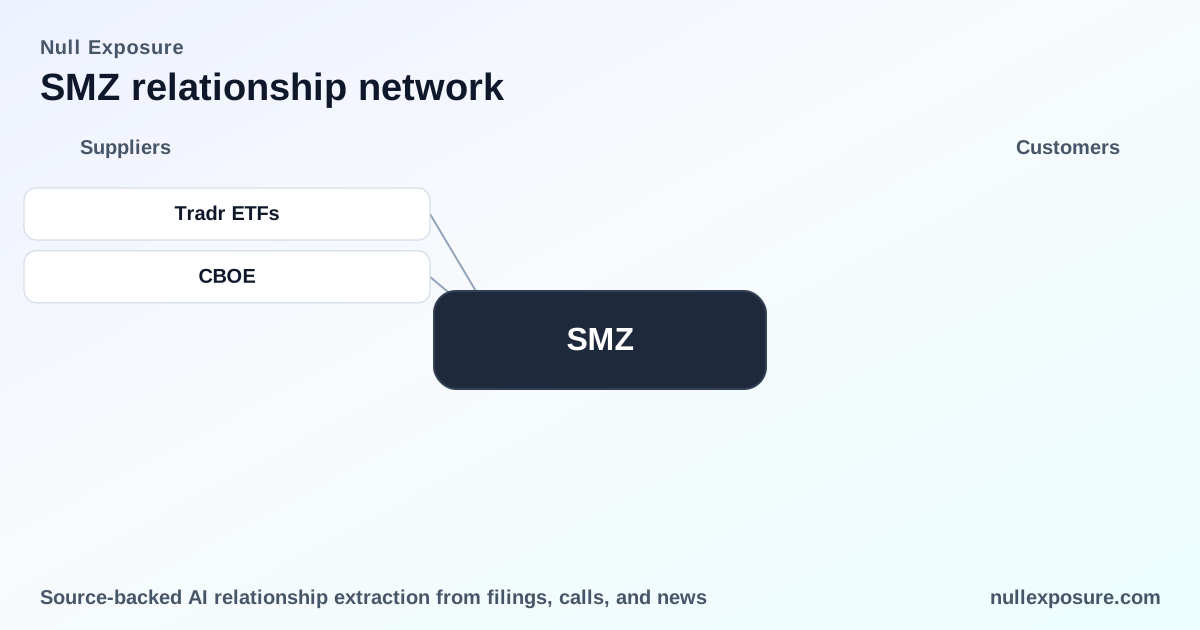
Tradr launched a suite of leveraged and inverse funds that includes the Tradr 2X Short SMR Daily ETF, ticker SMZ, positioning the fund inside its leveraged ETF product set. According to Benzinga coverage on March 10, 2026, Tradr lists SMZ as one of its newly introduced leveraged/inverse ETFs. (Benzinga, March 10, 2026)
Cboe (exchange listing and market venue)
SMZ began trading on the Cboe exchange, which serves as the primary visible venue for order flow and investor execution; Benzinga reported that the new Tradr funds, including SMZ, commenced trading on Cboe on March 10, 2026. Listing on Cboe establishes the exchange as a critical commercial relationship for SMZ’s liquidity and market access. (Benzinga/Cboe reference in market coverage, March 10, 2026)
What these relationships mean for counterparties and operators
The two relationships above are the operational spine for SMZ: the sponsor that structures and markets the fund (Tradr) and the exchange that provides the marketplace (Cboe). From a supplier-risk and contracting perspective, that implies the following actionable characteristics.
- Single-product concentration around the sponsor: The sponsor owns the product economics and legal documentation, so vendor diligence should prioritize sponsor credit, compliance history, and prospectus terms rather than peripheral third-party suppliers.
- Exchange dependence is critical: With Cboe as the listing venue, market-quality and execution risk are concentrated on exchange operations and market makers; service-level expectations should be set around trading hours, listing rules, and market structure performance.
- Operational maturity is high but transactional: Leveraged/inverse ETFs follow a well-known operational playbook (creation/redemption cycles, rebalancing), so integration complexity for firms taking SMZ on as a counterparty is low compared with bespoke derivative or managed-account offerings.
- Commercial negotiation levers are limited: Sponsors set standard fee tables and prospectus-level terms; counterparties should expect limited flexibility on product economics but can influence distribution agreements, authorized participant arrangements, and market-making incentives.
Constraints and company-level signals
The available supplier intelligence returned no explicit contractual constraints for SMZ in the reviewed records. Treat this absence as a company-level signal: no disclosed vendor-level lock-ins, explicit counterparty covenants, or operational constraints were surfaced in the indexed sources. For diligence teams, this flag directs focus toward independent verification—review the prospectus, exchange notices, and AP relationships—rather than searching for named third-party contractual restrictions in the public feed.
Practical risk checklist for investors and operators
- Verify prospectus terms and management fee schedule directly with the sponsor; public reporting confirms product launch but not fee detail.
- Confirm Cboe listing status and trading volume history through exchange data to assess liquidity and spread risk.
- Evaluate authorized participant and market-maker coverage to ensure creation/redemption functionality aligns with institutional needs.
For a consolidated view of exchange and sponsor relationships, use our supplier intelligence tools at https://nullexposure.com/.
Bottom line and next steps
SMZ is a market-native ETF product where commercial risk concentrates on the sponsor and the exchange; counterparties should prioritize sponsor due diligence and exchange liquidity checks over vendor-contract minutiae. The public reporting (Benzinga, March 10, 2026) confirms Tradr as sponsor and Cboe as the listing venue—two relationships that define the product’s operational and market profile. For teams building counterparty risk frameworks or negotiating AP/market-maker terms, the immediate priorities are prospectus review, exchange performance metrics, and liquidity partner commitments.
To start comparative supplier analysis or map exchange counterparty exposures for SMZ, visit https://nullexposure.com/. For tailored supplier diligence and exchange mapping, get the full intelligence package at https://nullexposure.com/.