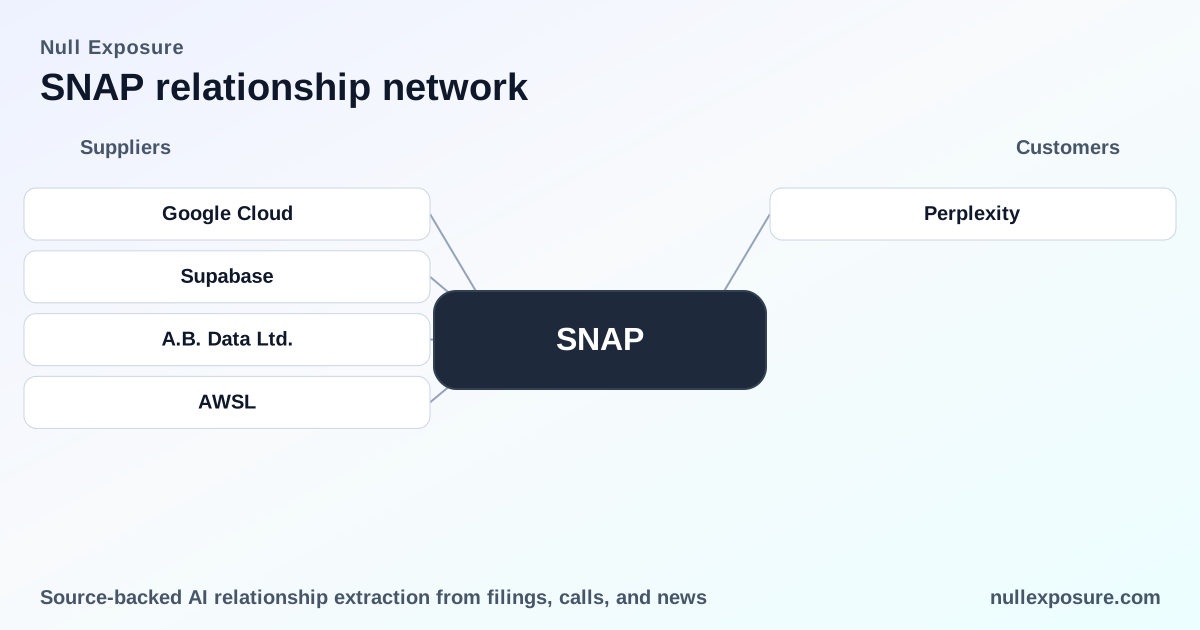
Snap Inc (SNAP) — Supplier relationships and operational constraints investors should price in
Snap operates a camera-first social platform that monetizes primarily through advertising while expanding revenue lines into augmented reality (AR) developer services and platform products. The company outsources core network and hosting infrastructure to third parties and increasingly partners with specialist developers and service vendors to deliver AR tooling to creators and advertisers. For active investors, the combination of concentrated cloud infrastructure dependence and growing third-party platform partnerships is the central operational story to underwrite risk, negotiating leverage, and capital allocation decisions.
Learn more about supplier risk scoring and relationship signals at https://nullexposure.com/.
How supplier posture translates to investment risk and operational reality
Snap’s supplier relationships shape four investment-relevant constraints: concentration, criticality, contract maturity, and spend variability. The company’s public disclosures show that Snap relies on large third‑party cloud providers for essentially all network infrastructure, which creates concentration and operational-criticality risk; concurrently, Snap is building an AR developer ecosystem through vendor partnerships that expand product scope but introduce vendor management complexity.
Key takeaways:
- Concentration risk is material: Snap names Google Cloud and AWS as primary hosting providers, so outages or pricing pressure at those platforms are high-impact events.
- Criticality is high: Network hosting is non‑discretionary for platform operation—these vendors are operationally critical.
- Spend profile is mixed: Filings indicate a wide range of supplier spend at the company level—from sub‑$100k reimbursements to multi‑tens‑of‑millions engagements—pointing to both large strategic contracts and numerous smaller, tactical vendors.
- Partnership-driven product expansion: Snap Cloud and other tools extend revenue opportunity but increase reliance on third-party developer tooling.
For a structured view of Snap’s supplier exposures and how they influence valuation and operational risk, visit https://nullexposure.com/ for specialized analysis.
Supplier relationships called out in filings and press
Google Cloud
Snap states that “substantially all of our network infrastructure is provided by third parties, including Google Cloud and AWS,” indicating Google Cloud is a named infrastructure provider for hosting and networking services. This positions Google Cloud as a core operational provider whose commercial terms and uptime directly affect Snap’s platform economics and service availability, according to Snap’s FY2025 Form 10‑K filed for the fiscal year ended December 31, 2025.
AWS
Alongside Google Cloud, Amazon Web Services (AWS) is explicitly cited as a primary hosting provider delivering essential network infrastructure for Snap’s operations. The FY2025 10‑K confirms AWS as part of the company’s third‑party hosting mix, underscoring dual‑provider concentration among hyperscale cloud vendors and the attendant dependency risk described in the same filing.
Supabase
Snap has launched Snap Cloud built in partnership with Supabase, which gives AR developers hosted APIs, secure storage, edge functions, and real‑time capabilities to power richer AR experiences. This commercial partnership represents a product-level collaboration intended to accelerate developer adoption of Snap’s AR tooling; the arrangement was described in media coverage of Snap’s AR and platform strategy in March 2026.
A.B. Data Ltd.
A.B. Data Ltd. appears in public filings and notices as the settlement administrator handling communications for a Snap securities settlement, with A.B. Data’s address used for mailing related to the case. This is a vendor relationship tied to legal and compliance administration rather than product delivery, noted in a March 2026 settlement notice published online.
Company-level constraint signals that matter for valuation
The disclosures include a set of company-level constraint signals that investors should treat as actionable inputs to risk modeling and due diligence:
- Relationship role: service_provider — Snap describes third parties as service providers for network infrastructure, indicating these are operational vendors, not purely ancillary suppliers.
- Segment: infrastructure — Snap explicitly classifies the relevant vendors in the infrastructure segment (hosting and networking).
- Spend bands: filings show a range of spend profiles—evidence references include small executive reimbursement amounts under $100k and larger service payments into single‑digit and multi‑tens‑of‑millions bands, signaling both concentrated high-dollar engagements and numerous low-dollar items across the vendor base.
- Example company-level figures reported include single engagements in the $1m–$10m and $10m–$100m bands at the corporate level. These are company‑level signals and are not assigned to any individual supplier unless explicitly named in the excerpt.
These constraint signals translate into three practical operating model characteristics: high vendor concentration for critical infrastructure, mixed spend maturity across contracts (some large, negotiated agreements and many smaller engagements), and a supplier estate that requires active vendor governance as product complexity grows.
What investors should watch next
- Contract renewals and pricing: Hyperscaler pricing changes or contract renegotiations with Google Cloud/AWS will materially affect Snap’s cloud spend and gross margin trajectory.
- Operational resilience: Platform uptime and redundancy between these providers are key operational metrics; any outage correlation across providers should be flagged immediately.
- Monetization of AR stack: Partnerships like Supabase move Snap into a platform/provider role for developers; track developer uptake and revenue contribution to validate upside assumptions.
For an investor-ready breakdown of supplier concentration, contractual maturity, and scenario-driven P&L impacts, check the full supplier risk playbook at https://nullexposure.com/.
Bottom line and actionable next steps
Snap’s supplier profile is characterized by high operational dependence on a small number of hyperscale cloud providers and a strategic push to commercialize AR through third‑party partnerships. That mix creates asymmetric risk (concentration + criticality) but also clear levers for margin improvement if Snap can negotiate favorable terms and extract higher monetization from its AR platform.
Actionable steps for investors:
- Monitor Snap’s disclosures for cloud‑contract terms and any material vendor concentration language in upcoming earnings and the next 10‑K.
- Evaluate outage history and redundancy design across Google Cloud and AWS to quantify availability risk to ad revenue.
- Track adoption metrics for Snap Cloud and AR developer monetization to assess the durability of new revenue lines.
If you want tailored supplier exposure modeling or a vendor risk memo that links supplier events to valuation scenarios, visit https://nullexposure.com/ to commission custom analysis and alerts.