Sleep Number (SNBR): Supplier Concentration Is an Operational Lever — and a Vulnerability
Sleep Number sells mattresses, adjustable foundations, and connected sleep services, and monetizes through direct retail, partner channels, and consumer financing that accelerates purchases. The company sources most product components externally, operates targeted in-house manufacturing for covers and engineering, and relies on third‑party financing and customer service relationships to drive sales conversion and post‑sale support. Investors should treat supplier concentration and financing partnerships as first‑order operational risks that directly affect revenue pacing and margins. For a concise supplier risk profile and relationship mapping, visit https://nullexposure.com/.
How Sleep Number actually buys and makes its products
Sleep Number is a buyer in a largely outsourced supply chain. The firm sources raw materials and components from third parties and in some cases uses sole‑source suppliers for critical parts such as air chambers, control electronics, specific foam formulations, fabrics and zippers. Sleep Number offsets some outsourcing by operating a dedicated cut‑and‑sew facility in Irmo, South Carolina, and an engineering and prototyping center in Salt Lake City, Utah. These in‑house assets provide control over cover production and product development while leaving core mechanical and electronic components dependent on external vendors.
According to Sleep Number’s FY2024 Form 10‑K, the company “obtains these materials, components and products from suppliers who serve as the only source of supply, or who supply the vast majority of the Company’s needs of the particular material, component or product,” creating high concentration risk on discrete inputs.
The supplier constraints that define the operating model
Sleep Number’s supplier posture is best understood as a mix of leverage and exposure:
- Contracting posture — buyer. The company sources the materials and components it needs rather than vertically integrating all production; this creates bargaining leverage in some categories but puts Sleep Number at the mercy of single‑source vendors for others. (Company disclosure on supplier sourcing.)
- Concentration — high for specific components. Several parts are provided by single or dominant suppliers; where replacement sourcing is nontrivial, lead times and price pass‑throughs can materially impact production and gross margin. (FY2024 10‑K.)
- Criticality — components are mission‑critical. Air chambers, control systems and certain electronic components are essential to Sleep Number’s differentiated product offering; disruption would directly impair the core product and revenue capture. (FY2024 10‑K.)
- Maturity and geography — global footprint with selective verticals. Sleep Number operates with a network of global suppliers while maintaining localized, specialized facilities for cover assembly and prototyping in the U.S., which supports product innovation and partial supply resilience. (Company disclosures describing Irmo, SC and Salt Lake City facilities.)
These company‑level signals are embedded in the firm’s public filings and define the framework for evaluating counterparty arrangements and procurement strategy.
Who Sleep Number contracts with: full supplier relationship coverage
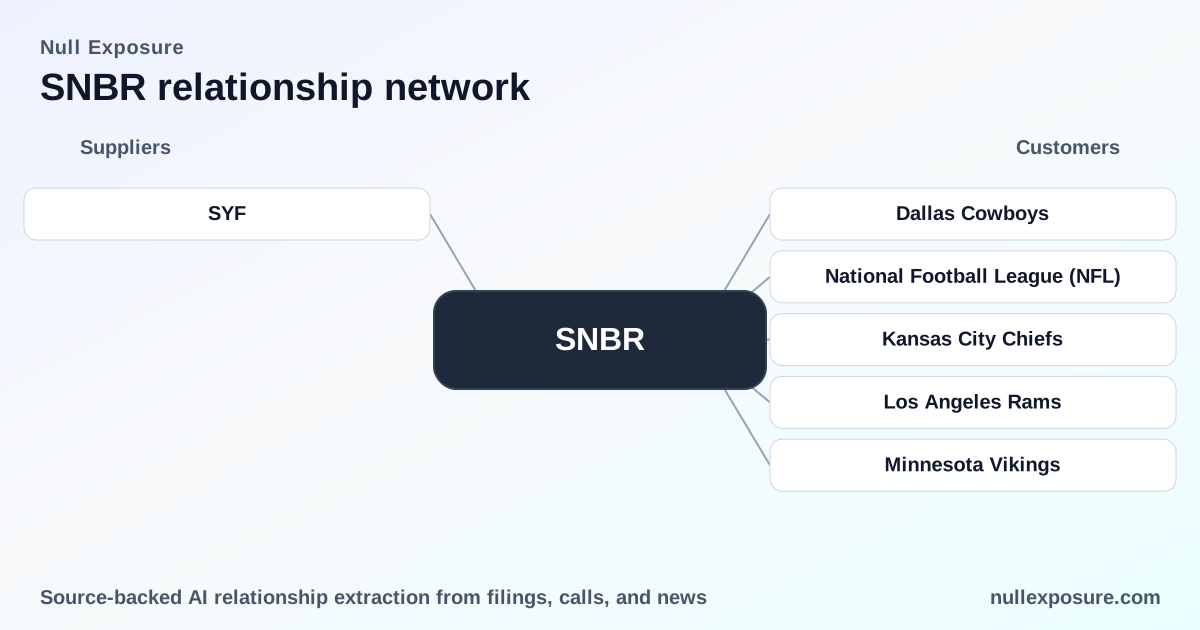
Sleep Number’s public disclosures name a small number of counterparty relationships relevant to supplier and service operations. All relationships identified in the filings are summarized below.
-
Synchrony Financial — Sleep Number relies on Synchrony for the majority of its consumer financing services, which underpins customer purchase affordability and intake flows. According to Sleep Number’s FY2024 Form 10‑K, Synchrony provides the majority of its consumer financing services and is therefore a critical commercial partner for sales conversion and credit facilitation. (FY2024 Form 10‑K filing.)
-
Customer service supplier (unnamed in the filing) — the company also discloses reliance on “another supplier for the majority of its customer service support,” indicating a single large external provider handles a meaningful share of post‑sale and support volume, though the vendor is not named in the public excerpt. (FY2024 Form 10‑K filing.)
Those two vendor relationships—the named financing partner and an unnamed customer service supplier—capture the material external dependencies Sleep Number discloses at a relationship level.
Why the Synchrony dependence matters to investors
Synchrony provides the credit product that enables many Sleep Number purchases. That creates a direct revenue lever: financing availability drives conversion and average ticket size. It also creates correlated risk: a change in Synchrony’s underwriting, program terms, or willingness to fund co‑branded credit products would materially affect unit sales and promotional flexibility. According to the FY2024 10‑K, Synchrony supports the majority of Sleep Number’s consumer financing services, making this relationship a core commercial dependency.
Monitor contract tenor, recourse terms, fee structure, and program termination rights when assessing execution risk; these elements determine how quickly Sleep Number could pivot if financing terms change.
Financial context that amplifies supplier risk
Sleep Number’s latest reported period (quarter ending 2025‑12‑31) shows TTM revenue of $1.411 billion and a negative diluted EPS of -$5.77, with gross profit of $832.95 million and slim overall operating leverage. The firm’s profit margin and operating margin are under pressure (negative on a TTM basis), and valuation metrics indicate limited market enthusiasm (forward P/E elevated, EV/EBITDA high). These outcomes increase the sensitivity of the business to supply disruptions and financing partner constraints: when margins are tight, cost or timing shocks from critical suppliers are harder to absorb without immediate pricing or promotional changes. (Company financials, latest reported period.)
What operators and investors should do next
- Prioritize contract diligence with Synchrony. Obtain key economic terms, termination rights, and program change clauses—these are front‑line levers for sales pacing.
- Map single‑source parts and potential dual‑sourcing options. For parts labeled as sole source (air chambers, electronics, fabrics, zippers), quantify lead time, qualification cost and alternative suppliers.
- Stress test cash flow under supplier disruption scenarios. Given the negative EPS and tight margins, model revenue and gross profit under constrained financing availability and delayed component deliveries.
- Monitor customer service continuity. Confirm contingency plans for the unnamed major customer service supplier to avoid service degradation that would impair repeat sales and NPS.
For a targeted supplier risk dashboard and relationship monitoring, see our supplier intelligence portal at https://nullexposure.com/.
Bottom line — tradeoffs are clear and actionable
Sleep Number’s business combines proprietary product features with a predominantly outsourced supply chain and a heavy reliance on external financing to close sales. The company's supplier concentration on critical parts and the reliance on a single financing partner are explicit operational levers that increase both upside (through fast go‑to‑market) and downside (through supply or finance disruptions). Investors should push for transparency on contract terms, diversification plans for single‑source components, and scenario planning tied to Synchrony program changes.
For ongoing coverage on supplier and counterparty risk across consumer brands, subscribe and explore more at https://nullexposure.com/.