Sun Country (SNCY) — supplier relationships that shape cash flow and deal risk
Sun Country Airlines runs a hybrid leisure carrier model: it monetizes passenger schedules, air cargo, and charter services while extracting ancillary revenue from baggage, seat selection and loyalty partnerships. The airline’s cost base and capital profile are materially shaped by airframe OEMs and concentrated commodity suppliers, while episodic capital markets and advisory partners show up around strategic transactions and liquidity events.
Explore supplier and counterparty signals for due diligence and risk scoring at https://nullexposure.com/.
Why these supplier ties matter to investors
Sun Country’s economics are simple but fragile: route density, fleet utilization and fuel cost control drive margins. That makes relationships with aircraft manufacturers and fuel vendors strategically critical and high-friction — long lead times, embedded service and parts networks, and concentrated spend create persistent operating leverage. Conversely, underwriters and advisors are transactional and event-driven, signaling access to capital markets and the sophistication of M&A execution without changing daily operations.
If you evaluate partner concentration, read more and benchmark counterparties at https://nullexposure.com/.
Who Sun Country is dealing with — concise relationship snapshots
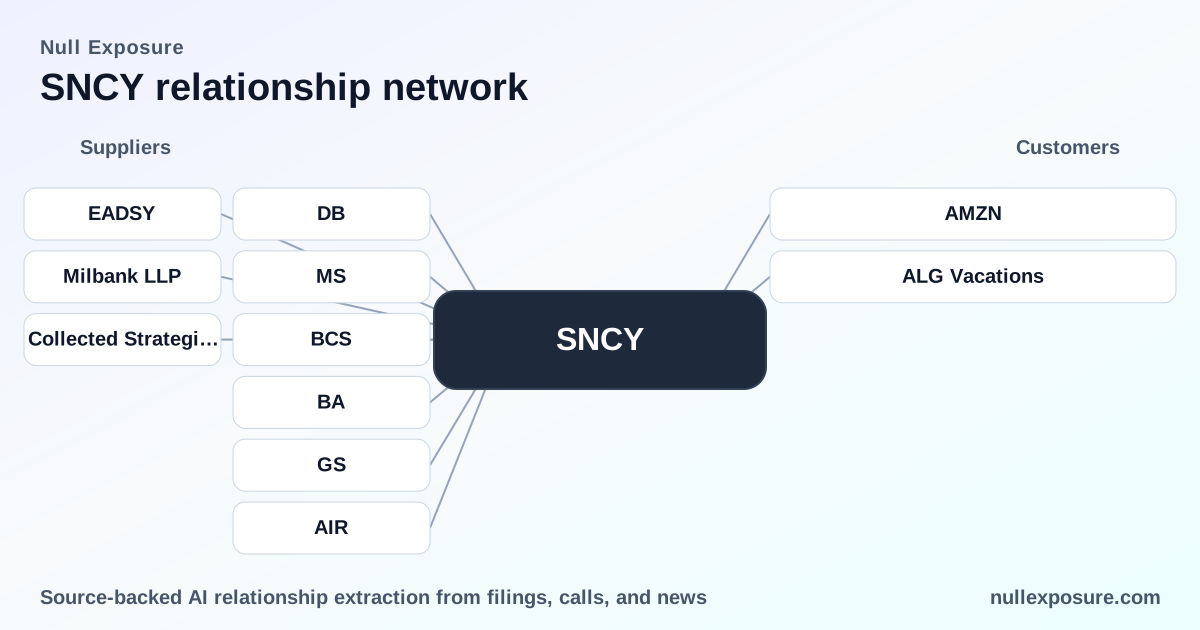
Deutsche Bank, Morgan Stanley, Barclays (IPO underwriters, FY2021)
Barclays, Deutsche Bank and Morgan Stanley acted as underwriters on Sun Country’s IPO process, indicating capital-markets access and institutional distribution capability during the FY2021 offering phase. This underwriting group reflects standard investment‑bank support for a consumer-facing, asset‑heavy operator (source: MarketRealist article on Sun Country IPO: https://marketrealist.com/p/when-is-sun-country-ipo-date/).
Boeing Co. (fleet supplier exposure, FY2026 reporting)
News coverage around the combination with Allegiant highlights that the combined carrier will rely heavily on Boeing narrow‑body aircraft, signaling continued dependence on Boeing for fleet capacity, spare parts and aftermarket support — a critical operating relationship with long lead times and high switching costs (sources: Dallas News, January 12, 2026 — https://www.dallasnews.com/business/airlines/2026/01/12/allegiant-buys-sun-country-in-merger-of-budget-airlines/; Statesman coverage — https://www.statesman.com/business/travel/article/allegiant-merger-sun-country-21290661.php).
Airbus SE (fleet supplier exposure, FY2026 reporting)
Reporting on the Allegiant combination also notes Airbus narrow‑body aircraft in the combined fleet, implying mixed OEM exposure that diversifies platform risk but preserves high operational dependence on OEM supply chains and long-term parts contracts (sources: Dallas News and Statesman coverage cited above).
Goldman Sachs & Co. LLC (financial advisor, FY2026)
Goldman Sachs served as Sun Country’s financial advisor in the transaction with Allegiant, representing front‑end transaction execution and valuation advisory capacity that supports deal pricing and financing strategy (source: Allegiant investor relations announcement, January 2026 — https://ir.allegiantair.com/news/news-details/2026/Allegiant-and-Sun-Country-Airlines-to-Combine-Creating-a-Leading-More-Competitive-Leisure-Focused-U-S--Airline/default.aspx).
Milbank LLP (legal advisor, FY2026)
Milbank LLP acted as Sun Country’s legal counsel in the combination process, supplying transactional legal capacity to execute regulatory filings, purchase agreements and closing mechanics — a standard but necessary relationship for M&A closure (source: Allegiant investor relations announcement, January 2026 — https://ir.allegiantair.com/news/news-details/2026/Allegiant-and-Sun-Country-Airlines-to-Combine-Creating-a-Leading-More-Competitive-Leisure-Focused-U-S--Airline/default.aspx).
Collected Strategies (strategic communications advisor, FY2026)
Collected Strategies handled strategic communications advisory in the Allegiant transaction, indicating attention to stakeholder messaging and reputational management through the deal lifecycle — relevant for investor relations and integration optics (source: Allegiant investor relations announcement, January 2026 — https://ir.allegiantair.com/news/news-details/2026/Allegiant-and-Sun-Country-Airlines-to-Combine-Creating-a-Leading-More-Competitive-Leisure-Focused-U-S--Airline/default.aspx).
Constraints that shape Sun Country’s operating model
A material company-level constraint in recent filings: fuel procurement concentration. Sun Country disclosed that roughly 46% (2025) and 45% (2024) of fuel purchases came from two vendors, each representing 10% or more of total fuel purchases — placing fuel spend in a $10m–$100m band by vendor with high confidence. This is a direct signal of supplier concentration risk: a small number of vendors account for a large share of commodity exposure, limiting bargaining leverage and increasing vulnerability to supplier disruption.
Operational implications:
- Contracting posture: Fuel and OEM contracts are typically medium‑to‑long term with limited near‑term repricing flexibility; Sun Country’s procurement posture is therefore oriented toward continuity rather than spot opportunism.
- Concentration: High vendor concentration on fuel reduces negotiating leverage and amplifies price shock sensitivity in a commodity‑intensive business.
- Criticality: Aircraft OEM relationships are mission critical—airframe availability, maintenance support and parts flow directly affect revenue generation.
- Maturity: Advisor and underwriter relationships are mature and transactional; OEM and fuel relationships are long‑dated and operationally embedded.
These constraints are company-level signals that affect cash flow volatility and integration risk in any strategic transaction.
What investors should watch next
- Fuel supplier renegotiation or diversification. Given the concentration, successful diversification or hedging would reduce downside commodity risk and stabilize margins.
- Fleet strategy following Allegiant combination. Managing a Boeing/Airbus mixed fleet requires disciplined spare‑parts planning and maintenance integration to avoid erosion of utilization.
- Capital markets access and financing terms. The presence of top-tier advisors and past underwriters indicates the company can access institutional capital when needed, but transaction timing and terms will determine dilution and covenant exposure.
For a deeper supplier‑level break‑out and to model counterparty concentration into your valuation, visit https://nullexposure.com/.
Bottom line
Sun Country’s supplier map is a classic airline profile: critical, concentrated operational suppliers (airframe OEMs and fuel vendors) combine with episodic financial and legal partners for transactions. Investors should treat OEM and fuel relationships as structural drivers of margin volatility and operational risk, while viewing underwriters and advisors as indicators of financing and M&A capability rather than recurring operational dependencies. Monitor fuel vendor concentration metrics and fleet integration execution as the primary levers that will determine near‑term cash‑flow resilience and the ultimate value capture of any strategic combination.