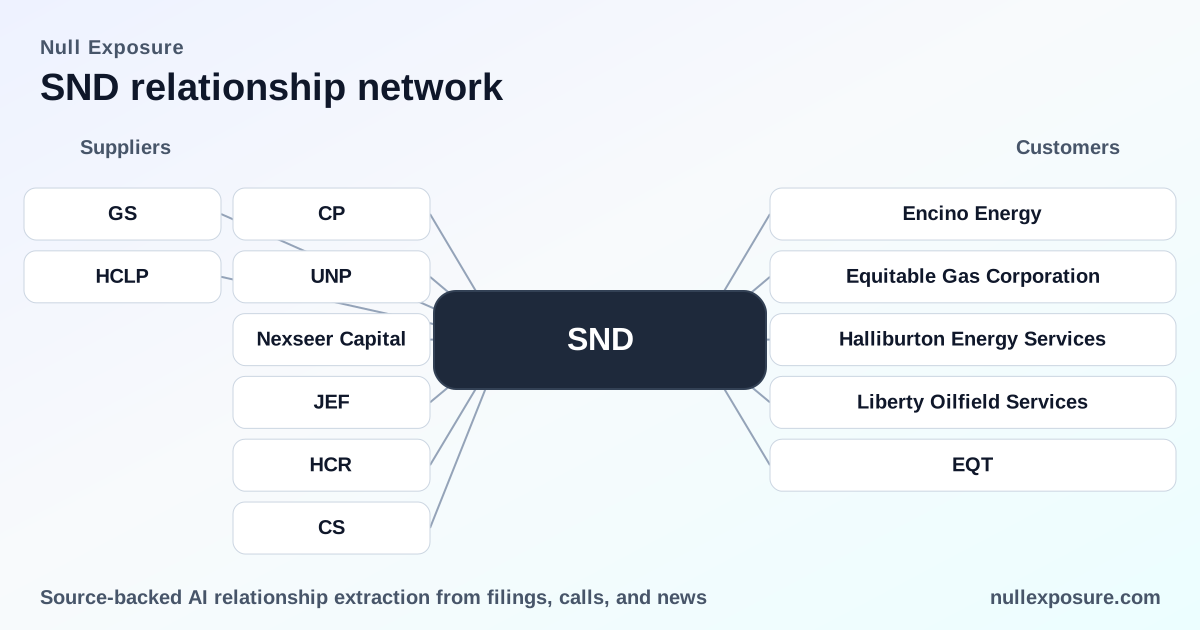
Smart Sand (SND): Supply-chain footprint and counterparty map investors must price
Smart Sand operates as an integrated fracturing-sand provider: it excavates, processes and sells proppant to oil and gas operators while operating in-basin transloading and rail-enabled facilities that accelerate delivery and reduce well-site logistics costs. Revenue is generated primarily through sand and services sales, bolstered by transload throughput fees and equipment-finance structures that shift capital intensity off the production line. The company's margin profile and capital commitments are driven as much by rail and lease access as by commodity demand for sand. For deeper supplier and counterparty exposure analysis, visit https://nullexposure.com/.
Why counterparty structure matters for a soft-commodity services play
Smart Sand's business is capital- and logistics-intensive. The company’s operating model shows long-duration contractual commitments, a mix of owned and leased logistics assets, and routine use of third-party contractors for excavation and blasting—a profile that increases operational leverage to transport and financing partners. Where Smart Sand has unit-train access or long-term leases, it secures distribution optionality that reduces per-ton delivered cost; where it relies on third-party services or external financing, counterparty risk converts into operational and credit risk for SND equity holders.
Key company-level constraints and what they signal
- Smart Sand reports material future minimum commitments under contracts totaling $29,348 (as presented in the company's commitment schedule), indicating sizable multi-year obligations that shape free-cash-flow flexibility and capital allocation priorities. This figure is a company-level signal of scale and duration in obligations, not a relationship-specific promise.
- The firm explicitly operates in-basin transloading facilities under long-term lease agreements in multiple regions, showing a contracting posture that locks in logistics access and supports predictable throughput economics.
- Mining operations combine in-house work and third-party service providers for heavy equipment and drilling/blasting, which positions Smart Sand as both an operator and a purchaser of services; this creates a blended cost base and dependence on specialist contractors.
- A spend-band signal of $10m–$100m for future minimum commitments implies medium-sized capital commitments over time; treat this as a company-level budgeting band rather than a single-vendor spend amount.
For an integrated supplier-risk dashboard and ongoing monitoring, see https://nullexposure.com/.
Supplier relationships — the counterparties you need on your radar
Below are the relationships surfaced in public reporting and filings. Each entry gives a concise, plain-English effect on Smart Sand’s operations and a source note.
-
Canadian Pacific (CP) — Smart Sand’s Oakdale, Wisconsin expansion included the optionality to ship unit trains on Canadian Pacific, providing an alternative routing to Union Pacific and expanding rail capacity for several hundred cars. This optionality reduces single-rail dependency and supports scale shipments from the flagship mine (RT&S coverage of the Oakdale expansion, FY2017).
-
Union Pacific (UNP) — Smart Sand completed a unit-train capable rail facility in Byron Township and moved its first unit train via Union Pacific on December 26, demonstrating operational capability to load and dispatch full unit trains to midstream and end customers. Unit-train access materially lowers per-ton shipping costs for large contracts (RT&S report, FY2017).
-
Nexseer Capital — The Oakdale equipment financing is structured as a Master Lease Agreement with Nexseer Capital and is secured by machinery, equipment and tools at the Oakdale facility, which converts capital expenditure into lease obligations and ties equipment uptime to third-party lessor protections (GlobeNewswire release announcing long-term debt refinancing, FY2019).
-
Jefferies Finance (JEF) — Smart Sand entered a five-year, $20.0 million ABL credit facility with Jefferies Finance as part of its 2019 refinancing package; this facility provides committed working capital capacity and shapes near-term liquidity covenants and available borrowing capacity (GlobeNewswire release, FY2019).
-
Hi-Crush Inc. (HCR) — In March, Smart Sand acquired a shuttered Blair, Wisconsin mine from Hi-Crush for $6.5 million, adding regional reserves and restart optionality at an acquisition price that supports low-cost capacity expansion. This transaction illustrates opportunistic inorganic growth and regional consolidation (Wisconsin Public Radio reporting, FY2022).
-
Hi-Crush (HCLP) — Local reporting also records the Blair mine purchase from Hi-Crush for $6.5 million, corroborating the acquisition and reinforcing the company’s strategic push to redeploy idled assets into active supply (Wisconsin Examiner brief, FY2022).
-
Credit Suisse (CS) — Credit Suisse served as a co-lead underwriter on Smart Sand’s initial public offering, providing capital markets access and signaling institutional underwriting support for SND’s listed financing event (Journal Sentinel/JSONLINE coverage of the IPO filing, FY2016).
-
Goldman Sachs (GS) — Goldman Sachs joined as a co-lead underwriter on the company’s IPO alongside Credit Suisse, playing a parallel role in primary-market distribution and price discovery at listing (Journal Sentinel/JSONLINE coverage, FY2016).
What these relationships imply for investors
- Logistics optionality is a valuation lever. Unit-train access to both Union Pacific and Canadian Pacific reduces marginal transport costs and provides routing flexibility that directly improves delivered margin on large-volume contracts.
- Lease and finance arrangements shift capital risk. Master leases and ABL facilities push certain capex burdens onto financiers while creating contractual minimums that compress cash-flow flexibility; the company’s reported multi-year commitments total a meaningful number that investors must fund through operations or refinancing.
- Operational execution depends on third-party service providers. Use of external heavy-equipment and blasting contractors moderates fixed labor overhead but increases vendor concentration risk in peak periods; this is a deliberate operating posture consistent with a services plus supply model.
- Strategic M&A is opportunistic. The Hi-Crush acquisition underscores a strategy to buy idled assets at low cost to quickly increase supply capacity, which supports growth without equivalent upstream greenfield capex.
If you evaluate supplier concentration or want automated tracking of counterparties and contractual commitments, browse our tools at https://nullexposure.com/ for structured exposure views.
Bottom line and investor action points
Smart Sand is a logistics-anchored commodity supplier whose earnings are a function of sand demand, transport economics and the structure of financing and lease commitments. Investors should price in contract duration, rail optionality, and financing cadence as primary determinants of cash-flow stability. Monitor unit-train utilization, ABL availability, and any changes to long-term lease obligations as forward-looking indicators of margin resilience. For continuous counterparty monitoring and to see how these relationships evolve across peers, visit https://nullexposure.com/.