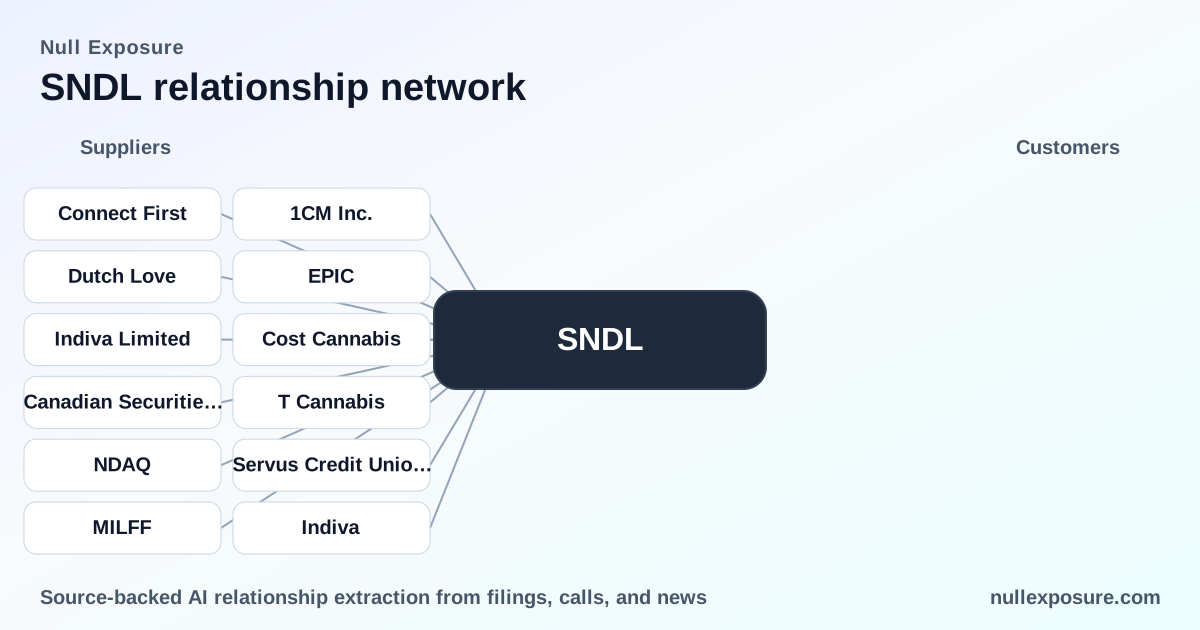
SNDL Inc.: Supplier relationships, retail roll-up, and what operators should price in
SNDL Inc. operates as a vertically oriented Canadian cannabis company that produces, distributes and increasingly owns retail outlets, monetizing through wholesale product sales, direct retail margin, and loyalty-driven customer lifetime value. The company’s strategy over FY2024–FY2026 has pivoted toward retail roll‑ups and selective asset purchases to capture margin and traffic, while maintaining a large packaged goods revenue base (Revenue TTM: $946.4M; Gross Profit TTM: $258.6M). Investors and operators evaluating supplier relationships should treat SNDL as an acquisitive counterparty that is shifting commercial pricing power downstream into retail ownership. For deeper supplier exposure analysis and ongoing tracking, visit the Null Exposure home page: https://nullexposure.com/
Why SNDL’s recent deals matter to suppliers and operators
SNDL’s commercial posture is now as much a retailer as a brand owner. That changes supplier dynamics: contracts can be negotiated with an integrated buyer who controls shelf placement and can internalize promotional spend. The company’s asset purchases and stalking‑horse bids indicate a contracting posture focused on cash-priced asset transfers and staged closings, not long-term supply contracts. Suppliers should price for faster payment cycles on traditional wholesale accounts but expect more aggressive negotiation when SNDL controls retail distribution.
For a running view of SNDL’s partner map and supplier implications, see https://nullexposure.com/
What the deal flow shows (high-level signals)
- Acquisition-led expansion: SNDL is using cash and structured closings to acquire retail locations, expanding control over consumer touchpoints.
- Low counterparty concentration risk for suppliers: the firm is buying many small retail assets across banners, reducing single-supplier criticality at the corporate level.
- Operational maturity mixed with margin pressure: Revenue near $1 billion with positive operating margin but negative EPS reflects scale with ongoing restructuring and integration costs.
- Capital posture: market cap ~ $373M and EV/EBITDA ~ 8.95 signals a buyer using available balance-sheet flexibility to execute roll‑ups.
Key partner and acquisition relationships you need to know
Below I list every counterparty mentioned in public reporting from our results, with a concise plain‑English summary and a direct source reference for verification.
1CM Inc. (also reported as 1CM / EPIC / MILFF)
SNDL entered into and later amended an arrangement agreement to acquire 32 retail stores from 1CM operating under Cost Cannabis and T Cannabis banners for total cash consideration of $32.2 million, and completed an initial closing for five stores in Alberta and Saskatchewan in January 2026. This is the primary retail roll‑up vehicle in recent reports. (PR Newswire, Dec 15, 2025: https://www.prnewswire.com/news-releases/investor-alert-pomerantz-law-firm-investigates-claims-on-behalf-of-investors-of-sndl-inc---sndl-302666478.html; Newsfile/GlobeNewswire, Jan 7–8, 2026: https://www.newsfilecorp.com/release/279748/SNDL-1CM-Complete-Purchase-and-Sale-of-5-Retail-Stores-in-Alberta-and-Saskatchewan, https://www.globenewswire.com/news-release/2026/01/07/3214946/0/en/SNDL-1CM-Complete-Purchase-and-Sale-of-5-Retail-Stores-in-Alberta-and-Saskatchewan.html)
Cost Cannabis
Cost Cannabis is one of the retail banners included in the 1CM transaction; SNDL’s agreement explicitly covers stores operating under the Cost Cannabis name across Ontario, Alberta and Saskatchewan as part of the 32-store acquisition. (StratCann, Dec 15, 2025: https://stratcann.com/financials/sndl-and-1cm-amend-acquisition-agreement-moving-to-two-stage-closing/)
T Cannabis
T Cannabis is the second banner identified in the 1CM arrangement; the acquisition terms reference T Cannabis-branded outlets as part of the $32.2 million purchase. (StratCann, Apr–Dec 2025 coverage: https://stratcann.com/financials/sndl-enters-agreement-to-acquire-32-1cm-retail-locations/)
Indiva / Indiva Limited
Following Indiva’s creditor protection, SNDL placed a successful stalking‑horse bid and is acquiring Indiva’s assets, including an Ontario edibles facility—an acquisition that bolsters SNDL’s edibles capability and SKU breadth. Management cited stronger edibles demand post-acquisition. (Mugglehead, June 2024–FY2024 reporting: https://mugglehead.com/sndl-makes-successful-bid-for-indiva-and-its-ontario-edibles-facility/; The Globe and Mail coverage referenced management commentary on edibles growth: https://www.theglobeandmail.com/investing/markets/stocks/SNDL/pressreleases/258666/sndl-stock-loses-31-in-six-months-should-you-buy-the-dip/)
Servus Credit Union Ltd. and Connect First
SNDL completed the acquisition of the principal indebtedness of Delta 9 Cannabis Inc. from Connect First and Servus Credit Union, a transaction noted alongside restructuring moves and workforce reductions in FY2024; this indicates SNDL’s willingness to acquire distressed credits as part of consolidation. (StratCann, July 2024 reporting: https://stratcann.com/news/sndl-to-lay-off-106-as-part-of-restructuring/)
Dutch Love
SNDL announced acquisitions of several Dutch Love retail stores (four stores reported), adding to the company’s physical footprint and signalling targeted market entry via small-format retail purchases. (StratCann, FY2024 coverage: https://stratcann.com/news/sndl-to-lay-off-106-as-part-of-restructuring/)
Canadian Securities Exchange (CSE)
SNDL obtained approval from the Canadian Securities Exchange to renew its share repurchase program, signalling a capital allocation choice that can support equity value and influence supplier negotiations by stabilizing shareholder base. (GlobeNewswire press release, Nov 21, 2025: https://www.globenewswire.com/news-release/2025/11/21/3193030/0/en/SNDL-Announces-Renewal-of-Share-Repurchase-Program.html)
Nasdaq
The company’s share repurchases are executed through Nasdaq trading facilities among other permitted venues, highlighting SNDL’s multi-market listing and active capital management on U.S. exchanges. (GlobeNewswire, Nov 21, 2025: https://www.globenewswire.com/news-release/2025/11/21/3193030/0/en/SNDL-Announces-Renewal-of-Share-Repurchase-Program.html)
Operational and commercial constraints (company-level signals)
- Contracting posture: SNDL is an acquisitive buyer executing cash transactions, amended multi‑stage closing agreements, and stalking‑horse bids rather than preferring long-term supplier exclusivity; suppliers should expect transactional, price‑sensitive procurement behavior.
- Concentration: SNDL mitigates single-vendor risk by acquiring many small retail assets; corporate revenue is broad but retail footprint fragmentation reduces supplier dependency on any single counterparty.
- Criticality: Where SNDL owns retail assets, its purchasing decisions become directly critical to branded suppliers’ shelf presence—suppliers who secure retail agreements with SNDL-owned stores gain channel advantage.
- Maturity: The firm shows scale (approx. $946M revenue) but transitional profitability (EPS negative, operating margin positive), which means suppliers should underwrite some integration-driven volatility during roll-ups.
Mid‑report action: if you manage supplier exposure to Canadian retail operators, review your contract terms with integrated buyers now — more detail and ongoing monitoring are available at https://nullexposure.com/
Conclusion: tactical implications for investors and suppliers
SNDL is executing a clear strategy: convert wholesale revenue into owned retail margin through targeted acquisitions, while consolidating packaged-goods capabilities via asset purchases like Indiva’s edibles facility. For suppliers, that translates into a buyer who can both demand lower wholesale prices and offer high-value shelf access when SNDL controls distribution. For investors, the roll‑ups present a path to improved cash flow if integration succeeds; watch transaction costs and working‑capital impacts.
Take action: review contractual protections, assess exposure to SNDL‑owned retail, and monitor integration milestones. For continuous supplier-risk monitoring and relationship scoring, visit https://nullexposure.com/ — sign up for updates and model the impact of SNDL’s retail expansion on your revenue mix.