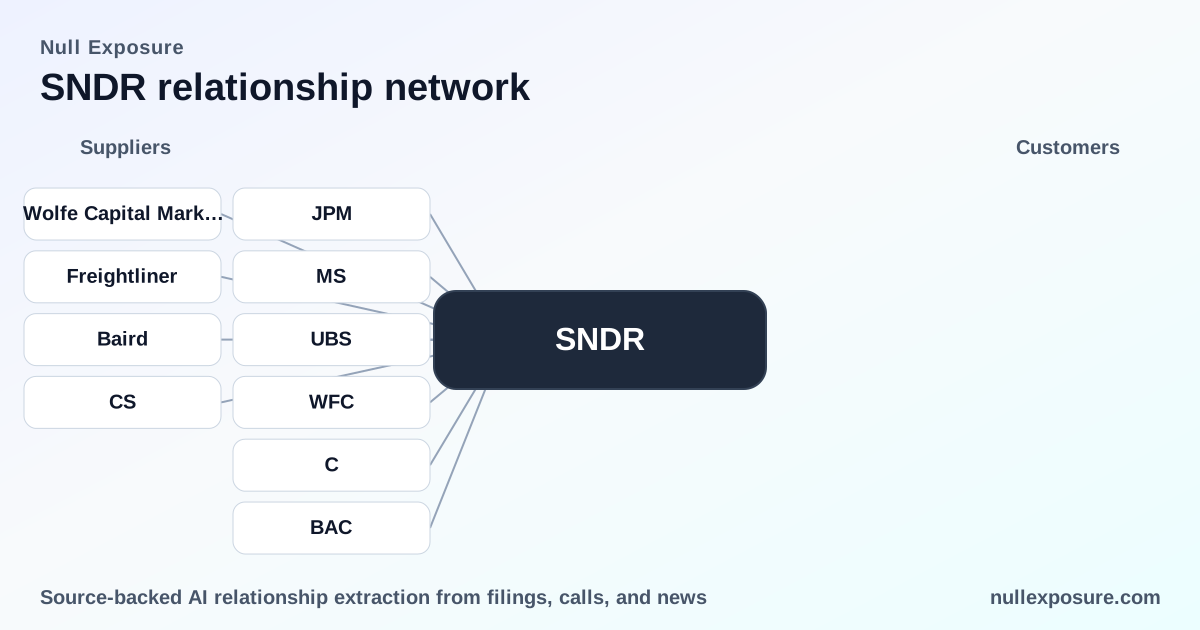
Schneider National (SNDR) — supplier relationships that shape operating risk and capital outcomes
Schneider National monetizes scale in surface transportation and logistics by operating asset-heavy trucking and intermodal fleets while also managing large third‑party carrier networks and brokerage services; revenue derives from owned operations and fee-based logistics where the company both buys capacity and sells managed freight services. With a FY2025 revenue run‑rate near $5.67 billion and material third‑party flows, investor scrutiny of Schneider’s supplier and capital‑markets relationships is core to forecasting cash flow stability and execution risk. Explore deeper counterparty intelligence and supplier exposure at https://nullexposure.com/.
What the relationships reveal about Schneider’s operating model
Schneider runs a hybrid model: asset ownership for trucking and intermodal, complemented by a large managed‑services logistics business that contracts thousands of third‑party carriers. Company disclosures show the Logistics segment oversaw over 20,700 qualified third‑party carriers and managed roughly $2.4 billion of third‑party freight in 2024, and the firm carries multi‑hundred‑million dollar equipment commitments—a capital commitment profile that influences supplier negotiations and procurement cadence.
Key operating characteristics driven by those relationships:
- Contracting posture: Mix of long‑term equipment commitments (capital procurement) and high‑volume, transactional third‑party carrier contracts, producing both supplier-lock and spot exposure.
- Concentration & scale: Large aggregate spend and thousands of counterparties reduce single‑counterparty concentration but increase operational dependency on third‑party capacity markets.
- Criticality: Third‑party carriers and OEMs for electric tractors (e.g., Freightliner) are operationally critical; capital markets banks are strategically important for liquidity and shareholder transitions.
- Maturity: Relationships span mature incumbent banks and established vehicle OEMs, indicating conventional counterparties rather than nascent providers.
These company‑level signals guide supplier risk assumptions and procurement stress testing for investors who underwrite SNDR counterparties. For more structured supplier scoring and scenario analysis, visit https://nullexposure.com/.
Counterparties that matter — what each relationship says to investors
Morgan Stanley — active joint book‑running manager (IPO role)
TruckingInfo reported (March 10, 2026) that Morgan Stanley acted as one of the active joint book‑running managers on Schneider’s IPO, a role that positions the bank as a lead underwriter for the shareholder sale and secondary market distribution. This is a capital‑markets relationship rather than ongoing operating procurement.
Source: TruckingInfo, March 10, 2026.
UBS Investment Bank — active joint book‑running manager (IPO role)
UBS Investment Bank was named alongside Morgan Stanley and BofA Merrill Lynch as an active joint book‑runner on the FY2026 IPO, confirming UBS’s role in primary distribution and investor placement for the Schneider share sale.
Source: TruckingInfo, March 10, 2026.
BofA Merrill Lynch — active joint book‑running manager (IPO role)
BofA Merrill Lynch served as an active joint book‑runner in the IPO syndicate, executing primary underwriting responsibilities for the shareholder sale and contributing to market reception and placement strategy.
Source: TruckingInfo, March 10, 2026.
Citigroup — passive joint book‑running manager (IPO role)
Citigroup was listed as a passive joint book‑running manager, indicating participation in the syndicate on a supporting basis for the FY2026 offering rather than a lead underwriter function.
Source: TruckingInfo, March 10, 2026.
Credit Suisse — passive joint book‑running manager (IPO role)
Credit Suisse joined the group of passive joint book‑runners, reflecting a standard syndicate role in distributing the shareholder sale without being a primary manager.
Source: TruckingInfo, March 10, 2026.
J.P. Morgan — passive joint book‑running manager (IPO role)
J.P. Morgan was named among the passive joint book‑running managers, a syndicate role that supports execution and secondary distribution rather than guiding the offering.
Source: TruckingInfo, March 10, 2026.
Wells Fargo Securities — passive joint book‑running manager (IPO role)
Wells Fargo Securities participated as a passive joint book‑runner in the IPO syndicate, providing additional distribution capacity for the selling shareholders.
Source: TruckingInfo, March 10, 2026.
Baird — co‑manager (IPO role)
Baird was identified as a co‑manager on the shareholder offering, a common role for regional or specialty firms that support allocation and investor outreach.
Source: TruckingInfo, March 10, 2026.
Wolfe Capital Markets and Advisory — co‑manager (IPO role)
Wolfe Capital Markets and Advisory acted as a co‑manager, reflecting inclusion of boutique underwriting capability in the syndicate for the FY2026 offering.
Source: TruckingInfo, March 10, 2026.
Freightliner — electric truck OEM and operational supplier
Independent coverage (Sahm Capital, February 14, 2026, and QuantiSnow, March 2026) notes Schneider has deployed nearly 100 Freightliner eCascadia battery‑electric trucks and has surpassed 10 million zero‑emission miles, signaling a direct OEM relationship that is operationally critical for Schneider’s decarbonization and fleet renewal programs.
Sources: Sahm Capital, February 14, 2026; QuantiSnow, March 2026.
How the syndicate and supplier set drives shareholder outcomes
The IPO syndicate composition is informative for governance and capital orientation: the transaction was structured as a seller‑led secondary, with selling shareholders (principally Schneider family members and insiders) divesting equity and the company receiving no proceeds from that sale, according to reporting on the FY2026 offering. That structure preserves corporate cash but limits Schneider’s immediate balance‑sheet dilution or capital injection from the transaction, leaving equipment and growth capex to operating cash flow and existing commitments.
Operationally, the Freightliner relationship directly supports Schneider’s ESG and fleet‑modernization narrative, and the 10 million zero‑emission miles metric is an operational milestone investors should map to maintenance, charging infrastructure, and capex cadence.
Mid‑analysis action: For comparative supplier scoring and to quantify exposure across banks and fleet OEMs, see https://nullexposure.com/.
Investment implications: risk, upside, and monitoring checklist
- Liquidity & capital allocation: A seller‑led IPO that channels no proceeds to the company reduces near‑term balance‑sheet flexibility; investors should track equipment commitments (recently cited at ~$140.7 million) versus free cash flow and lease financing availability.
- Counterparty concentration: Thousands of third‑party carriers lower single‑counterparty concentration but create operational dependence on the North American capacity market and rail partnerships; the Logistics segment’s management of ~$2.4 billion in third‑party freight is a material operating lever.
- Execution risk from suppliers: OEM relationships for electric tractors (Freightliner) are strategically critical for Schneider’s emissions and cost trajectory; supply chain disruptions or warranty issues at OEMs translate directly to operating costs and customer service.
- Capital markets access: Presence of major global banks across active, passive, and co‑manager roles signals continued institutional distribution capability for future equity or debt actions, but the seller‑led nature of the current transaction changes the capital consequences for the company.
Conclusion — what investors should do next
Schneider’s supplier map blends traditional large‑bank capital relationships with operational suppliers that are core to its fleet transition strategy. Key investor priorities are monitoring equipment commitments, execution against zero‑emission targets with Freightliner, and how selling‑shareholder liquidity events influence governance and future capital raises. For tailored counterparty risk scoring, scenario modeling, and supplier exposure analytics, visit https://nullexposure.com/.
- Explore supplier intelligence for Schneider and peer carriers: https://nullexposure.com/
- Request a supplier risk brief tailored to your exposure: https://nullexposure.com/