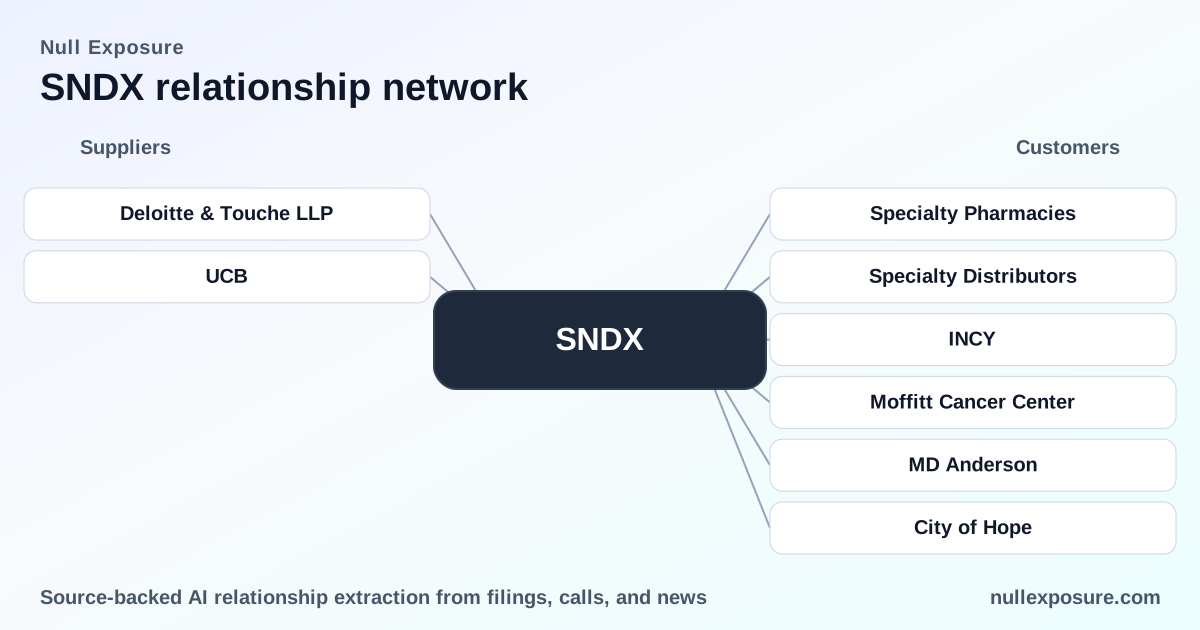
Syndax Pharmaceuticals (SNDX): supplier relationships and what they mean for investors
Syndax Pharmaceuticals operates as a clinical-stage oncology company that develops and commercializes targeted cancer therapies, monetizing through licensing arrangements, partnerships, clinical-stage product development, and the eventual sale of approved medicines. The company derives scale from strategic collaborations and outsourced manufacturing rather than owning in-house production, and its recent financials show $172.4M revenue trailing twelve months with negative margins and a market capitalization of about $2.12B, indicating the market is pricing growth and pipeline value rather than steady cash flows. For deeper supplier-risk monitoring and competitive exposure mapping, visit https://nullexposure.com/.
How Syndax runs its supply chain: a concise operating thesis
Syndax deliberately outsources manufacturing and many operational services to third parties and partners, concentrating its resources on R&D, clinical development, and commercial strategy. The company explicitly states it does not own manufacturing facilities and depends on contract manufacturers and named partners (including Incyte for certain raw materials) to supply active pharmaceutical ingredients and finished product for trials and commercial needs. This operating posture produces several embedded business-model characteristics:
- Contracting posture: Syndax accepts a vendor-heavy model—production and many operational functions are outsourced to contract manufacturing organizations (CMOs), contract research organizations (CROs), and external IT/security vendors—reflecting a focused R&D company rather than an integrated manufacturer.
- Concentration risk: The company discloses reliance on a sole supplier or limited number of suppliers for certain active pharmaceutical ingredients, which creates supplier concentration and single-point-of-failure exposure for critical inputs.
- Criticality of relationships: Suppliers and licensing partners are mission-critical because interruptions in API supply, third-party manufacturing, or partner-controlled IP would directly affect clinical timelines and potential commercial launch.
- Maturity signal: As a clinical-stage biopharma with outsourcing posture, Syndax’s supplier landscape is typical of companies that prioritize speed to trial and cost flexibility over capital investments in manufacturing.
The foregoing signals derive from company disclosures in its regulatory filings and are company-level characteristics rather than a commentary on any single vendor.
The concrete relationships investors should know
Below are the supplier/partner relationships surfaced in public materials and what each implies for operations and governance.
Deloitte & Touche LLP — external auditor and governance partner
According to Syndax’s 2024 Form 10‑K, Deloitte & Touche LLP serves as the company’s independent auditor, with an auditor location in New York, New York. The selection of a Big Four auditor is a standard governance signal for a Nasdaq-listed biopharma and supports financial reporting credibility for investors. (Source: Syndax 2024 10‑K filing.)
UCB — originator of axatilimab licensing rights
A Syndax business update published in February 2026 notes that Syndax licensed exclusive worldwide rights to develop and commercialize axatilimab from UCB in 2016, making UCB the originator of this program and a foundational IP partner for that asset. This licensing history explains part of Syndax’s pipeline composition and highlights that critical program rights were acquired rather than developed internally. (Source: Syndax press release via GlobeNewswire, February 26, 2026.)
Why these relationships matter for valuation and risk
Syndax’s commercial and operational value depends on stable external partnerships and uninterrupted supplier flows. The auditor relationship with Deloitte is a governance and reporting positive that reduces financial reporting risk for investors. Conversely, the UCB license is a strategic asset that transfers development and commercialization economics—including milestone and royalty obligations—into Syndax’s P&L profile, so tracking partner-related payments and program milestones is essential for revenue forecasts.
From the supplier-risk perspective, the company’s public disclosures make two things explicit: (1) reliance on third-party manufacturers and on a limited pool of API suppliers elevates supply continuity risk, and (2) use of external service providers—from CROs to cybersecurity consultants—creates operational dependency that investors must monitor. These are structural exposures that influence timeline risk, cost volatility, and potential regulatory or commercial setbacks.
For ongoing operational visibility and supply-chain risk scoring, see https://nullexposure.com/ — the platform consolidates supplier signals and public filings for investment-grade monitoring.
Practical implications for investors and operators
Syndax’s supplier posture yields predictable near-term priorities and watch items:
- Track announcements about manufacturing reshoring, second-source qualification, or changes in API suppliers, because reduced concentration materially lowers program timelines risk.
- Monitor license-related milestone payments from the UCB-originated axatilimab program and any downstream commercialization terms that affect revenue sharing or royalty burdens.
- Watch for audit opinions, auditor changes, or material weakness disclosures — the Deloitte relationship anchors current reporting; any change is a noteworthy governance signal.
- Keep tabs on third-party service-provider continuity (CROs, CMOs, hosting and cybersecurity vendors) as operational disruptions or contract disputes will directly affect clinical and go-to-market timelines.
Bottom line: risk-adjusted positioning and what to watch next
Syndax’s model is asset-light and partner-dependent: it preserves capital and accelerates development timelines but concentrates operational risk in a limited set of external suppliers and licensors. Financially, the company shows meaningful revenue for a clinical-stage player yet carries negative margins and a high price-to-sales multiple, so valuation depends heavily on successful execution of partnerships, supply continuity, and program milestones.
Investors should prioritize disclosures about supplier diversification, milestone receipts tied to licensed programs (like axatilimab), and any material changes around manufacturing contracts or audit relationships. For a consolidated view of supplier relationships and strength-of-evidence scoring tied to filings and press announcements, consult https://nullexposure.com/.
Final recommendations
- Keep an active watch on contract manufacturing arrangements and any announcements of second sources or in‑house manufacturing plans; these are direct levers on program risk and time to revenue.
- Model royalty/milestone obligations from licensing deals into long‑term cash-flow scenarios today rather than assuming clean revenue retention at launch.
- Maintain attention on governance signals—auditor continuity and audit opinions—because they affect investor confidence and the perceived quality of financial disclosures.
For ongoing supplier-level monitoring of SNDX and comparative exposure across the sector, visit https://nullexposure.com/ for tracked relationships, filing-based signals, and a single-pane view of third-party dependencies.