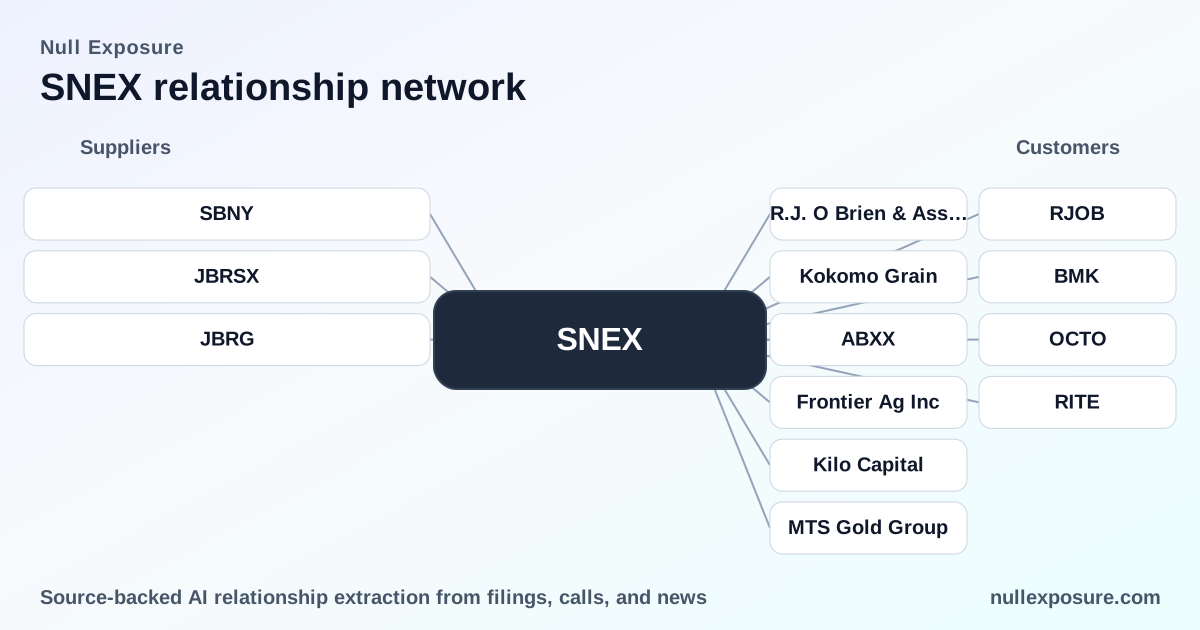
StoneX (SNEX): Supplier relationships, operational posture, and what investors should price in
StoneX operates as a global financial services network that connects corporates, institutions, merchants and investors to markets across FX, commodities, metals, payments and brokerage services. It monetizes through transaction and execution fees, clearing and financing spreads, physical commodity margins (increasingly through recent vertical integration in metals), and client deposits and liquidity services. StoneX’s scale—global correspondent relationships, trading flow, and expanding physical capabilities—drives recurring fee income while exposing the firm to concentrated operational and counterparty risks.
For a concise vendor-risk and supplier map tied to StoneX’s public disclosures, visit NullExposure.
How StoneX runs the business and why supplier relationships matter
StoneX presents as an integrated market intermediary: it deploys electronic connectivity, correspondent banking rails, and physical logistics to deliver local payments, trade execution, custody and physical metals processing. The company reports large top-line activity (Revenue TTM reported as $141.8 billion) and a market capitalization that supports institutional scale. That scale depends on a global fabric of third-party infrastructure—payment corridors, communications, settlement networks and specialized processing vendors—that are operationally critical to the company’s ability to collect fees and settle trades.
Key business-model characteristics to price into SNEX:
- Contracting posture: StoneX relies on long-running service arrangements (correspondent banks, communications, and metals-processing vendors) that function as operational primitives for revenue capture; these relationships are more contract-sensitive than price-sensitive.
- Geographic concentration: The firm’s footprint is explicitly global—StoneX operates with roughly 375 correspondent banking relationships that enable local currency payments across many jurisdictions. That gives revenue diversification but increases regulatory and operational surface area.
- Criticality and vendor maturity: Vendors host client data and provide core infrastructure; disruptions translate directly into lost revenue and reputational damage. StoneX categorizes these vendors as critical to its operations. If you want a deeper look at supplier exposures and how they influence valuation, start at NullExposure.
The supplier relationships recorded in public filings
The company disclosure set we reviewed lists three distinct supplier/counterparty mentions. Each is short and operationally specific; below are plain-English summaries with source context.
Signature Bank — lender and liquidity counterparty
Signature Bank is identified as a lender under certain StoneX facilities; while StoneX reported no immediate adverse impact from Signature Bank’s receivership, the filing notes that failures of financial institutions can reduce access to liquidity and therefore impair StoneX’s ability to fund client activity or access short-term cash. (Source: StoneX FY2025 Form 10‑K, filed September 30, 2025.)
JBR — acquisition of recycling and refining business (10‑K disclosure)
StoneX Metals Limited executed a sale-and-purchase agreement to acquire JBR’s recycling and refining business, including licenses, silver inventory and refining equipment, thereby taking ownership of those physical assets and associated permits. This is a direct purchase of physical metals-processing capacity that extends StoneX’s control over supply chain inputs. (Source: StoneX FY2025 Form 10‑K, filed September 30, 2025.)
JBR — earnings call confirmation of operational integration
In the Q4 2025 earnings call StoneX reiterated that it acquired JBR assets early in the fiscal year and that the acquisition enables StoneX to produce London Good Delivery silver bars and extend physical metals capabilities, signaling a move toward vertical integration in precious metals handling and manufacturing. (Source: StoneX 2025 Q4 earnings call, March 2026.)
What the supplier disclosures imply about operational risk
The public disclosures and constraints surface several company-level signals relevant for investors and operational managers:
- Global infrastructure dependency: StoneX’s payment and clearing model runs on a global set of correspondent relationships and the SWIFT network, supplemented by direct electronic connectivity. This underpins the company’s revenue model but increases exposure to cross-border settlement disruptions.
- Vendors are critical service providers: StoneX explicitly classifies vendors as essential to core functions—trade execution, transaction processing, communications and hosting—so vendor outages translate into revenue interruption and client service failures.
- Data and cyber risk is material: Vendors host personally identifiable information for clients; a compromise would create regulatory breach risk, direct remediation costs, and reputational harm that can depress fee flows.
- Strategic vertical integration in metals reduces third‑party dependency: The acquisition of JBR assets shifts part of the metals value chain in‑house, converting an external supply/ processing relationship into an owned capability and capturing additional margin and control.
These are not abstract issues: they define how management negotiates vendor contracts, structures liquidity facilities, and allocates capital for redundancy and cyber defenses.
Practical implications for investors and operators
For investors, the combination of large transactional revenue and vendor-critical infrastructure implies that valuation should reflect both operational leverage and outsized tail risk from vendor or counterparty failure. For operators, the priorities are rigorous vendor governance and contingency planning.
Actionable items to monitor:
- Review counterparty and correspondent bank concentration metrics and contractual terms for liquidity facilities.
- Track integration milestones and production capacity from the JBR acquisition to understand how much margin migration to in‑house processing occurs.
- Scrutinize vendor cyber controls, data localization arrangements and contractual indemnities for vendor failure or data breach.
Key takeaway: StoneX’s business model delivers recurring fee capture through a broad global network, but that same network concentrates operational risk in a set of critical vendors and banking counterparties—risks that are partially mitigated by strategic moves such as the JBR acquisition that internalize supply chain elements.
If you want an actionable vendor-risk scorecard and contract-level pointers tied to StoneX’s disclosures, explore NullExposure for structured supplier intelligence.
Final read for investors: balance scale with contingency
StoneX’s scale and diversified market services are durable revenue drivers, and its move into physical metals processing is a clear profit-pool extension. However, counterparty liquidity events (as highlighted by the Signature Bank disclosure) and critical vendor concentration are valuation-relevant operational hazards. Investors should price in both the upside from vertical integration and the potential downside from vendor and correspondent-bank disruptions.
For a deeper supplier-focused analysis and to benchmark StoneX’s counterparties against peers, visit NullExposure — the quickest way to convert public disclosures into investable intelligence.