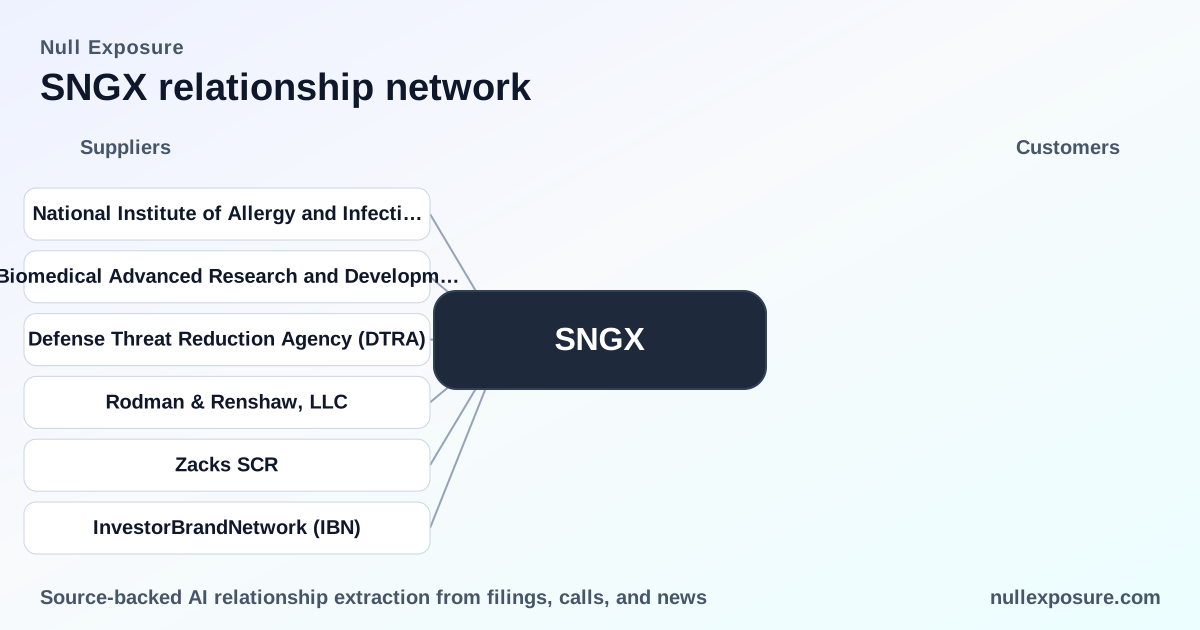
Soligenix (SNGX) — supplier relationships and what they mean for investors
Soligenix operates as a small-cap biopharmaceutical company that monetizes primarily through government grants and contracts for biodefense programs while advancing clinical-stage therapeutics for eventual commercial sales. The company’s operating model is characterized by heavy reliance on third‑party manufacturing and government funding, episodic capital raises, and targeted commercialization partnerships for device-dependent products such as HyBryte™. For investors and operators evaluating supplier counterparty risk, the profile is clear: concentrated, mission‑critical public-sector funding plus bespoke distribution/manufacturing arrangements that underpin product strategy. Learn more about how these relationships affect exposure at https://nullexposure.com/.
What the partnership map looks like in plain language
Soligenix maintains a mix of public‑sector funders, financing intermediaries and investor‑relations outlets that together shape its funding runway and go‑to‑market mechanics. The company’s public grants and contracts underpin R&D in biodefense, while exclusive supply and distribution agreements — notably for the light device component of HyBryte™ — provide a commercial pathway once regulatory milestones are achieved. Government funding is not peripheral; it is a material revenue-equivalent support mechanism for product development.
Visit https://nullexposure.com/ for an integrated view of supplier risk and contract concentration.
All reported relationships — concise investor summaries
-
National Institute of Allergy and Infectious Diseases (NIAID)
Soligenix’s biodefense business has been supported by grant and contract funding from NIAID, which funds development activities tied to infectious disease countermeasures (reported FY2025). According to a Digital Journal investor release, NIAID is a named government funder of the company’s biodefense segment (Digital Journal, Mar 2026). -
Biomedical Advanced Research and Development Authority (BARDA)
BARDA is cited alongside other federal agencies as a funding source for Soligenix’s biodefense programs, signaling engagement with advanced development and preparedness funding streams (reported FY2025). This relationship is documented in the same Digital Journal summary of the company’s funding base (Digital Journal, Mar 2026). -
Defense Threat Reduction Agency (DTRA)
DTRA is listed as another government partner supporting the biodefense segment, indicating multiple defense and public‑health funding channels rather than a single‑agency dependency (reported FY2025). The Digital Journal release explicitly names DTRA as a contributor to program support (Digital Journal, Mar 2026). -
Rodman & Renshaw, LLC
Soligenix entered an At Market Issuance Sales Agreement with Rodman & Renshaw on January 23, 2026, creating an explicit financing vehicle to raise capital through controlled share issuance, which directly affects potential dilution and liquidity management (TradingView report, Jan 23, 2026). -
Zacks SCR
Zacks SCR is noted for providing paid research coverage; a Zacks disclosure flagged that the service received compensation from the issuer or related parties, signaling an investor‑relations channel that is at least partially sponsored (Zacks SCR disclosure, FY2025). -
InvestorBrandNetwork (IBN)
InvestorBrandNetwork is cited as the publisher of promotional investor content used by the company to optimize awareness and recognition, which is a common investor‑relations tactic for small caps seeking visibility (TradingView financewire referencing IBN, FY2026).
Each of these relationships is either funding‑oriented (NIAID, BARDA, DTRA), financing‑oriented (Rodman & Renshaw), or communications‑oriented (Zacks SCR, IBN), and collectively they define how Soligenix secures development capital, prepares for commercialization, and manages investor perception.
Contracting posture, concentration and criticality — what the constraints tell investors
Soligenix’s disclosed constraints and contract excerpts reveal a consistent operating posture:
-
Long‑term supply arrangements exist for commercial device components. The company disclosed an exclusive Supply, Distribution and Services Agreement with The Daavlin Distributing Co. (signed January 2021) that secures long‑term manufacture and distribution of the proprietary light device integral to HyBryte™. That agreement is explicitly contractual and positions Daavlin as both manufacturer and distributor for the device component (company disclosure, Supply, Distribution and Services Agreement, Jan 2021).
-
Third‑party manufacturing is core to execution. Soligenix depends on contract manufacturing organizations and external suppliers for drug substance raw materials and for manufacturing services that meet clinical and commercial quality standards; this dependence is an operational constraint the company itself cites.
-
Government funding is material to the business model. The company warns that the loss of government funds would have a material adverse effect on its ability to progress the biodefense business. That language signals high revenue-equivalent concentration in public‑sector finance versus commercial sales at present.
-
Relationships are active and operationally critical. The company classifies its supplier relationships as active and integral to both development and future commercialization; long‑term agreements and exclusive deals indicate strategic commitment rather than ad‑hoc sourcing.
These constraints combine into a profile where supply chain concentration, public funding dependency, and externally manufactured product components are the central risk axes.
Visit https://nullexposure.com/ to see how these contract characteristics change counterparty risk scores in practice.
Investment implications: risks, levers and what to watch
-
Funding risk is front‑and‑center. With zero revenue TTM and negative EBITDA, the company’s operational continuity depends on continued grant/contract support and on capital market access (the Rodman ATM agreement is a direct lever for near‑term liquidity). Investors should treat federal contracts as operational substitutes for revenue until commercial sales scale.
-
Concentration and single‑supplier risk for device commercialization. The exclusive Daavlin arrangement concentrates manufacturing and distribution for the HyBryte™ light device; that exclusivity simplifies commercialization strategy but creates single‑point‑failure risk if the supplier relationship deteriorates.
-
Visibility and potential dilution. The At Market Issuance Sales Agreement with Rodman & Renshaw provides flexibility to raise capital through market issuance; this improves short‑term runway but increases dilution risk for equity holders.
-
Investor communications are managed and partially sponsored. Paid coverage and promoted content channels (Zacks SCR, IBN) increase visibility but also indicate a reliance on sponsored communications to reach investors — a common pattern in micro‑cap biotech where organic analyst coverage is sparse.
Bottom line and next steps
For investors and operators assessing Soligenix as a supplier counterparty or investment, the company’s model is clear: a government‑funded development engine supported by targeted exclusive supplier arrangements and periodic access to equity markets for funding. The primary operational risks are funding continuity, concentrated manufacturing/distribution arrangements for the HyBryte™ device, and potential dilution from market issuances. Equally, the presence of multiple federal agencies as funders (NIAID, BARDA, DTRA) diversifies public‑sector support compared with single‑agency dependency.
If you evaluate counterparties or need a consolidated view of supplier concentration and contractual posture for small‑cap life sciences, start with a tailored supplier risk review at https://nullexposure.com/. For a deeper supplier‑level analysis and monitoring plan aligned to procurement and investor objectives, see our platform at https://nullexposure.com/.
Key takeaway: Soligenix’s supplier profile is strategically focused but operationally concentrated; government funding sustains development while exclusive supplier deals set the terms for commercialization — both levers must be monitored continuously.