Smith & Nephew (SNN): Distribution partnerships widen trauma and pelvis offerings — what investors should price in
Smith & Nephew develops, manufactures and sells medical devices globally and monetizes through device sales, recurring consumables, and procedure-driven instrument revenues sold via its direct commercial organization and selective distribution agreements. The company carries a roughly $14.0B market capitalization with trailing revenue of $6.16B and an operating margin near 11.4%, and it uses strategic partnerships to accelerate adoption of niche technologies in trauma, foot & ankle, hand & wrist and pelvic fracture care. For investors, the recent FY2026 distribution deals are accretive to portfolio breadth without large capital commitments, shifting the growth debate from R&D cadence to commercial execution and channel integration. For a consolidated review and supplier-risk intelligence, visit https://nullexposure.com/.
Why these distribution agreements change the commercial playbook
Smith & Nephew’s model balances internal product development with targeted licensing and distribution deals to rapidly expand addressable procedures. These agreements are commercial horsepower rather than R&D bets: the company gains immediate product offerings that leverage existing sales and hospital relationships, while partners get Smith & Nephew’s scale in the US market.
Key business-model characteristics to evaluate:
- Contracting posture: Smith & Nephew uses exclusive and non‑exclusive distribution contracts to capture specialized product lines without acquiring the underlying companies.
- Concentration and criticality: Distribution lines are product-level and additive to core implants and consumables; they increase revenue concentration in high-growth procedure sets (trauma, pelvic fixation) but do not replace core OEM revenue.
- Maturity and integration risk: These are commercial-stage products being folded into existing go‑to‑market channels, so the primary execution risk is sales adoption and inventory/channel management rather than clinical validation.
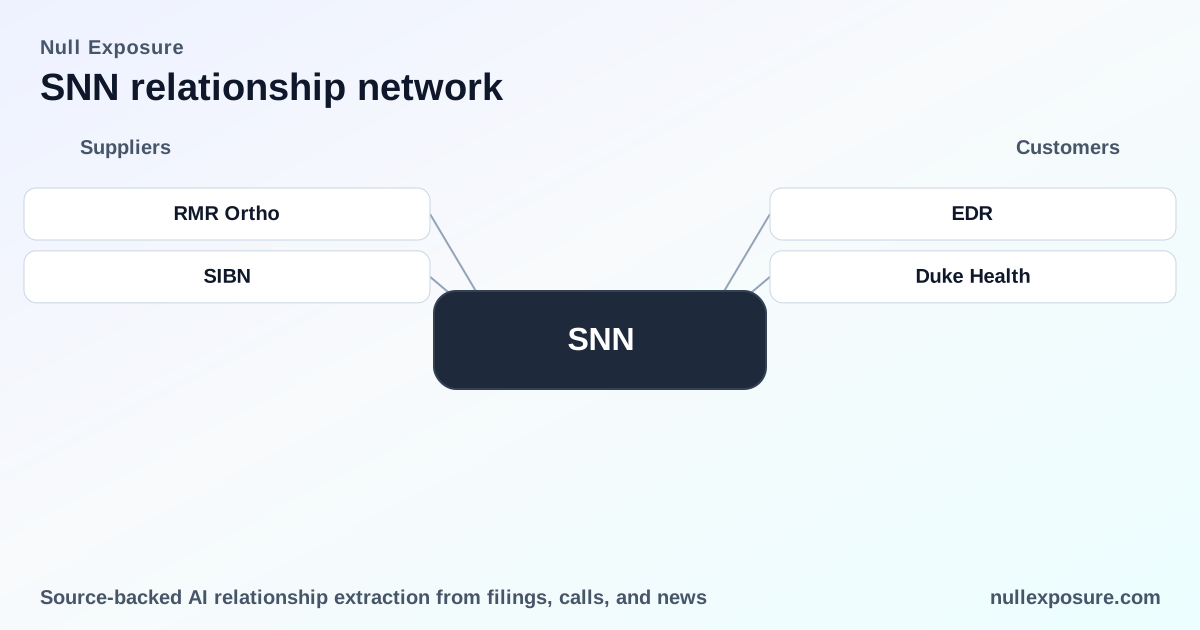
Who Smith & Nephew is partnering with (the supplier relationships investors should know)
RMR Ortho — A’TOMIC™ Nitinol Fixation System
Smith & Nephew signed an exclusive US distribution agreement to add RMR Ortho’s A’TOMIC™ Nitinol Fixation System to its Trauma, Foot & Ankle and Hand & Wrist portfolio, positioning the device as a dynamic-compression fixation option for trauma cases. This is a commercial extension: Smith & Nephew brings national sales coverage and hospital relationships to a patented fixation technology. Source: Finviz press report, March 10, 2026 (https://finviz.com/news/320432/smithnephew-signs-exclusive-us-distribution-agreement-with-rmr-ortho-for-patented-technology-that-provides-a-unique-dynamic-compression-nitinol-fixation-option-atomic-to-our-surgeons).
Additional coverage and show-floor positioning for the deal appeared in Smith & Nephew materials and trade reporting around AAOS 2026 (GlobeNewswire, March 3, 2026; RyOrtho, Feb–Mar 2026).
SI‑BONE (SIBN) — iFuse TORQ portfolio distribution
Smith & Nephew entered a distribution agreement for SI‑BONE’s iFuse TORQ portfolio, intended to expand its pelvic fracture offering and provide a differentiated option for sacroiliac joint fixation. The agreement routes SI‑BONE’s iFuse products through Smith & Nephew’s channels in the US, adding a procedure-focused product line to the company’s reconstruction and trauma mix. Source: BioSpace press release, March 2026 (https://www.biospace.com/press-releases/smith-nephew-signs-distribution-agreement-with-si-bone) and related coverage in trade reporting and GlobeNewswire announcing product highlights for AAOS 2026.
What this means for growth, margins and risk
These deals are low-capex, high-leverage commercial extensions: Smith & Nephew captures incremental margin on distributed product sales while avoiding the upfront costs of acquisition. The financial profile — forward P/E ~12.6, EV/EBITDA ~11.2, and operating margin ~11.4% — implies investors are valuing operational execution and margin resilience from core franchises while pricing modest upside from incremental channels.
Key implications:
- Upside: Faster route-to-market for novel technologies, incremental revenue with limited R&D outlay, and improved penetration in trauma and pelvic procedures.
- Risks: Integration execution (training, stocking, surgeon adoption) and revenue mix compression if distributed products yield lower gross margins than flagship implants; partners retaining control over IP or pricing could limit margin capture.
- Balance: Distribution agreements scale commercially but require disciplined product rationalization and inventory management to avoid diluting overall margins.
For a supplier-focused competitive map and to track how these deals alter procurement exposure, see https://nullexposure.com/.
Operational constraints and company-level signals investors should track
Although there are no explicit constraint excerpts tied to these specific FY2026 relationships, the company-level operating signals are clear: Smith & Nephew prioritizes distribution agreements to accelerate commercial scale, prefers asset-light growth over large acquisitions in these product niches, and relies on its existing salesforce to deliver adoption. Monitor these operational signals:
- Salesforce retraining cadence and evidence of upgraded procedure volume in trauma and pelvic segments.
- Inventory turnover and distributor stocking patterns as distributed product SKUs enter hospital formularies.
- Any change in deal terms disclosed in filings that shift margin or exclusivity windows.
Practical investor takeaway and next steps
Smith & Nephew’s FY2026 distribution agreements with RMR Ortho and SI‑BONE are strategic, commercially driven moves that extend the company’s procedural reach without heavy capital deployment. For investors, the immediate questions are execution-focused: can the company convert its commercial footprint into procedure volume and sustained margins for these products?
Actionable next steps:
- Watch US procedure volumes and product-level revenue disclosures in upcoming quarters for signs of adoption.
- Track margin contributions and inventory metrics in earnings reports to determine whether distributed SKUs are margin-accretive.
- Reassess valuation catalysts once early adoption data appears; the market will reward visible volume gains given the company’s reasonable forward P/E and EV/EBITDA.
Learn more about supplier relationships, integration risks and how they affect valuation at https://nullexposure.com/.
Bold takeaway: These distribution deals are a commercial acceleration tool — not acquisitions — that reduce capital risk while shifting the growth debate to execution. For a deeper supplier-risk profile and ongoing updates, visit https://nullexposure.com/.