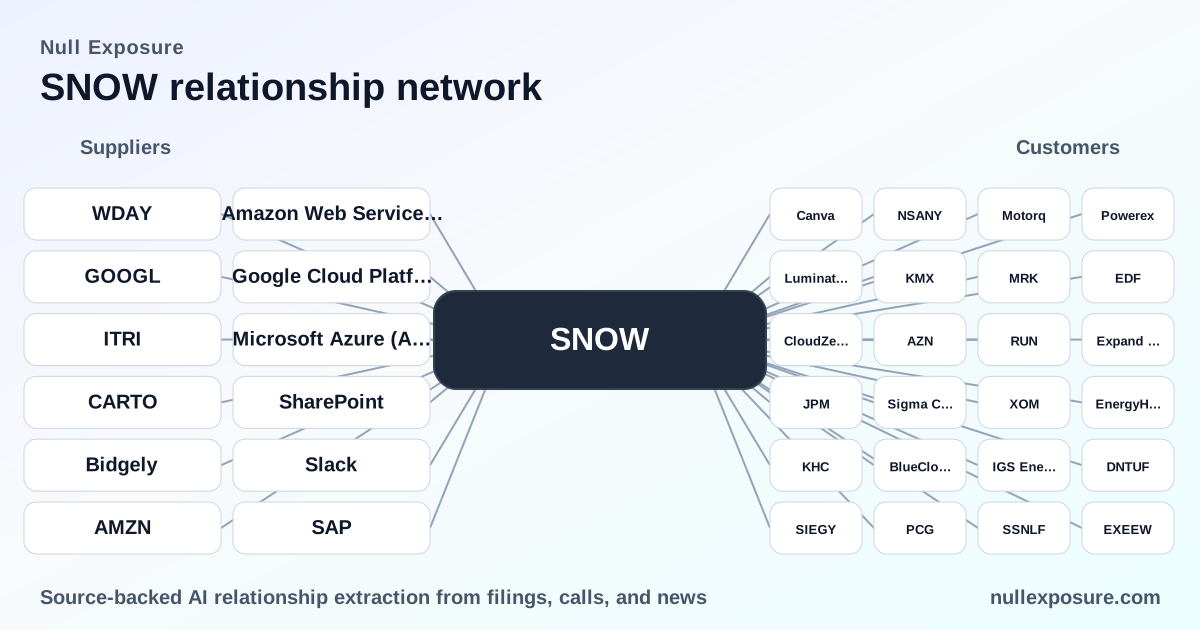
Snowflake’s supplier map: what investors need to know about the cloud and partner relationships that enable the AI Data Cloud
Snowflake sells a cloud-native data platform that customers consume as elastic compute, storage, and data services; the company monetizes principally through usage-based subscriptions, premium features and marketplace transactions. The core operating model depends on third‑party public cloud infrastructure and an expanding catalog of integrations and industry partnerships, which drive topline growth but embed material supplier risk and long-term contractual commitments. For corporate buyers and investors evaluating Snowflake supplier exposure, the essential question is whether Snowflake’s partner mix amplifies its go‑to‑market advantages or concentrates outsized operational and cost risk.
Learn more about supplier relationships and exposure at https://nullexposure.com/.
How Snowflake’s supplier posture converts to investor outcomes
Snowflake’s platform is not vertically integrated on underlying infrastructure — the company runs on public clouds and layers proprietary services, connectors and marketplace offerings on top. That structure yields high gross margins on software value-added services while transferring substantial infrastructure cost and availability risk to external providers.
- Contracting posture and committed spend. Snowflake discloses large, multi‑year cloud commitments: as of January 31, 2025, the company reported $755.3 million of remaining non‑cancelable contractual commitments tied to a single third‑party cloud agreement that is part of a $1.0 billion aggregate commitment covering June 2023–May 2028. This is a company‑level signal of material, multi‑year spend that affects cash flow predictability and negotiating leverage.
- Concentration vs. diversification. Snowflake operates on multiple public clouds — AWS, Azure, and GCP — which reduces single‑provider vendor lock but does not eliminate systemic risk tied to public cloud outages, pricing changes, or contract terms. Cloud providers are both critical infrastructure suppliers and strategic partners.
- Criticality and maturity. The relationship profile contains long‑standing platform dependencies (infrastructure) and an expanding set of integrations and industry solutions (connectors and ISV partnerships), indicating a mature commercial play that blends platform economics with ecosystem monetization.
Relationship inventory — line‑by‑line for diligence
Below are every supplier and partner mention surfaced in company filings, earnings remarks, and news coverage. Each item includes a concise plain‑English summary and source reference.
Amazon Web Services (AWS) — FY2025 10‑K
Snowflake states that its platform operates on public cloud infrastructure provided by Amazon Web Services, among others, making AWS a core infrastructure supplier for platform deployment. Source: Snowflake FY2025 10‑K (filed for period ending Jan 31, 2025).
Google Cloud Platform (GCP) — FY2025 10‑K
Snowflake confirms that Google Cloud Platform is one of the public cloud infrastructures used to host and deliver its platform, supporting multi‑cloud availability. Source: Snowflake FY2025 10‑K (FY2025 filing).
Microsoft Azure (Azure) — FY2025 10‑K
Microsoft Azure is listed alongside AWS and GCP as a hosting environment for Snowflake, reflecting the company's deliberate multi‑cloud footprint. Source: Snowflake FY2025 10‑K (FY2025 filing).
SharePoint — 2026 Q1 earnings call
Snowflake highlighted connectors enabled by its Datavolo acquisition that give customers seamless connectivity to enterprise systems such as SharePoint, expanding integration reach inside corporate workflows. Source: Snowflake Q1 FY2026 earnings call (Mar 2026).
Slack — 2026 Q1 earnings call
Connectors built from the Datavolo technology let customers integrate Snowflake with Slack to make collaboration data accessible and queryable inside the data platform. Source: Snowflake Q1 FY2026 earnings call (Mar 2026).
SAP — 2026 Q1 earnings call
Snowflake cited SAP as a system type that customers can now analyze within Snowflake, using connectors that bring ERP data into the platform for cross‑system analytics. Source: Snowflake Q1 FY2026 earnings call (Mar 2026).
Workday — 2026 Q1 earnings call
Workday is identified as another enterprise system that flows into Snowflake for unified analytics, showcased by customer use cases such as AstraZeneca. Source: Snowflake Q1 FY2026 earnings call (Mar 2026).
Google Drive — 2026 Q1 earnings call
Snowflake connectors also support data in Google Drive, enabling straightforward import of business files and spreadsheets into Snowflake for analysis. Source: Snowflake Q1 FY2026 earnings call (Mar 2026).
Itron — InvestingNews coverage (FY2026)
Itron, a global utility technology provider, is building a Grid Planning solution on Snowflake to help utilities manage grid complexity, demonstrating Snowflake’s growing industry solution footprint in energy. Source: InvestingNews, March 2026 coverage of Snowflake energy solutions.
CARTO — InvestingNews coverage (FY2026)
CARTO is delivering cloud‑native spatial analytics directly on Snowflake so energy companies can run geospatial analysis without moving data, illustrating how third‑party ISVs extend Snowflake’s addressable market. Source: InvestingNews, March 2026.
Bidgely — InvestingNews coverage (FY2026)
Bidgely’s vertical AI is integrated with Snowflake to present natural‑language insights for utilities, signifying partner‑led verticalization of Snowflake’s platform. Source: InvestingNews, March 2026.
AWS — news sentiment (Intellectia.ai, FY2026)
News coverage raised questions around Snowflake service disruptions following AWS data center attacks, underscoring operational risk when key workloads sit on third‑party infrastructure. Source: Intellectia.ai news report (March 2026).
What the supplier profile means for investment decisions
- Revenue leverage with embedded infrastructure cost exposure. Snowflake’s revenue growth and high gross profitability come from software and services, but infrastructure costs are third‑party expenses and include multi‑year commitments that will influence gross margin and operating leverage.
- Operational risk is concentrated in cloud availability and security. Public cloud outages or targeted attacks can interrupt Snowflake services, as reported in March 2026 coverage of AWS incidents; continuity plans and multi‑region deployments reduce but do not eliminate this exposure.
- Ecosystem monetization is a growth vector. Connectors and ISV partnerships (Workday, SAP, CARTO, Bidgely, Itron) extend Snowflake’s value proposition into vertical workflows and industry solutions, driving upsell and sticky data gravity.
Closing takeaways and next steps
Snowflake’s model combines software value capture with outsourced infrastructure, producing attractive top‑line growth but significant supplier and contractual exposure. The disclosed multi‑year cloud commitments and the centrality of AWS/Azure/GCP to delivery are the dominant operational levers investors must monitor.
For a systematic view of Snowflake’s supplier exposure and contract risk, visit https://nullexposure.com/ and review our supplier intelligence for SNOW.
If you want tailored due diligence or portfolio impact analysis on Snowflake’s supplier relationships, start at https://nullexposure.com/ and request a supplier risk briefing.