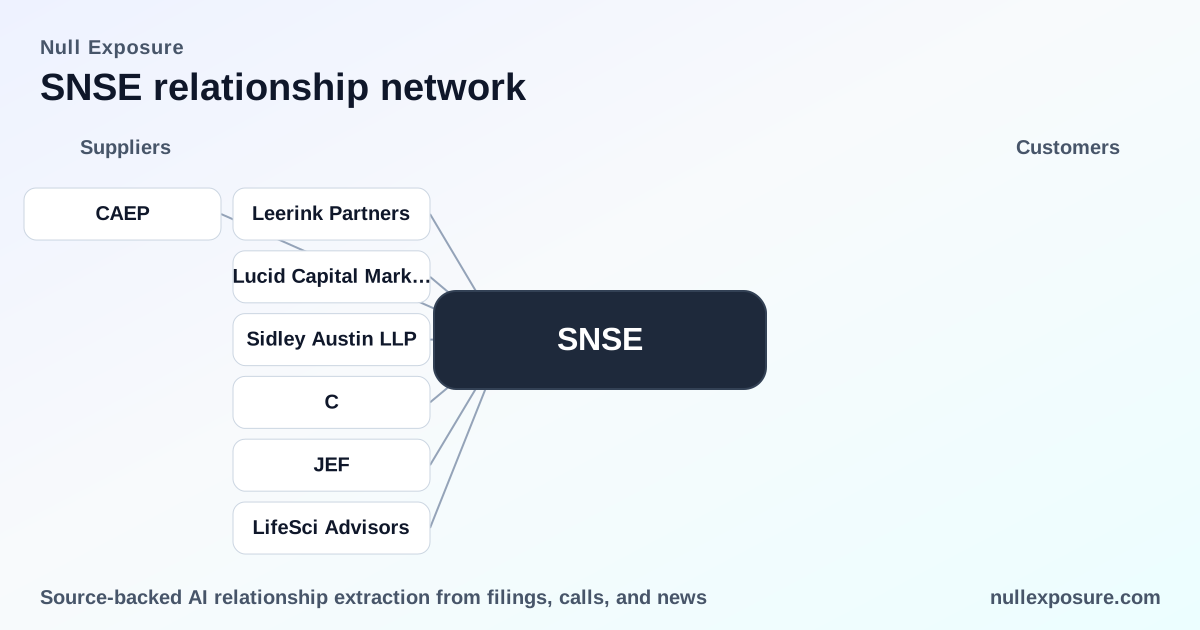
Sensei Biotherapeutics (SNSE): supplier and advisor footprint that shapes near-term execution risk
Sensei Biotherapeutics is a clinical-stage immunotherapy company that advances investigational oncology assets through outsourced development and clinical supply relationships. The company monetizes by advancing drug candidates toward clinical inflection points and unlocking value through licensing, strategic transactions, or potential commercialization partnerships; while revenue is currently nil, value accrues from clinical progress and transaction activity. For investors evaluating counterparties, the composition of Sensei’s advisers, capital markets agents, and manufacturing/service suppliers matters as much as the science: these partners determine financing access, deal execution, and the continuity of clinical supply.
Explore full supplier mapping and relationship signals at https://nullexposure.com/ for a structured view of counterparties and evidence.
What Sensei actually buys and who is critical to execution
Sensei outsources core development functions. The company relies on third‑party manufacturing and service providers for R&D, clinical operations, and production on a patient-by-patient basis, which makes counterparties operationally critical to trial timelines and safety of supply. Lease obligations and third‑party IT/security arrangements indicate a lean internal infrastructure and dependence on external vendors for both wet lab capacity and digital risk management.
- Outsourced manufacturing is a central operating reality: Sensei uses contract manufacturing organizations (CMOs) to produce TMAb candidates and relies on third parties for a range of clinical functions. This creates a contracting posture that is vendor-dependent and operationally fragile if a supplier is disrupted.
- Financial and legal advisors are organized around near-term financing and transactions: Multiple banks and advisory shops are working on financing and strategic review activities, indicating active capital markets engagement and a prioritization of transactional pathways to value realization.
- Balance sheet signals show modest committed lease spend but meaningful near-term obligations: Finance and operating lease obligations reported through 2024 signal predictable fixed outflows in the low‑millions, consistent with a small-cap biotech structure.
If you want a structured counterparty risk profile and actionable supplier intelligence, start here: https://nullexposure.com/.
Who’s on Sensei’s supplier and advisor roster (concise summaries)
Leerink Partners
Leerink Partners is serving as the exclusive placement agent for Sensei’s concurrent financing tied to the acquisition of Faeth Therapeutics, indicating a lead role in private capital placement and syndication. (CityBiz, March 10, 2026: https://www.citybiz.co/article/808056/sensei-biotherapeutics-acquires-faeth-therapeutics/)
Lucid Capital Markets
Lucid Capital Markets is acting as financial advisor to Sensei on the same transaction, supporting deal structuring and execution priorities beyond pure placement. (CityBiz, March 10, 2026: https://www.citybiz.co/article/808056/sensei-biotherapeutics-acquires-faeth-therapeutics/)
Sidley Austin LLP
Sidley Austin LLP is retained as legal counsel to Sensei, a repeat role documented in a 2023 filing and referenced in 2026 coverage; the firm covers transaction documentation, corporate governance, and securities matters. (GlobeNewswire, March 7, 2023; CityBiz, March 10, 2026: https://www.globenewswire.com/fr/news-release/2023/03/07/2622602/0/en/Sensei-Biotherapeutics-Adopts-Stockholder-Rights-Agreement.html and https://www.citybiz.co/article/808056/sensei-biotherapeutics-acquires-faeth-therapeutics/)
Citi
Citi is listed alongside Cantor as a capital markets advisor supporting Sensei’s concurrent financing, providing market access and execution capacity for equity or hybrid financings. (CityBiz, March 10, 2026: https://www.citybiz.co/article/808056/sensei-biotherapeutics-acquires-faeth-therapeutics/)
Jefferies
Jefferies previously served as financial advisor to Sensei in relation to corporate governance actions, signaling established investment bank relationships that can be re-engaged for financing or strategic reviews. (GlobeNewswire, March 7, 2023: https://www.globenewswire.com/fr/news-release/2023/03/07/2622602/0/en/Sensei-Biotherapeutics-Adopts-Stockholder-Rights-Agreement.html)
LifeSci Advisors
LifeSci Advisors is acting as investor relations contact during Sensei’s initiated strategic review, indicating the company is using specialized communications support to manage investor dialogue and potential sale or partnership processes. (GlobeNewswire, October 30, 2025: https://www.globenewswire.com/news-release/2025/10/30/3177470/0/en/Sensei-Biotherapeutics-Announces-Initiation-of-Strategic-Review-to-Maximize-Shareholder-Value.html)
Cantor
Cantor is serving as a capital markets advisor alongside Citi, contributing fixed-income and equity market placement capabilities for concurrent financing activity. (CityBiz, March 10, 2026: https://www.citybiz.co/article/808056/sensei-biotherapeutics-acquires-faeth-therapeutics/)
Operational constraints that drive vendor risk and capital strategy
The relationship-level data sits alongside company-level constraints that clarify risk and concentration:
- Geography and fixed footprint: Sensei leases lab and office space in Boston with a lease expiring September 2026, establishing a regional operational hub that concentrates lab capacity and increases relocation risk if renewal fails.
- Material supplier reliance: The company explicitly depends on third‑party suppliers for clinical supplies produced on a patient‑by‑patient basis, creating high criticality for a small set of CMOs and logistic providers; any disruption translates directly into clinical timeline and safety risk.
- Manufacturing and services segmentation: Multiple constraint excerpts confirm CMOs and service providers handle manufacturing, R&D support, and clinical activities—this is not peripheral procurement; it is core to Sensei’s ability to run trials.
- Contracting posture and maturity: The vendor relationships reflect a typical small-cap biotech posture—outsourcing over ownership, with short to medium-term contracts and modest committed spend bands (operating lease obligations roughly $3.2M and finance lease obligations ~$0.9M as of year-end 2024), which creates flexible cost structure but elevated dependency on external counterparty continuity.
- Security and active vendor relationships: Sensei retains a third‑party IT firm to manage cybersecurity, indicating active outsourcing of critical non-laboratory functions.
These constraints are company-level signals that delineate Sensei’s operational model: outsourced execution, concentrated supplier criticality, and transactional dependence on capital markets advisors.
If you want an in-depth counterparty risk report that maps supplier criticality to cash runway and clinical milestones, visit https://nullexposure.com/.
Investor implications — read this before you underwrite exposure
- Execution risk is supplier-driven. Sensei’s clinical program progress and valuation are exposed to CMO continuity, logistics, and regulatory-compliant supply production. Investors must underwrite supplier redundancy and contingency plans as part of any valuation model.
- Deal activity is front and center. The presence of multiple placement agents and advisors (Leerink, Citi, Cantor, Lucid, Jefferies) signals active financing and strategic processes; near-term value realization will be heavily influenced by how these advisors execute financings or M&A.
- Operational fixed costs are modest but real. Lease obligations create predictable cash outflows that compress runway, so investor attention should focus on cash, burn, and the timing/size of financing the advisors are arranging.
Bold strategic takeaways: Sensei’s value hinges on clinical execution enabled by a small network of critical external suppliers and the success of near-term financing or transaction initiatives. Underwrite both operational continuity and transaction risk when modeling returns.
For a tailored supplier risk briefing or to compare Sensei’s counterparty map to peers, see the full coverage at https://nullexposure.com/.
Final thought: investors should treat Sensei as an asset-driven, advisor-facilitated small-cap biotech where the supplier roster and bank syndicate are as determinative as the science. Conduct diligence on CMO backup plans, contract terms, and the execution capacity of the placement agents before allocating capital.