Senstar Technologies (SNT): Supplier Relationships and Strategic Implications for Investors
Senstar Technologies designs and sells perimeter security hardware and software—perimeter intrusion detection, video management, analytics, and access control—and monetizes via product sales, integrated systems projects, and recurring services/support tied to its software and installed base. Revenue depends on large-system integrations and technology differentiation, and recent deal activity signals a deliberate move to expand sensor capabilities through acquisition. For investors evaluating supplier and partner dynamics, the combination of proprietary hardware, software analytics, and strategic M&A will determine margin sustainability and installation-cycle timing. Learn more on the firm’s supplier footprint at https://nullexposure.com/.
Why supplier and partner relationships matter for Senstar
Security systems are sold and installed as integrated solutions where supplier selection directly affects product differentiation, installation timelines, and aftermarket service economics. Senstar’s operating model shows four actionable characteristics:
- Contracting posture — system-level and project-oriented. Senstar sells complete security solutions that require tight integration across hardware, sensors, software, and installation services; contracts therefore skew toward multi-component, multi-year engagements rather than one-off commodity purchases.
- Concentration — product and technology concentrated but diversified by component. The company relies on specialized sensors and analytics; supplier concentration is a source of vulnerability unless diversified through owned capabilities or multiple vendors.
- Criticality — high. Security hardware and analytics are mission-critical for customers in government, transportation, and energy, producing higher switching costs and predictable aftermarket service demand.
- Maturity — established base with targeted technology expansion. Senstar has an established perimeter/security business while pursuing adjacent sensor technologies to accelerate growth and protect margins.
These company-level signals frame how investors should evaluate each supplier or partner relationship: look for strategic fit, integration risk, vendor concentration, and effects on recurring revenues. If you want a rapid supplier-risk scan, visit https://nullexposure.com/ for more context.
The relationships on record (what the data shows)
Below are the relationships that appear in public reporting and press coverage. Each entry is concise and tied to the original disclosure.
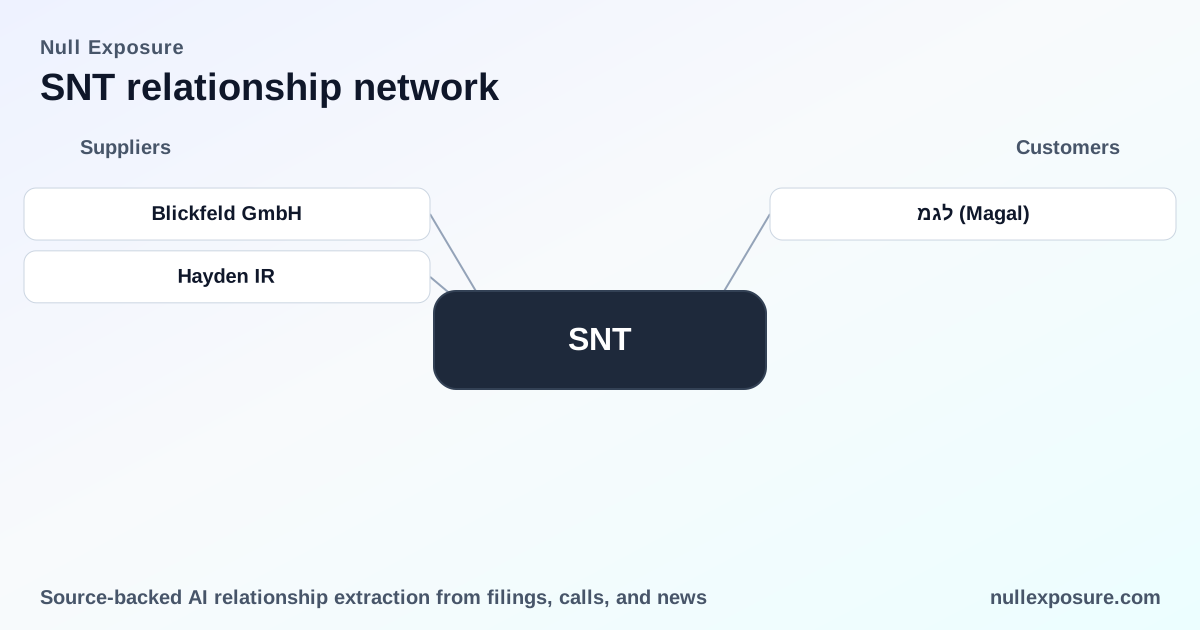
Blickfeld GmbH — strategic acquisition to add 3D LiDAR capability
Senstar’s wholly owned subsidiary signed a definitive agreement to acquire Blickfeld GmbH, a developer of 3D LiDAR sensors with integrated software used in security and industrial applications; this expands Senstar’s hardware portfolio into high-resolution, software-integrated LiDAR sensing. According to a Pulse2 report published March 10, 2026, the acquisition positions Senstar to internalize a previously external sensor technology and accelerate product integration and differentiation.
Hayden IR — investor relations partner named in results announcement
Hayden IR is listed as the investor relations contact for Senstar in the company’s Q3 2025 results announcement; for investors this formal IR relationship clarifies communications and access to management for earnings and corporate disclosures. A PR Newswire notice regarding the company’s third-quarter 2025 reporting (published November 25, 2025) identifies Corbin Woodhull of Hayden IR as the IR contact.
What each relationship implies for risk and opportunity
The Blickfeld transaction and the engagement with Hayden IR deliver complementary signals. Acquiring Blickfeld converts a supplier/partner dependency into an owned capability, which reduces long-term supply concentration risk while raising near-term integration and capital allocation questions. The Hayden IR relationship is a governance and communications signal: consistent IR support improves transparency and investor access but does not materially change operating risk.
- Integration and execution risk is the primary near-term concern for the Blickfeld deal: product roadmaps, channel alignment, and combined R&D priorities determine whether the acquisition accelerates recurring software revenue or simply increases one-time integration costs.
- Strategic benefit is material: owning a LiDAR sensor developer strengthens Senstar’s product differentiation against competitors who rely on third-party LiDAR vendors.
- Investor communications, via Hayden IR, reduce information asymmetry and help investors track integration milestones and margins as they evolve.
How these supplier moves change the company’s operating profile
The acquisition of a sensor developer is a structural change: it shifts Senstar from being a systems integrator reliant on third-party sensors to an integrated vendor with in-house sensing IP—this increases gross-margin upside if integration succeeds and aftermarket software adoption scales. That structural change also alters contracting posture: downstream customers buying Senstar systems will see a more vertically integrated offering, which typically results in longer contracts and greater aftermarket revenue potential.
At the same time, investors must watch capital allocation: acquisitions consume cash and management bandwidth, and successful integration depends on execution track record. The Hayden IR engagement provides an easy conduit for tracking those milestones and will be the natural point of contact for follow-ups after earnings and deal announcements.
If you are modeling Senstar’s margin trajectory, consider the impact of in-house sensor production on gross margins and the phasing of acquisition-related costs; for an enterprise-wide supplier risk assessment, see https://nullexposure.com/ for tools and deeper supplier analytics.
A short investor checklist going forward
- Track integration milestones for Blickfeld: product roadmaps, time-to-market for LiDAR-enabled systems, and early win announcements. These drive margin leverage and cross-sell potential.
- Monitor capex and R&D allocation post-acquisition to see if Senstar prioritizes in-house manufacturing, firmware/software development, or channel expansion.
- Use Hayden IR as the access point for management guidance and follow-up questions about supply-chain impacts and commercialization timelines.
- Watch for supplier concentration shifts: converting third-party suppliers into owned capabilities reduces vendor risk but increases execution risk.
Bottom line: control the sensor stack, control the margin
Senstar is executing a clear strategic play: deepen core security offerings by internalizing key sensor technology while maintaining disciplined investor communications. The Blickfeld acquisition is the most consequential supplier-related move on record and repositions Senstar’s product and supplier risk profile toward vertical integration. Investors should weigh the upside from differentiated, integrated systems against the near-term integration and capital allocation demands. For ongoing monitoring and supplier-focused analysis, visit https://nullexposure.com/ and review the supplier intelligence that tracks these developments in real time.