Southern Company (SO): What the Inlyte Energy Tie Reveals About Supplier Strategy and Commercial Risk
Southern Company operates as a regulated gas and electric utility holding company that monetizes through rate-regulated electricity and gas delivery, large capital investments in generation and transmission, and cost recovery mechanisms embedded in state regulatory regimes. Revenue stability flows from regulated returns on invested capital and fuel/power cost pass-throughs; earnings variability arises from capital program execution, fuel and purchased-power exposure, and regulatory outcomes. For investors and counterparties, supplier relationships are best read through that lens: they are extension points of capital programs and operational risk, not standalone commercial businesses. Learn more technical supplier exposure analysis at https://nullexposure.com/.
Why this Inlyte installation matters for the investment case
Southern Company’s decision to host Inlyte Energy’s first U.S. iron‑sodium battery at its Energy Storage Test Site is a targeted, low‑risk way to accelerate technology evaluation while preserving regulatory optionality. The deployment signals Southern’s active procurement posture in storage technologies that support grid reliability and decarbonization objectives, but it does not transfer large-scale technology or vendor concentration risk to the utility book by itself. A March 2026 report on Energy‑Storage.News described the installation at Wilsonville, Alabama and tied it to Southern’s broader storage plans and federal support for the utility’s projects (see https://www.energy-storage.news/us-doe-closes-us26-5-billion-loan-package-to-utility-southern-company-for-16gw-of-capacity-including-bess/).
All supplier relationships disclosed in the results—and what they mean
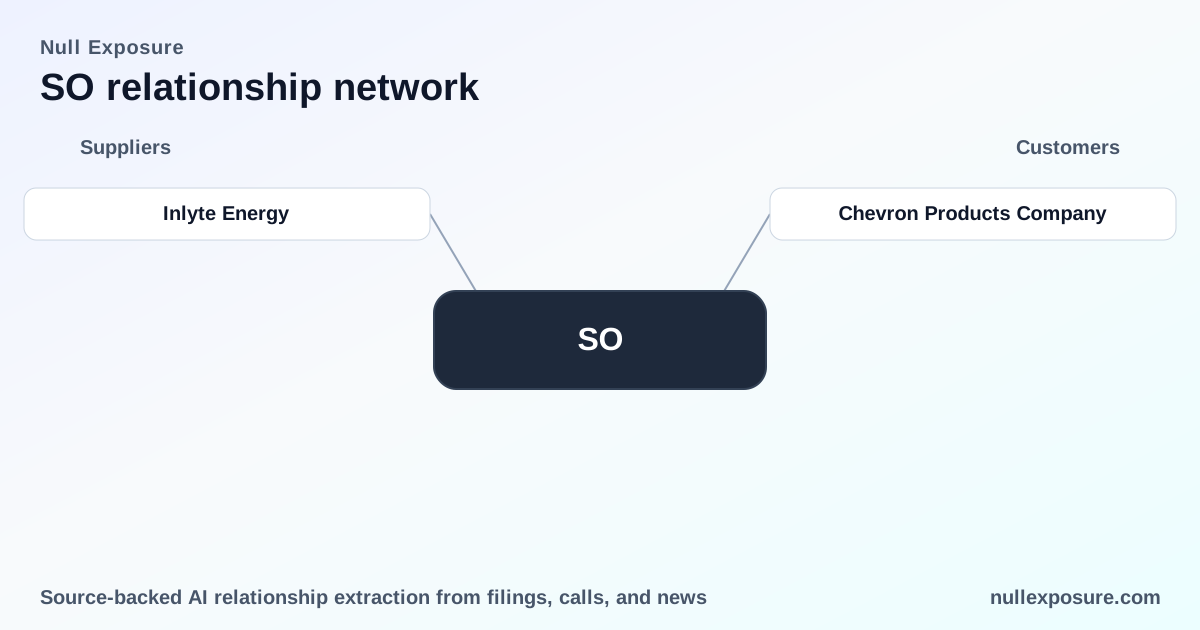
Inlyte Energy — Southern Company installed Inlyte’s first U.S. iron‑sodium energy storage system at its Energy Storage Test Site in Wilsonville, Alabama, positioning the vendor for validation under an incumbent utility testing regime; the deployment is framed as a demonstration that supports future procurement decisions (Energy‑Storage.News, March 2026: https://www.energy-storage.news/us-doe-closes-us26-5-billion-loan-package-to-utility-southern-company-for-16gw-of-capacity-including-bess/).
Contracting posture, spend bands and materiality—interpreting the constraints as company signals
Southern Company’s supplier footprint reflects a mix of long-term strategic contracts and shorter-term commodity arrangements, a posture consistent with large regulated utilities that lock in fuel, maintenance and certain capacity-related services while leaving flexibility for volatile commodity purchases.
- Long-term contracting is a structural feature. SEC filings disclose long-term agreements for nuclear fuel (up to 10 years), gas supply commitments (SCS contracted 627 Bcf for 2025 with terms up to 10 years), and long-term service agreements intended to secure maintenance for generating assets. These LTSAs and fuel contracts create predictable cost and supply baselines that stabilize rate cases and capital planning (company filings, 2024–2025).
- Short-term contracts persist where flexibility matters. Coal burn requirements and some purchased power commitments run on one- to three-year cycles, preserving operational discretion to respond to market price signals and regulatory developments.
- Spend scale is large and concentrated. Southern discloses program-level spending that can reach into the hundreds of millions and billions—for example, Georgia Power’s potential spend of up to $14 billion on approved generation and transmission proposals through 2029—so supplier selection and project delivery have enterprise‑level financial impact.
- Purchasing role is dominant. Southern functions primarily as a buyer across fuel, capacity and services, and its procurement decisions directly affect supplier economics and scale.
Together these constraints describe a utility that balances long-term contractual certainty for critical inputs with tactical short-term purchases for commodities, while retaining the appetite to make multi‑hundred‑million to multi‑billion capital commitments through regulatory approvals.
Operational and regulatory implications for investors and suppliers
Southern’s supplier interactions sit at the intersection of procurement discipline, regulatory cost recovery, and technology transition.
- Regulatory anchoring of cost recovery reduces commercial upside for suppliers but increases payment certainty. The utility’s ability to pass through fuel and approved capital costs reduces counterparty credit exposure relative to merchant counterparts, but it also places supplier economics within rate case timelines and prudence reviews, increasing execution risk for suppliers that rely on rapid commercialization.
- Technology pilots are risk‑reducing entry points for new vendors. The Inlyte installation illustrates Southern’s pattern: accept demonstration‑scale deployments inside test facilities to validate life‑cycle performance before committing procurement at scale. This preserves investor capital while creating a pathway for emerging technologies to earn future business.
- Materiality and concentration accentuate delivery risk. Given the scale of Southern’s planned spend, a supplier that captures a significant program could become material to Southern’s operational plans and to their own revenue base; conversely, Southern’s procurement missteps or regulatory disallowances could have material financial consequences for the supplier. SEC filings flag that fuel and purchased power are significant components of operations and that cost disallowances (for example, in Southern Company Gas matters) could be material to financial statements (company filings, 2024–2025).
How to read supplier risk in valuation and portfolio construction
For investors and operators, supplier exposure to Southern Company should be priced across three vectors:
- Regulatory dependency: Suppliers that rely on cost recovery tied to Southern’s rate cases have cashflow profiles that are subject to prudence reviews and political cycles.
- Concentration risk: Winning a large procurement tranche with Southern can scale a supplier rapidly but makes that supplier vulnerable to a single counterparty’s regulatory and credit dynamics.
- Maturity and contract tenor: Long‑term LTSAs and fuel arrangements lock in revenues for suppliers providing critical services, while short‑term commodity supply leaves margins exposed to market volatility.
Apply a higher discount to suppliers that are early‑stage technology vendors with limited diversification and seek a premium for suppliers with long-term maintenance or fuel contracts that embed predictable revenue streams.
Learn more about mapping supplier exposure and regulatory tail risk at https://nullexposure.com/.
Practical investor takeaways
- Southern’s procurement strategy blends long-term contractual certainty for critical inputs with selective pilot programs (the Inlyte deployment is an example), reducing system-level risk while preserving optionality for emerging technologies.
- Supplier relationships can be materially large; execution and regulatory prudence determine ultimate financial outcomes—both for Southern and for significant suppliers.
- New energy technology vendors should expect demonstration‑first deployments before scale procurement, which lowers supplier revenue near-term but de‑risks utility adoption.
For direct analysis of Southern Company supplier footprints and to receive alerts on relationship changes, visit https://nullexposure.com/.
Bottom line: Southern Company’s supplier posture is that of a patient, regulated monopoly—it buys predictability where necessary, pilots where uncertainty is high, and structures its capital plan to preserve regulatory recoverability. For investors, that translates into stable cashflow underpinned by regulatory frameworks, with episodic execution risk tied to procurement delivery and regulatory outcomes.