SOBR Safe: supplier relationships and what they mean for investors
SOBR Safe develops non‑invasive identity verification and continuous transdermal alcohol detection devices and monetizes through hardware sales, recurring device services and strategic partnerships that extend monitoring and intervention capabilities. The company finances growth through equity raises and placement agent arrangements while outsourcing manufacturing and component procurement, which gives investors exposure to product traction combined with operational leverage to third‑party manufacturers. For a deeper mapping of supplier counterparties and operating constraints, visit https://nullexposure.com/.
Quick take: the business model and where suppliers fit in
SOBR Safe sells wearable alcohol‑monitoring devices and associated services; revenue is concentrated on low absolute dollars today (Revenue TTM ~$364k) while the company funds operations with equity placements and placement agent arrangements. Manufacturing and component sourcing are outsourced, and the firm executes short‑term purchasing rather than long‑term supply contracts, creating both flexibility and vendor concentration risk. The company’s capital strategy has included small private placements (circa $2 million) underwritten or placed by boutique investment banks, which directly affect liquidity and dilution for shareholders.
Counterparties you need on your radar
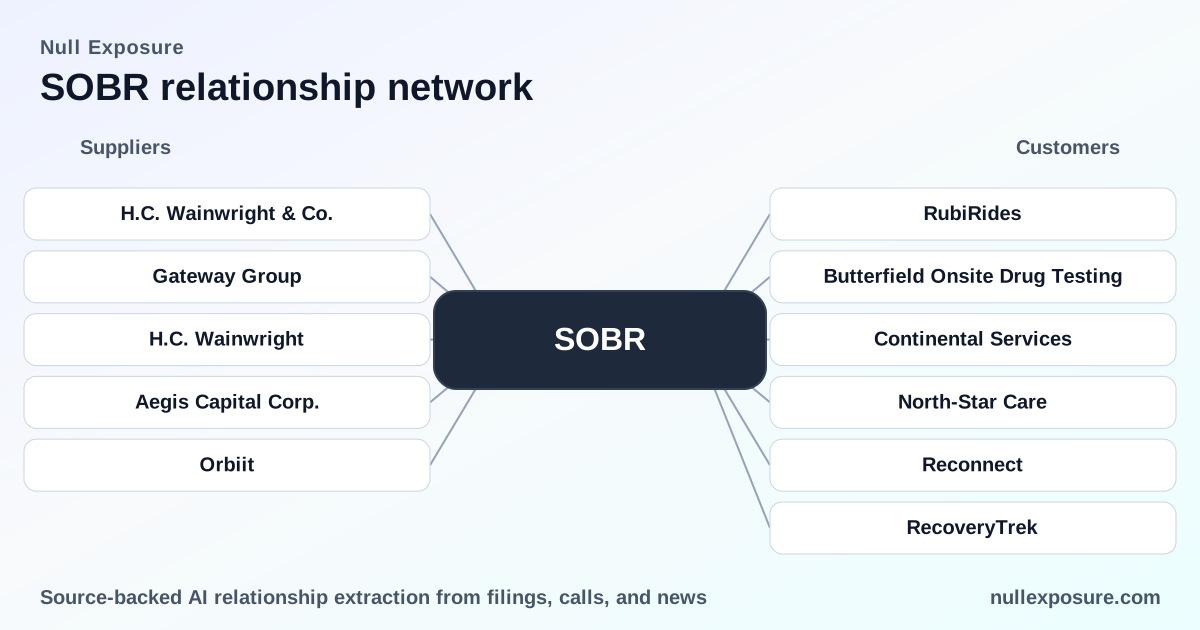
Below I run through every supplier/partner referenced in public materials and press coverage, and explain the practical implication for operations and investor risk.
H.C. Wainwright & Co.
H.C. Wainwright served as the exclusive placement agent for SOBR Safe’s approximately $2 million private placement, and the company granted placement agent warrants in connection with the transaction; this arrangement underwrites near‑term liquidity needs through capital markets channels. According to press coverage in late 2025 and follow‑ups into FY2025, H.C. Wainwright acted as exclusive placement agent and was granted placement agent warrants (reported by Benzinga and AccessWire/TradingView in December 2025).
Aegis Capital Corp.
Aegis Capital received a cash tail fee related to the same private placement close, indicating secondary placement or distribution economics were granted to additional broker‑dealers. The closing notice in FY2025 named Aegis Capital Corp. as a recipient of a cash tail fee for its role in the transaction (AccessWire, FY2025).
Gateway Group (investor relations)
Gateway Group is referenced as the company’s investor relations contact for press releases, reflecting an outsourced investor‑relations relationship rather than an operating supplier function. SOBR’s investor communications list Gateway Group contacts (Scott Liolios/Taylor Stadeli) in FY2025 press releases (AccessWire/PR notices, FY2025).
Orbiit
Orbiit is a commercial partner providing an AI and support platform that integrates with SOBR’s wearable band to deliver 24/7 AI support, alerts and GPS tracking for end users—this is a product‑extension partnership that increases the value proposition of the SOBRsure device. The partnership was announced in a PR Newswire release in FY2025 describing the integration of Orbiit’s platform with SOBR’s continuous transdermal detection band (PR Newswire, FY2025).
What the supplier constraints reveal about SOBR’s operating posture
The public constraints extracted from filings and press materials tell a consistent company‑level story about procurement, geography and role reliance:
- Short‑term contracts / purchase order posture. The company explicitly states it does not have long‑term supply contracts and purchases components on a purchase‑order basis, which signals operational flexibility but higher exposure to supplier price volatility and lead‑time interruptions. This short‑term posture reduces fixed obligations but increases execution risk during volume scale‑up.
- U.S. centric manufacturing and testing. SOBR reports that design, manufacturing, quality testing and distribution for integrated devices take place in the United States, which supports tighter quality control and IP protection but can increase unit costs and supplier concentration in a single geography.
- Dependence on third‑party manufacturers. The company depends on external firms to manufacture and supply key components, making third‑party manufacturing a critical operational risk. This dependence concentrates supply‑chain execution externally while the company retains product design and commercialization responsibilities.
These constraints are company‑level signals and should be read as structural characteristics that influence margins, time to scale and dilution risk when capital is required to bridge growth.
If you want a structured supplier risk score for SOBR’s counterparties and how they affect valuation, see more at https://nullexposure.com/.
Investment implications: risks that move the stock
SOBR’s supplier posture and recent financing activity combine into a clear investment profile:
- Operational risk is concentrated: outsourcing manufacturing and purchasing on short‑term POs creates execution sensitivity to single‑source suppliers and lead‑time shocks.
- Liquidity and dilution are recurring levers: the use of placement agents and small private placements (the ~$2M raise) signals reliance on capital markets to fund near‑term operations, which increases shareholder dilution risk if product revenue does not scale.
- Product value‑add through partnerships: commercial partnerships like Orbiit expand recurring engagement and service revenue potential, improving lifetime value if adoption grows.
Key takeaway: SOBR trades off capital efficiency and flexibility against supply‑chain and financing risk; investors should underwrite manufacturing continuity and placement agent economics into valuation.
Practical next steps for investors and operators
- For investors: demand clarity on supplier concentration (single‑source parts), average purchase‑order lead times, and the company’s contingency plans for scale‑up. Confirm how placement agent warrants and tail fees affect dilution under multiple financing scenarios.
- For operators: prioritize supplier diversification and negotiated lead‑time protections; accelerate margin expansion by evaluating near‑term contract frameworks with critical manufacturers.
Explore services and supplier mapping that help quantify these risks at https://nullexposure.com/.
Bottom line
SOBR Safe is a hardware‑led technology company that outsources manufacturing, uses short‑term procurement and relies on capital raises placed by boutique underwriters to support operations. That combination creates a classic small‑cap growth profile: high optionality from partnerships and product differentiation, paired with meaningful supplier and financing execution risk that investors must model explicitly. For bespoke counterparty intelligence and ongoing monitoring of SOBR’s supplier network, visit https://nullexposure.com/ for detailed coverage and alerts.