Sable Offshore (SOC): Supplier relationships, constraints and what investors should price in
Sable Offshore Corp. operates as an upstream oil and gas explorer and producer focused on assets in the North Atlantic and off California, monetizing through hydrocarbon production and strategic financing events that fund development and operations. The firm leverages long-duration leases and asset-backed financing to maintain field access while using placement agents for equity raises tied to debt relief and partner arrangements. Investors should value SOC as an asset-heavy explorer with concentrated geography, chronic negative earnings and capital structure dynamics driven by third-party financing and placement activity. For direct access to relationship intelligence and supplier analytics, visit https://nullexposure.com/.
Quick read: the commercial picture that matters
SOC’s operating model is defined by three commercial realities: concentrated regional exposure, dependence on large institutional counterparties for derivative and financing arrangements, and a mix of long-dated leases for field access alongside short-term transition agreements tied to asset transfers. Financially, the firm posts negative operating and net income metrics and relies on episodic equity raises to address lender contingencies and fund operations. This combination makes supplier and financial relationships both operationally critical and valuation-relevant.
What the public coverage tells investors
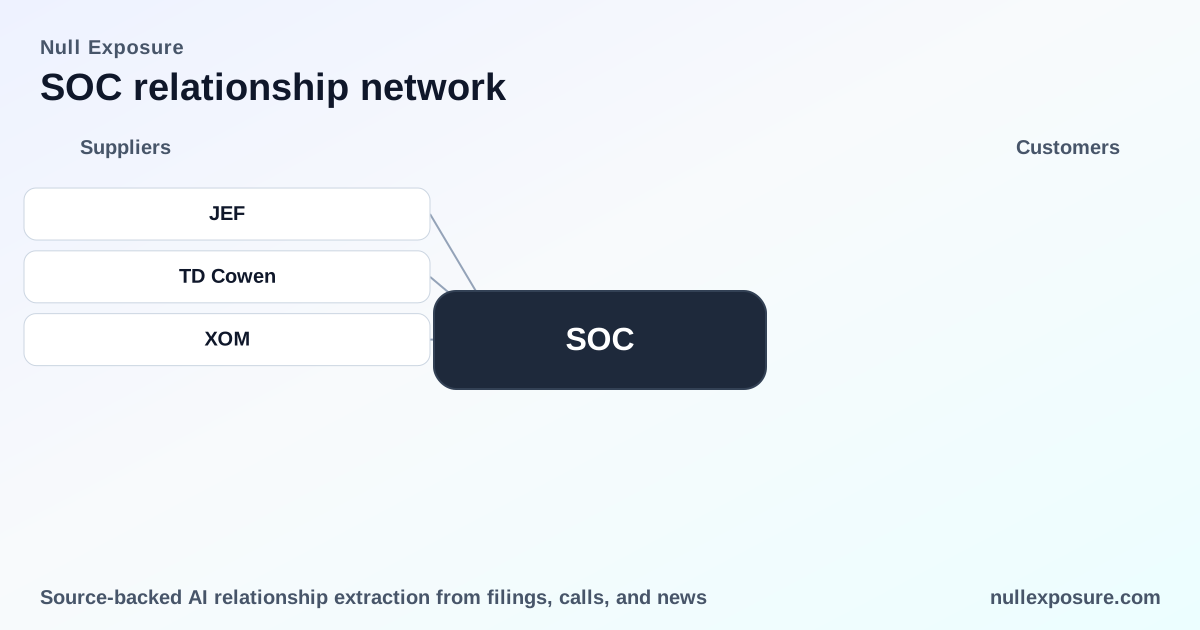
A Reuters-syndicated report published on TradingView on March 10, 2026, drove recent market moves: SOC completed a roughly $250 million equity raise to satisfy a loan extension condition with Exxon Mobil, and the stock had previously plunged nearly 31% when the company announced the extension was contingent on raising at least $225 million. Placement agents Jefferies and TD Cowen structured the equity issue, and the financing event reshaped near-term liquidity and creditor relationships. According to the report, the equity raise and the tied loan extension were material catalysts for the stock’s bounce.
For more context on counterparties, documentation, and contract types that drive SOC’s cost of capital and operational flexibility, explore actionable supplier mapping at https://nullexposure.com/.
Key supplier and partner relationships (publicly reported)
Below I cover every relationship flagged in the available results with concise, source-backed takeaways.
Jefferies — placement agent for the equity raise
Jefferies acted as a joint placement agent on SOC’s roughly $250 million equity offering that underpinned a loan extension tied to Exxon Mobil. The bank’s role directly influenced timing and execution of the capital raise that addressed a creditor covenant. A Reuters report syndicated on TradingView detailed this placement agent role in March 2026.
TD Cowen — co-placement agent alongside Jefferies
TD Cowen served as the other joint placement agent on the same financing, working in tandem with Jefferies to place the equity required to satisfy lender conditions. The TradingView/Reuters piece from March 2026 lists TD Cowen as a named arranger on the transaction.
Exxon Mobil (XOM) — creditor and operational counterparty in transition services
Exxon Mobil was the creditor whose loan extension was contingent on SOC raising equity; the company’s shares fell nearly 31% on November 3 when that contingency was disclosed. The same reporting notes Exxon provided transition services following the asset sale — short-term operational support that concluded in May 2024. The Reuters report on TradingView in March 2026 captures both the loan contingency and the transition services history.
Operational constraints and what they imply for supplier risk
SOC’s public disclosures and the reporting above reveal a set of operating-model constraints that translate directly into supplier and investor risk:
-
Long-term lease commitments govern field access. SOC records right-of-use assets and lease liabilities for operating leases with a weighted-average remaining lease term above a decade, creating multi-year fixed obligations that lock in cost and location exposure. This is a company-level structural driver of fixed operating leverage.
-
Short-term transition services were used during asset transfers. SOC relied on a Transition Services Agreement with Exxon Mobil for critical operational, accounting and IT support for three months after closing; that short-term arrangement reduced near-term operational friction during ownership transfer but increased dependency on the counterparty during the transition.
-
Regulatory counterparty dependence. SOC requires permits and approvals from government agencies including the Office of Spill Prevention and Response and similar local regulators to restart production, making regulatory relationships a direct operational constraint.
-
Counterparty concentration toward large financial institutions. SOC restricts derivative and financing counterparties to creditworthy market-makers and institutional lenders, which centralizes counterparty credit exposure but ensures access to market liquidity when needed.
-
Geographic concentration risk. The company operates exclusively in California and adjacent waters, exposing revenue and operations to state-level regulatory change, regional infrastructure constraints and localized supply/demand dynamics.
Collectively, these constraints produce high fixed-cost exposure, concentrated counterparty credit risk, and regulatory/operational single-region vulnerability, all of which feed into funding needs and supplier selection.
Why the relationships matter for valuation and operations
The Jefferies/TD Cowen placement structure and the Exxon loan contingency are not ancillary items — they are central to SOC’s short-term solvency profile and to the timing of production restart plans. When a major lender conditions a loan extension on an equity raise, the identity and execution capability of placement agents become a tangible financial lever. Likewise, short-term service arrangements with a former owner or a major integrated oil company materially reduce operational downtime but create reliance that must be managed off-cycle.
Midway readers who need a supplier-focused risk map and counterparty heatmap can get actionable intelligence at https://nullexposure.com/.
Investor takeaways and tactical calls
-
Capital structure drives near-term outcomes. The equity raise tied to Exxon’s loan extension is the proximate determinant of liquidity; monitor placement progress and any follow-on deals staged by Jefferies and TD Cowen for signs of further dilution or covenant relief.
-
Operational continuity is conditional. Short-term transition services have concluded, but permits and local regulatory approvals remain gating factors for production restarts in SOC’s concentrated operating footprint.
-
Counterparty selection is defensive. SOC’s deliberate use of large, creditworthy counterparties for derivatives and financing reduces counterparty credit risk but increases dependency on institutional capital markets, making access to placement agents and banks a de facto operational asset.
For a deeper dive into the supplier network and how counterparties influence valuation, visit https://nullexposure.com/.
Closing view
Sable Offshore is an asset-centric operator whose valuation is driven as much by who it transacts with as by the hydrocarbon potential of its fields. The documented relationships with Jefferies, TD Cowen and Exxon Mobil show capital markets and legacy counterparties steering near-term outcomes. Investors should weight financing execution and regulatory clearances equally with production metrics when modeling upside and downside scenarios.