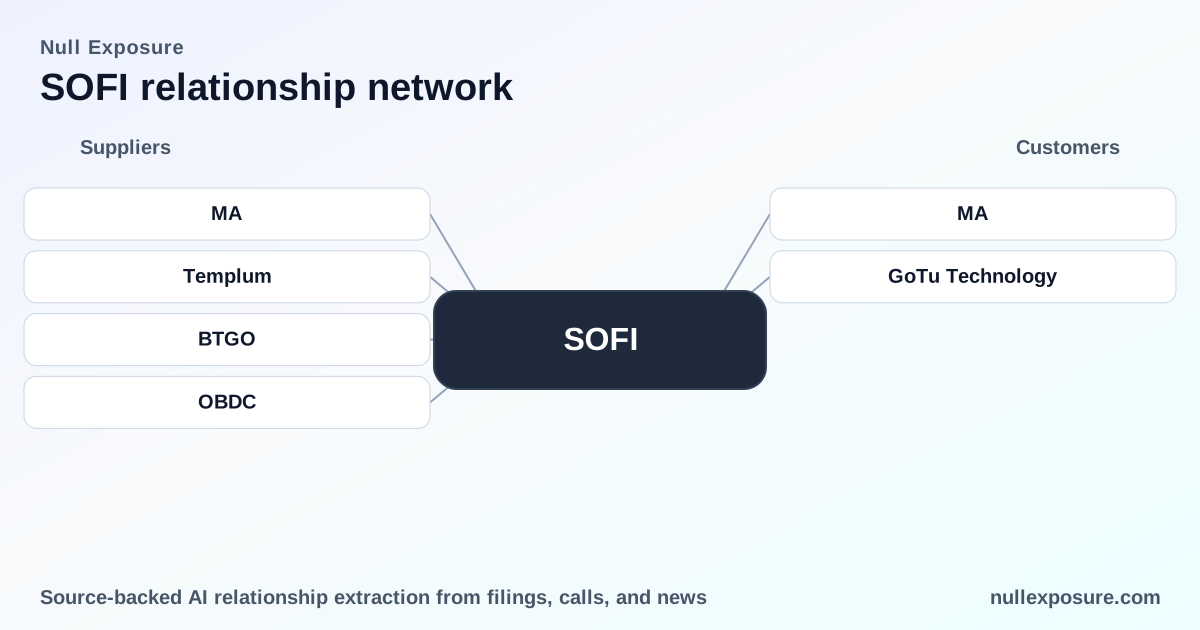
SoFi’s supplier map: stablecoins, custody, private markets and lending partners that move the needle
SoFi Technologies runs a consumer-focused digital financial services platform that monetizes through interest spread on lending, subscription and interchange fees, and fees from investment and wealth products. The firm scales by cross-selling credit, deposits, payments and investment services to a single member base; strategic supplier relationships extend product reach (card rails, custody, asset provisioning, private placements) while keeping SoFi capital-light on certain products. Investors should value SoFi not only as a lender and payments player but as an orchestrator that relies on external partners for critical rails and distribution. For a deeper supplier risk profile, visit NullExposure home.
How these suppliers affect revenue and risk is the central story below: these are commercial relationships that enable product launches (SoFiUSD), broaden capital sources, and add member-facing investment inventory—and they carry operational and contracting implications that change the risk/return trade-off for equity holders.
Quick snapshot of company scale and operating posture
SoFi reported trailing twelve-month revenue of $3.583 billion and a market capitalization around $22.48 billion as of the latest quarter (FY2025/Q4). The business delivers attractive gross margins but runs a capital-light expansion strategy by partnering for payments, custody and third‑party capital, which increases product speed-to-market but also introduces vendor concentration and termination risk.
Vendor-by-vendor: what each reported relationship delivers
Mastercard — payments rail for SoFiUSD stablecoin
SoFi has a commercial arrangement with Mastercard to enable settlement for its SoFiUSD stablecoin across Mastercard’s global payments network, positioning the bank to scale merchant and consumer acceptance quickly via an incumbent card network. This partnership was reported in multiple March 2026 news pieces, including a Tikr analysis referencing Reuters and MarketBeat instant alerts in early March 2026 (FY2026 reporting window). (Sources: Tikr blog citing Reuters, March 2026; MarketBeat instant alert, March 2026 — https://www.tikr.com/blog/sofi-technologies-stock-trades-near-18-heres-what-could-drive-the-next-move; https://www.marketbeat.com/instant-alerts/sofi-technologies-nasdaqsofi-trading-up-29-whats-next-2026-03-05/)
BitGo — custody and stablecoin infrastructure
BitGo has been selected to provide custody and infrastructure services for the SoFiUSD stablecoin, giving SoFi an institutional-grade custodial partner for tokenized dollar holdings and distribution. Multiple March 2026 reports note BitGo’s role as the custody and infrastructure provider for SoFiUSD (FY2026). (Sources: Finviz coverage and Tikr reporting, March 2026 — https://finviz.com/news/286088/where-will-sofi-technologies-be-in-5-years; https://www.tikr.com/blog/sofi-technologies-stock-trades-near-18-heres-what-could-drive-the-next-move)
Templum — curated private market placements for members
Templum is offering select private placement opportunities (including names like OpenAI, Perplexity AI, and Colossal Biosciences) to SoFi members, representing a fee-generating conduit for institutional-style private market access to a retail cohort. MarketBeat and Finviz noted Templum’s role in early 2026 private market offerings to SoFi’s customer base (FY2026). (Sources: MarketBeat instant alert, March 2026; Finviz coverage, March 2026 — https://www.marketbeat.com/instant-alerts/sofi-technologies-nasdaqsofi-trading-up-29-whats-next-2026-03-05/; https://finviz.com/news/286088/where-will-sofi-technologies-be-in-5-years)
Blue Owl Capital — capital partner for small business lending marketplace
Blue Owl Capital is named as a funding partner in SoFi’s small business lending marketplace, allowing SoFi to originate loans in a capital-light fashion and expand beyond consumer finance into SMB credit supply channels. FinancialContent coverage in January 2026 referenced Blue Owl’s participation in SoFi’s small-business marketplace (January 28, 2026). (Source: Markets.FinancialContent article, January 28, 2026 — https://markets.financialcontent.com/stocks/article/finterra-2026-1-28-sofis-maturation-rally-deep-diving-the-12-gain-and-the-future-of-the-fintech-super-app)
What these relationships imply for investors: concentration, criticality and contracting posture
SoFi’s supplier set is deliberately targeted: major payments rails (Mastercard), institutional custody for tokenized USD (BitGo), private market inventory (Templum), and off‑balance-sheet capital (Blue Owl). Those choices accelerate product rollout and reduce capital commitment, but they introduce three company-level operating constraints to weigh in valuation and downside scenarios:
-
Contracting posture — short-term termination risk. SoFi discloses vendor agreements that are “terminable on short or no notice,” a contracting posture that gives counterparties flexibility and raises switching risk for SoFi if a provider withdraws services. This is a company-level signal from SoFi’s filings related to vendor termination terms.
-
Service-provider dependency and operational criticality. SoFi relies on third‑party custodians and cloud/payment providers to run key functionality and to hold digital assets on behalf of members. That reliance elevates operational risk: outages, regulatory changes or custodial disputes at a partner can disrupt member-facing services.
-
Funding dependence and capital sourcing. SoFi depends on third‑party funding sources and deposit balances to originate loans; partnerships like the one with Blue Owl illustrate a capital-light model that shifts credit risk allocation and creates dependence on external capital markets and institutional buyers.
Together these constraints mean SoFi is structurally efficient and nimble but operationally and commercially exposed to counterparty actions, contract renewal cycles, and third-party regulatory posture. Investors should fold this into scenario analysis around product durability and margin volatility.
Key takeaways for investors
- Mastercard and BitGo accelerate SoFiUSD distribution and custody, converting a product launch into a potentially broad payments and settlement play. That elevates addressable volume but places SoFi squarely in the crosshairs of payments and crypto regulation. (Sources above.)
- Templum is a revenue-enabling partner for exclusive private placements, which can drive fee income and increase member engagement without large balance-sheet commitments. (Sources above.)
- Blue Owl underpins capital-light SMB lending expansion, enabling scaled origination while preserving capital efficiency but creating dependence on third-party funding. (Source above.)
- Operational risk is concentrated in a few service providers and short-term vendor contracts, and investors should model scenarios where one counterparty’s withdrawal or regulatory action compresses product availability or increases costs.
If you want a concise supplier risk scorecard and counterparty timeline for SoFi, start here: NullExposure home.
What investors should monitor next
Watch three vectors over the coming quarters: (1) contract renewals and any shift from short-term to longer-term commercial terms with core providers; (2) regulatory guidance on stablecoins and custody that could change economics or compliance cost; and (3) the flow-through of private-placement fees and small-business marketplace volume into reported fee revenue. Together, those metrics will determine whether these partnerships are durable drivers of scale or episodic amplifiers that leave SoFi exposed.
For a full supplier map and alerts when relationships change materially, visit NullExposure home.
Bottom line: SoFi’s supplier relationships are strategic levers that drive distribution and capital efficiency, but they also concentrate operational risk in a small number of external providers and contract arrangements—an investment dynamic that rewards active monitoring of counterparties, contracts, and regulatory developments. For tailored intelligence on these counterparties and how to incorporate them into financial models, go to NullExposure home.