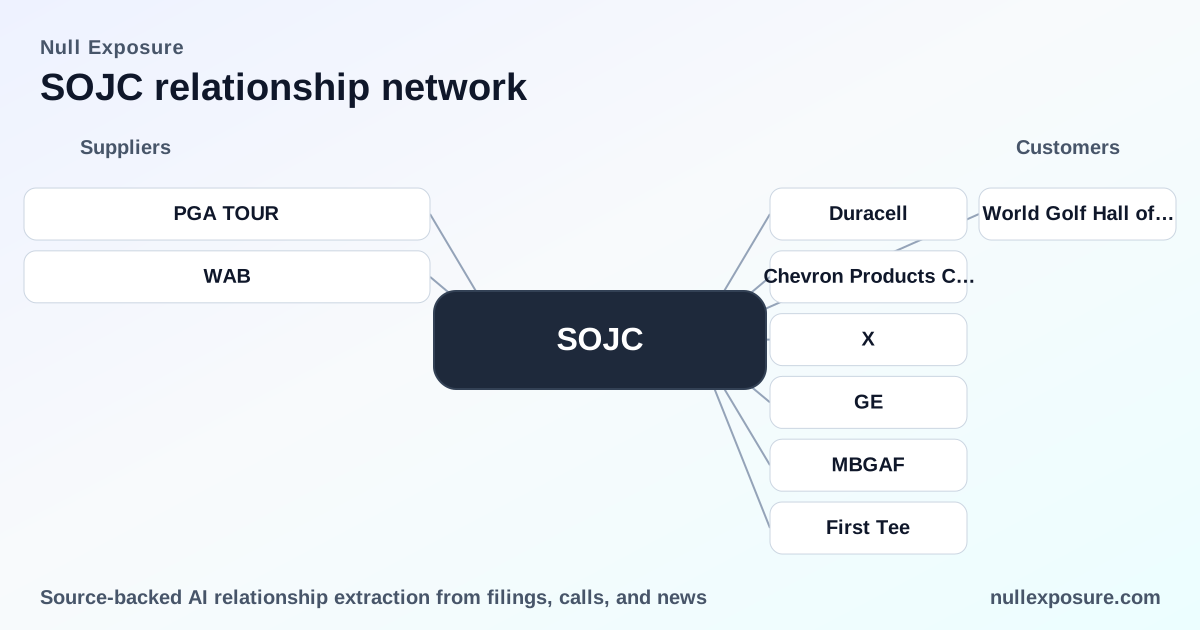
Southern Company (SOJC) — Supplier Relationship Review for Investors
Southern Company operates as an integrated electric utility focused on generation, transmission and distribution, monetizing through regulated electricity sales, long-term fuel supply contracts, and internal service-cost allocations across subsidiary operating companies; the SOJC preferred shares deliver an income profile supported by the company’s regulated cash flows and contractual fuel and service arrangements. Investor focus should be on supplier concentration, contract tenor, and the operational criticality of key engineering and fuel partners, which drive reliability and capital deployment risk for the enterprise. For a consolidated view of supplier exposure and related signals, visit https://nullexposure.com/.
What the supplier footprint looks like in practice
Southern Company combines large-scale fuel procurement and long-term utility contracts with an internal service model (SCS) that centralizes many operational functions and allocates cost across subsidiaries. The constraints in public filings show a predominant long-term contracting posture for gas and fuel, supplemented by shorter-term coal agreements, and a material role as a buyer and consumer of engineering and construction services. Key company-level signals distilled from filings:
- Contracting posture: Long-term commitments dominate gas supply (contracts up to 10 years), while some coal purchase arrangements run 1–3 years, producing a mixed-tenor procurement profile that supports rate-case stability for regulators.
- Role and delivery model: Southern Company acts both as a large-scale buyer of fuel and as a centralized service provider through SCS, meaning many supplier relationships are mediated internally rather than held directly at the utility operating company level.
- Spend scale: Vendor engagements span from mid-sized professional services (audit and advisory fees in the $1m–$10m band) to potential capital expenditures in the $100m+ and up to $14 billion range tied to approved transmission and generation projects through 2029.
- Operational criticality: Engineering, procurement and construction (EPC) partners and control-system suppliers for nuclear units are strategically critical; failures or protracted disputes in those relationships directly affect construction schedules and regulatory outcomes.
These signals establish a profile where counterparty continuity and contract enforcement matter as much as vendor price, and where large capital projects concentrate supplier risk.
Relationship snapshot: PGA TOUR
Southern Company maintains an Official Marketing Partner relationship with the PGA TOUR, a sponsorship that supports brand visibility and customer engagement across key regional and national events. According to a PGA TOUR press release from August 22, 2022, Southern Company renewed that designation and continues to leverage the partnership for marketing and community-facing initiatives (PGA TOUR, Aug 22, 2022: https://www.pgatour.com/article/news/company/2022/08/22/southern-company-renews-as-proud-partner-of-the-tour-championship).
Relationship snapshot: Westinghouse
Southern Nuclear and associated AP1000 utilities are working directly with Westinghouse and control-system suppliers on technical and contractual solutions for the Vogtle Units 3 and 4 projects, reflecting an ongoing engineering and vendor-management relationship that is central to project completion and regulatory filings. A Power Magazine industry update described these collaborative efforts and the utilities’ engagement with Westinghouse on control systems as part of the broader project remediation and completion activities (Power Magazine, IC update on Vogtle, FY2011 context: https://www.powermag.com/ic-update-on-plant-vogtle-units-3-and-4/).
How these relationships connect to the business model
Southern Company’s supplier map is split between commercial and reputational arrangements (marketing partners like the PGA TOUR) and operationally critical technical contracts (EPC and nuclear control-system suppliers such as Westinghouse). The company offsets commodity price volatility with long-term fuel contracts—SCS acts as the contracting agent for gas purchases and transportation—while outsourcing or centralizing technical services through long-term service agreements and LTSAs for maintenance support. This combination produces several investor-relevant dynamics:
- Rate-case insulation: Long-term fuel and transportation contracts provide predictable cost baselines that regulators use in setting rates, thereby protecting cash flows tied to regulated earnings.
- Concentration risk on capital projects: Large-scale EPC and control-system suppliers influence project timelines and cost overruns; vendor disputes or performance issues on nuclear projects produce outsized balance-sheet and reputational impact.
- Internal service allocation: SCS’s role reduces external vendor exposure for many functions, shifting some supplier risk inward while concentrating governance and oversight responsibilities at the system-service level.
For deeper supplier relationship monitoring and contract-signature timelines, visit https://nullexposure.com/ to access consolidated supplier signals.
Risk and opportunity checklist for investors
- Construction and vendor performance: Control-system and EPC vendor issues (e.g., Westinghouse-related remediation) are the primary operational risk that affects capital deployment and allowed returns.
- Regulatory sensitivity: Long-term fuel contracts stabilize input costs for rate cases, but regulators scrutinize procurement efficiency and capital additions, making supplier selection and cost control material to allowed ROE.
- Brand investments: Sponsorships like the PGA TOUR produce limited direct financial upside but support customer retention and community goodwill, which is valuable in regulated utility politics.
- Spend heterogeneity: Audit and professional-fee line items indicate routine third-party expenditures in the $1m–$10m band, while transmission and project CAPEX can push counterparty exposure well into the $100m+ category—both demand active vendor oversight.
Key takeaway: prioritize monitoring of EPC and control-system contract milestones, and watch procurement disclosures in regulatory filings for signals on cost-to-complete and vendor performance.
Practical next steps for investors and operators
- Request or monitor regulatory filings, construction schedules, and vendor change notices for Vogtle and other large projects to track Westinghouse-related risk.
- Track procurement and RFP outcomes from Georgia Power and Southern Power to assess which vendors win meaningful portions of the $14 billion potential spend through 2029.
- Evaluate how SCS allocations change over time—rising internalized services shift vendor exposure but increase governance concentration.
For ongoing supplier intelligence and to see how these relationships evolve in filing narratives, go to https://nullexposure.com/. If you’d like curated alerts for Southern Company supplier activity and vendor risk, start at https://nullexposure.com/ and set up tracking for SOJC.
Final investment takeaway: Southern Company’s revenue stability rests on regulated rate structures and long-term fuel contracts, while the principal supplier risk is concentrated in large capital projects and control-system vendors; investors should underwrite the SOJC preferred income stream against project completion risk and the company’s demonstrated contracting posture.