SOLC supplier relationships: what investors need to know
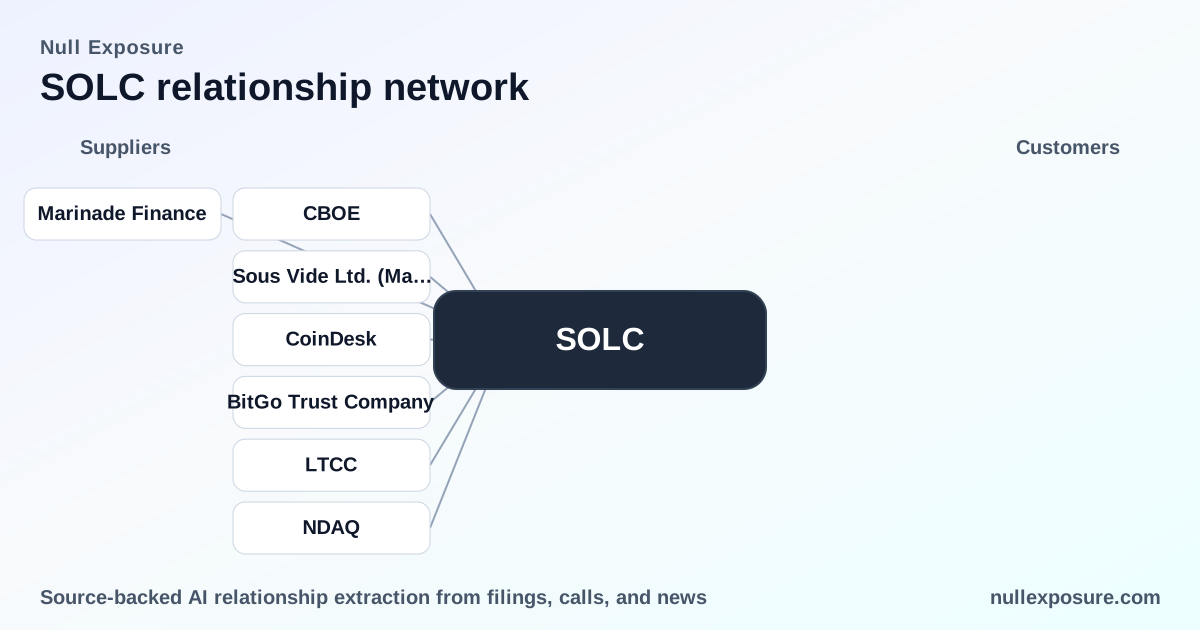
Canary Capital’s SOLC is structured as an exchange-traded vehicle that holds Solana and captures staking yield via a third‑party staking provider, while custody and market plumbing are outsourced to established crypto intermediaries; the product monetizes through management and service fees plus distributed staking income net of provider costs and custody fees. This brief maps the supplier network behind SOLC, isolates the operational dependencies that drive fund performance and risk, and gives actionable takeaways for investors evaluating counterparty exposure and operational concentration. For deeper supplier intelligence and relationship tracking, visit https://nullexposure.com/.
Why this fund matters to institutional allocators
SOLC is not a plain spot ETF — its value proposition is yield on top of core Solana exposure, which converts protocol-level staking economics into a fund-level return stream. That structure changes the risk/reward profile: NAV behavior will depend not only on Solana price but also on staking execution and the integrity of pricing and custody partners. Institutional due diligence should therefore prioritize custody security, staking operator reliability, and the data feeds that determine NAV.
Who SOLC relies on — relationship map
Below are every counterpart referenced in the available coverage, with a concise, plain‑English description and source attribution for each.
- Cboe BZX Exchange — The ETF is slated to trade on the Cboe BZX Exchange under the ticker “SOLC” once regulatory steps are finalized, positioning Cboe as the primary exchange venue for secondary-market liquidity. According to a CryptoRank news item (reported March 10, 2026), the filing specifies Cboe BZX as the intended listing venue.
- Sous Vide Ltd. (Marinade Finance) — Identified as the initial staking provider that will execute staking on the Trust’s Solana to generate yield for the fund; this links SOLC directly into Marinade’s liquid‑staking mechanics under the legal entity Sous Vide Ltd. A CryptoRank filing note (March 10, 2026) lists Sous Vide Ltd. as initial staking provider.
- CoinDesk — The fund will calculate NAV using the CoinDesk Solana CCIXber 60‑minute New York Rate, making CoinDesk’s price feed a determinative input to NAV calculation and intraday valuation. CoinDesk’s role is described in the CryptoRank coverage (March 10, 2026).
- BitGo Trust Company — BitGo is named as the custodian that will hold the Trust’s Solana, creating a single custody relationship responsible for on‑chain asset control and key custody operations. CryptoRank’s March 10, 2026 item identifies BitGo Trust Company as custodian.
- Canary Capital Group — Canary is the sponsor/manager behind the product, responsible for the overall fund structure, fee schedule, and go‑to‑market execution; industry coverage frames Canary as the engine behind the offering. Benzinga’s reporting (March 10, 2026) covers Canary’s launch of the Solana ETF product.
- Nasdaq — Market commentary referenced Nasdaq’s involvement in the market structure or approval landscape for Solana ETFs, signaling institutional exchange interest and the potential for multi‑venue trading or regulatory milestones tied to Nasdaq listings. A CoinCentral piece (reported March 10, 2026) cites Nasdaq in the context of approval momentum.
- Marinade Finance — Beyond the legal entity reference, Marinade is discussed as the staking‑enabled layer that gives SOLC an edge for yield-oriented investors, linking the fund’s performance to Marinade’s protocol mechanics and liquidity profile. CoinCentral’s coverage (March 10, 2026) highlights Marinade’s role in providing staking yield for the product.
- Canary Capital (duplicate/brand reference) — Separate press references list Canary Capital in commentary on the partnership with Marinade, reinforcing that Canary’s product strategy centers on staking‑enabled exposure rather than pure spot replication. CoinCentral and related coverage (March 10, 2026) describe the partnership.
Operational and counterparty implications for investors
With no explicit contractual constraints captured in the available records, treat the following as company‑level operating signals rather than relationship‑specific contract excerpts.
- Concentration risk: SOLC funnels critical operational functions through a small set of counterparties — custody (BitGo), staking execution (Marinade/Sous Vide), and NAV pricing (CoinDesk). That concentration creates a focal point for operational outages or disputes and elevates counterparty risk premiums in due diligence.
- Contracting posture: The fund’s operating model is typical of modern crypto ETPs — a sponsor delegates custody, staking, and pricing to specialized providers rather than vertically integrating. This implies a reliance on counterparty SLAs, insurance arrangements, and operational transparency rather than internal control over execution.
- Criticality and maturity: Custody and pricing inputs are high‑criticality services with mature, market‑standard incumbents (BitGo, CoinDesk) while the staking provider (Marinade) operates in a newer, protocol‑dependent space; this mix pairs established custody/pricing with a less mature yield engine. Investors should view staking operations as the principal source of active‑management variance and operational novelty.
- Liquidity and market access: Listing on recognized exchanges (Cboe BZX and referenced Nasdaq involvement) supports tradability and institutional adoption but does not remove dependency on on‑chain settlement and custody integrity.
For investors and allocators convinced by the yield narrative, evaluate contractual protections (representations, indemnities, insurance limits) with BitGo and Marinade, and stress‑test NAV calculation mechanics tied to CoinDesk pricing. If you want structured supplier intelligence and continuous tracking of these relationships, explore our platform at https://nullexposure.com/.
Key risk and opportunity takeaways
- Key opportunity: Staking exposure delivered via a traded vehicle converts protocol yield into an investable product, which can appeal to investors seeking income from crypto without direct on‑chain management.
- Key risk: The product’s return profile is dependent on third‑party staking execution and custodian practices; any failure at BitGo or Marinade would directly impair NAV and investor confidence.
- Data/valuation dependency: NAV is explicitly tied to the CoinDesk Solana rate, so pricing feed integrity and outages are systemically material to daily valuation.
For portfolio teams running counterparty screens, this is a classic trade‑off: outsourced specialization versus concentrated external dependencies. If you want custom, ongoing monitoring of SOLC supplier exposures and alerts for changes in these relationships, start here: https://nullexposure.com/.
Final recommendation
SOLC’s structure offers a clear product differentiator — yield on top of spot Solana exposure — but shifts the investment due diligence burden to supplier selection and monitoring. Prioritize review of custody agreements with BitGo, the operational SLA and smart‑contract interfaces with Marinade/Sous Vide Ltd., and the NAV methodology tied to CoinDesk. For continuous relationship intelligence and vendor risk scoring tailored to crypto ETPs, visit https://nullexposure.com/ to see how these dependencies evolve in real time.