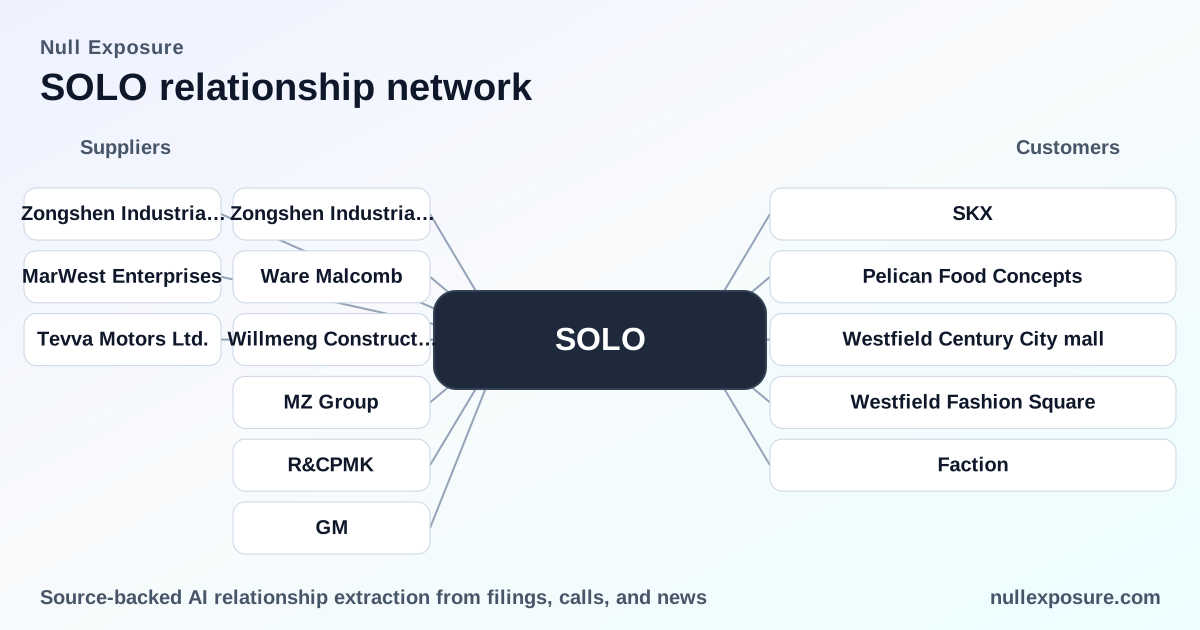
SOLO supplier map: who underpins ElectraMeccanica’s vehicle production and what it means for investors
ElectraMeccanica (SOLO) sells single-seat electric vehicles and monetizes primarily through vehicle sales to retail and commercial/fleet customers, supported by outsourced manufacturing, leased production space and outsourced corporate services (IR, PR, architecture and construction). The company operates a light-assembly, contract-manufacturing model that leverages external partners for core production and go‑to‑market functions, which concentrates operational risk in a small set of third parties while keeping fixed capital intensity lower than a vertically integrated OEM. For a full look at supplier exposures and partner relationships, visit NullExposure supplier coverage.
How SOLO runs its supply chain and why that matters to valuation
ElectraMeccanica’s economics rest on sales volume and margin on a low-overhead manufacturing footprint: vehicles are largely assembled under contract rather than built in-house, with the company leasing facilities for assembly and outsourcing architecture, construction, and communications. That model delivers a faster path to revenue if partners perform, but it also concentrates delivery risk — a single manufacturing partner or a single leased assembly site can materially impact production throughput and timing. The dataset for this review did not flag explicit contractual constraints; as a company-level signal, this indicates reliance on commercial supplier agreements rather than long-term captive capacity.
For investors, the trade-off is straightforward: lower capital intensity and faster scale-up vs. higher counterparty and concentration risk. Active monitoring of partner performance, plant readiness and PR/IR competency is essential. If you want ongoing updates on vendor exposures and documents, check NullExposure’s supplier intelligence hub.
Supplier and partner relationships — what investors need to know
Zongshen Industrial Group
Zongshen is referenced repeatedly as ElectraMeccanica’s manufacturing partner and strategic investor, credited with producing parts in China and enabling early SOLO production; earlier reporting described a production deal covering tens of thousands of units over multiple years. According to industry coverage in 2018, ElectraMeccanica signed a production deal with Zongshen to build 75,000 Solos over three years, and later press and local reporting confirm Zongshen’s role in producing parts and assembling the vehicle in China (Truth About Cars, 2018; ProactiveInvestors and AZCentral, 2020).
Ware Malcomb
Ware Malcomb is identified as the architect for ElectraMeccanica’s Mesa, Arizona plant, indicating the company contracted external architectural services to set up its U.S. light-assembly facility (AZ Big Media, FY2021).
Willmeng Construction
Willmeng Construction is listed as the general contractor for the Mesa plant build‑out, showing that ElectraMeccanica outsourced construction execution rather than self-performing the build (AZ Big Media, FY2021).
MarWest Enterprises
ElectraMeccanica leased the Mesa facility from a developer identified as MarWest Enterprises, signaling a landlord-tenant relationship for production real estate rather than ownership of the plant (AZ Big Media, FY2021).
MZ Group
MZ Group is listed as the company’s investor relations contact in a February 2022 press release, indicating ElectraMeccanica uses external IR services for investor communications (GlobeNewswire, FY2022).
R&CPMK
R&CPMK is cited as the public relations contact on the same GlobeNewswire release, confirming outsourcing of external communications and media relations (GlobeNewswire, FY2022).
General Motors Co.
Historical coverage captured speculative discussions that ElectraMeccanica had been in talks — or at least in the market conversation — about manufacturing at General Motors’ Oshawa plant, a rumored option as GM was closing the facility; this was reported as market chatter rather than a documented contract (ProactiveInvestors, FY2019).
Tevva Motors Ltd.
A legal dispute between Tevva Motors and ElectraMeccanica was documented in 2023, where Tevva filed suit against ElectraMeccanica in U.S. District Court in Arizona relating to an onetime partnership on a Class 8 hydrogen-powered truck project, illustrating that not all collaborations evolved into lasting commercial partnerships (Transport Topics/TTNews, FY2023).
What the relationship map implies for operational risk and value creation
ElectraMeccanica’s supplier roster shows a classic outsourced OEM profile: manufacturing is handled by foreign partners and assembly occurs in leased, third-party facilities with external architects and contractors managing the build-out. External PR/IR firms handle communications, reinforcing a light-staffed corporate model.
- Concentration risk is material. With a small set of named partners performing core functions, a single counterparty failure or geopolitical disruption could materially affect volumes and revenue timing.
- Counterparty criticality is high. Manufacturing and parts sourcing are central to delivery; service providers for PR/IR and construction are low to mid criticality but affect public perception and plant readiness respectively.
- Contracting posture is flexible. Leasing and outsourced services reduce fixed costs and allow scaling up or down, but they transfer execution risk to partners and introduce renegotiation exposures.
- Maturity of relationships varies. Some connections are longstanding production deals; others are transactional or speculative, suggesting heterogenous execution risk across the roster.
If you want a continuous feed of supplier movement and risk signals, consider visiting NullExposure supplier coverage for updates and document tracking.
What investors should watch next
Focus monitoring on three levers that will move the valuation trajectory: manufacturing throughput and quality metrics, plant lease and ramp status, and public communications effectiveness. Evidence of stable, documented production volume from manufacturing partners and timely plant ramping in leased facilities will de-risk the business model; conversely, litigation and speculative talks that do not result in binding contracts increase execution uncertainty.
For portfolio managers and operations teams, prioritize verification of supplier contracts, delivery schedules and contingency plans for alternate manufacturing routes. For equity analysts, track monthly or quarterly delivery metrics tied to partner performance and watch for updates to IR/PR contact activity that signal either stabilization or reputational volatility.
Final takeaway: ElectraMeccanica’s cost-light, outsourced model can accelerate revenue with limited capital deployment, but it concentrates operational risk in a short list of external partners — active supplier monitoring is essential. For a centralized view of supplier relationships, sourcing documents, and continuous alerts, visit NullExposure.