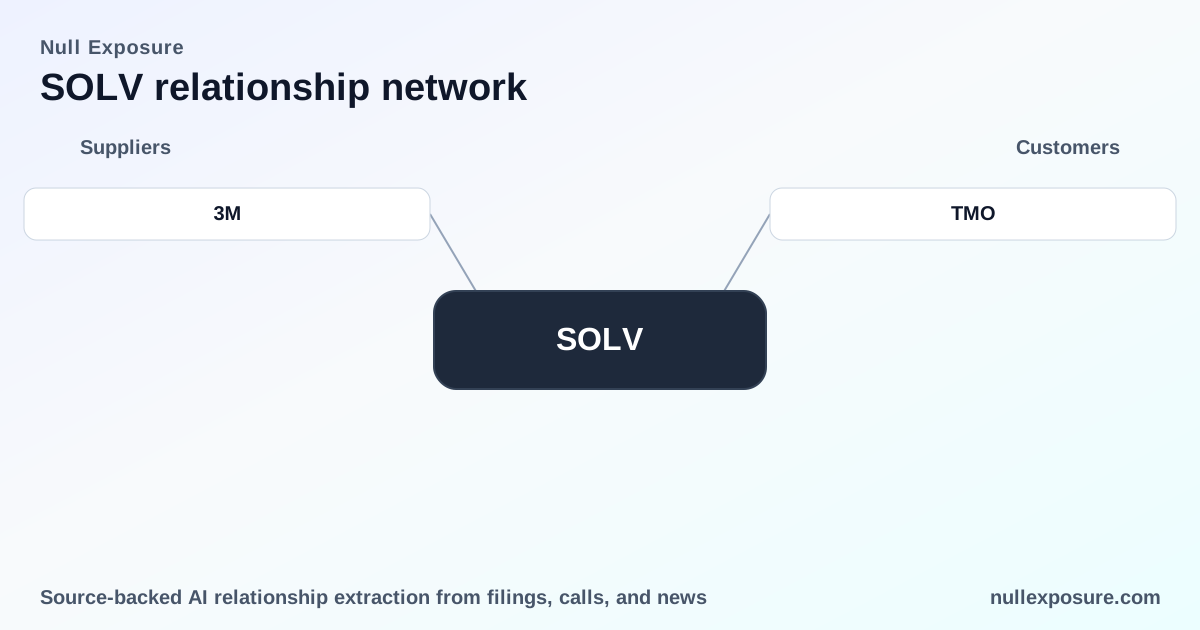
Solventum (SOLV): Supplier Concentration and the 3M Transition that Defines the Business
Solventum operates as a designer, manufacturer and commercializer of medical instruments and consumables, monetizing primarily through product sales into acute-care and procedural markets. Revenue generation is tightly coupled to manufacturing inputs and distribution capacity supplied by third parties, and Solventum’s commercial model monetizes finished goods while relying on strategic supplier arrangements to sustain product availability and margin. Investors should evaluate supplier concentration, transition timelines, and legal protections when assessing upside and operational risk. For an in-depth supplier risk view, visit https://nullexposure.com/.
Why supplier relationships drive Solventum’s value creation
Solventum’s operating model is manufacturing-dependent and distribution-sensitive. The company outsources critical chemical inputs, contract sterilization and uses third‑party manufacturing and distribution during a staged separation from its legacy partner. That posture produces two defining business characteristics: high concentration of input risk and time-bound transition exposures that affect near‑term revenue stability and margin recovery.
- The company reports substantial revenue tied to a narrow set of inputs and channels, making supplier continuity a direct determinant of product sales and EBITDA.
- Transition agreements around manufacturing and distribution create defined contractual windows where operational attention and working capital can be stressed.
These signals are company-level and derive from Solventum’s public disclosures and contract descriptions in the FY2024 filing. For more supplier-specific analytics and scenario modeling, see https://nullexposure.com/.
The 3M relationship: sole‑source supplier and transitional partner
3M is a principal supplier and transitional counterpart for Solventum. According to Solventum’s FY2024 Form 10‑K, 3M is the sole source for certain chemical materials and inputs used across products, and Solventum continues to leverage 3M’s distribution networks and manufacturing sites under transition agreements; 3M also provided indemnities for certain PFAS-related product claims tied to sales through 2025. (Source: Solventum FY2024 10‑K filing.)
3M’s role is both material and operationally intimate: the company disclosed that inputs sourced from 3M accounted for approximately $3 billion of revenue in fiscal 2024, including a proprietary material that underpinned roughly $2 billion of that revenue, creating concentrated exposure if supply were interrupted. (Source: Solventum FY2024 10‑K filing.)
What the contract excerpts imply for operations and investors
Several contract characteristics in filings clarify the commercial posture:
- The company-level disclosure notes master supply agreements and transition manufacturing arrangements that define multi-year contract horizons and staged handoffs; the master supply agreements initially run three years with automatic extensions contingent on supplier validation. This structure signals a deliberate but finite window to secure alternatives and validate third‑party supply. (Company-level filing language in FY2024 10‑K.)
- Solventum disclosed a Transition Services Agreement with a two‑year term (with a one‑year extension option) and Transition Contract Manufacturing Agreements with terms up to three years for individual services. Those short‑to‑medium term arrangements are explicitly connected to the separation activity with 3M and indicate concentrated timeline risk as operations decouple. (Solventum FY2024 10‑K.)
- The company uses third‑party sterilizers and contract manufacturers as part of its service footprint; this creates operational dependencies on service providers for regulatory-compliant throughput and product release timing. (Solventum FY2024 10‑K.)
Collectively, these contractual signals mean transition friction is predictable but material: Solventum has formal windows to replace or validate suppliers, but the economics and timing of substitution are non‑trivial and directly affect revenue continuity.
Relationship-by-relationship breakdown (complete coverage)
3M — Solventum lists 3M as the sole source for several chemical materials and inputs, and continues to use 3M’s distribution and manufacturing footprint under transition agreements; 3M provided indemnification for certain PFAS-related product claims for product sales through the end of 2025. According to the FY2024 Form 10‑K, 3M‑sourced inputs accounted for roughly $3 billion of Solventum’s fiscal 2024 revenue, including about $2 billion tied to a proprietary 3M manufacturing process. (Source: Solventum FY2024 10‑K filing.)
Risk profile and what investors should watch next
- Concentration risk is high and material. The company explicitly ties a significant portion of revenue to a narrow set of 3M‑origin inputs; loss of that supply would directly impact product sales and gross margin. (Solventum FY2024 10‑K.)
- Transition timelines compress near‑term execution risk. Contractual transition services and contract manufacturing terms are finite (two to three years for various agreements), creating milestones that will test Solventum’s ability to validate alternative suppliers and scale them into production without disrupting customers. (Solventum FY2024 10‑K.)
- Operational distraction and cost pressure are realistic. Management acknowledged that transition support obligations could divert personnel and resources, which increases the potential for temporary execution shortfalls during the separation phase. (Solventum FY2024 10‑K.)
- Regulatory and legal tails exist. The indemnity around PFAS claims limits immediate liability for certain periods, but the legal backdrop underscores reputational and compliance risk as products and labeling evolve. (Solventum FY2024 10‑K.)
These items form a concise risk matrix: supply concentration, transition execution, and legal/regulatory exposure are the principal factors that will determine Solventum’s margin progression and revenue stability through the next contract cycles.
For a structured vendor-risk heatmap and to model replacement timelines against cash‑flow sensitivity, explore resources at https://nullexposure.com/.
Practical investor checklist
- Confirm whether the proprietary 3M material has an identified validated alternative and a calendar for qualification.
- Monitor quarterly cost-of-sales and any deviation from historical purchase patterns tied to 3M; the company reported $128 million of cost of sales from purchases under master supply agreements in 2024, which is an active relationship signal. (Solventum FY2024 10‑K.)
- Track milestone deadlines in transition agreements and any public commentary on supplier qualification progress; these are near‑term catalysts for both operational outcomes and valuation rerating.
Bottom line and recommended action
Solventum operates a capital-light product commercialization model that is operationally heavy on third‑party inputs and distribution networks, with the 3M relationship central to both revenue and supply continuity. That concentration is manageable if the company successfully executes its transition plan, validates alternative sources and maintains channel continuity; failure to do so would crystallize meaningful downside to revenue and margins.
For investors and operators underwriting Solventum exposure, focus on supplier validation schedules, procurement milestones, and any change in indemnity or supply commitments from 3M. For more supplier-focused diligence and to benchmark Solventum’s supplier risk posture against peers, visit https://nullexposure.com/.
(Primary source for supplier relationships and contract excerpts: Solventum FY2024 Form 10‑K filing.)