SOLX supplier relationships: what investors need to know
SOLX is the ticker for the T‑REX 2X Long SOL Daily Target ETF, a leveraged single‑asset ETF product that generates revenue primarily through an annual management fee and through sponsor/distribution economics tied to fund assets. The vehicle is sponsored by REX Shares and managed by Tuttle Capital Management, with distribution and exchange listing provided by established fund services and U.S. exchanges — a classic asset‑management supplier stack that monetizes via fees and trading activity. According to press reporting, the funds carry an annual management fee of 1.5% of daily net assets (reported at launch in FY2025), which is the primary visible revenue line for the manager. (CryptoBriefing, Dec 2025)
If you want a concise supplier map and ongoing signals for fund counterparties, visit https://nullexposure.com/ to see how we layer supplier intelligence into investment workflows.
The supplier map in plain English
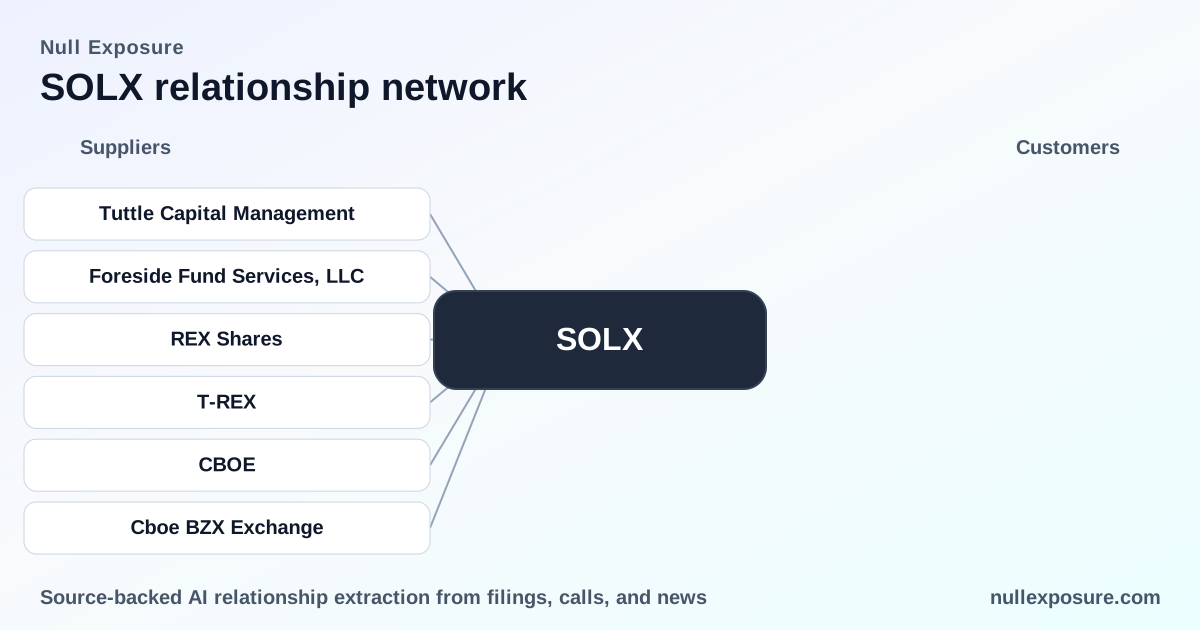
Below are every supplier relationship surfaced in available reporting for SOLX, with a short investor‑oriented description and the source.
-
Tuttle Capital Management — Manager: Tuttle is the appointed investment manager for the T‑REX leveraged ETFs and is paid the announced management fee (1.5% annually) to implement the fund’s daily leveraged exposure to SOL. According to CryptoBriefing coverage of the launch, Tuttle will manage the funds and charge the published 1.5% fee (CryptoBriefing, Dec 2025).
-
REX Shares — Sponsor: REX Shares is the sponsor behind the T‑REX branded ETFs; it is the vehicle through which the product is issued and marketed. ETFGI and multiple press outlets cited REX Shares as sponsor in the launch announcement (ETFGI, Dec 2025; CoinPaper, Dec 2025).
-
T‑REX (product brand) — Product brand and labeling: The T‑REX brand is the public face for the leveraged ETF series (T‑REX 2X Long SOL Daily Target ETF, SOLX). Press releases and market coverage consistently reference the T‑REX product line as the offering name used to position these leveraged single‑stock crypto ETFs (CoinPaper, Dec 2025).
-
Foreside Fund Services, LLC — Distributor: Foreside is named as the funds’ distributor, acting as the FINRA‑registered intermediary for share issuance and distribution; the announcement explicitly notes Foreside’s distributor role and its FINRA membership (ETFGI, Dec 2025).
-
CBOE (Cboe BZX Exchange / CBOE listing) — Listing venue and trading venue: The funds are listed and trading on a CBOE venue; reporting references listing and registration approval from the Cboe BZX Exchange and notes that the funds are now trading on CBOE. That listing gives the fund intraday liquidity and market access (ETFGI, Dec 2025; CryptoBriefing, Dec 2025).
Each relationship is operationally straightforward: sponsor issues the product, manager implements the strategy and collects fees, distributor handles share issuance, and the CBOE family provides market access.
What the supplier set tells you about the operating model
The SOLX supplier construct reflects a standard outsourced fund model where critical functions are parceled across specialist vendors:
-
Contracting posture: The structure uses contractual vendor arrangements typical for ETFs — a sponsor agreement with REX, an advisory/management agreement with Tuttle, a distribution agreement with Foreside, and listing/listing approval terms with CBOE/BZX. These are standard industry contracts that allocate execution, compliance, and distribution responsibilities across parties.
-
Concentration and counterparty exposure: Supplier concentration is moderate — a small number of counterparties provide essential services. Concentration risk is real: disruption at a single counterparty (manager, distributor, or exchange delisting) would materially affect fund operations and investor access.
-
Criticality of suppliers: The most critical suppliers are the sponsor/manager (REX and Tuttle) and the exchange venue (CBOE/BZX) because they underpin the product’s existence, pricing mechanics, and liquidity.
-
Maturity and emergence: This is a new product launch (FY2025); the supplier relationships are recently established, so operational playbooks and historical liquidity patterns are limited to launch activity. There are no public constraint notices in the records supplied, which is a company‑level signal that no explicit contractual constraints or blocking conditions were reported in the available coverage.
Investment implications: risks and upside
The supplier structure, fee profile, and listing choices drive the principal investment tradeoffs for SOLX:
-
Profitability and fee pressure: The 1.5% management fee is relatively high versus broad market ETFs and is the principal monetization lever for the manager; fees will shape net flows and investor stickiness (CryptoBriefing, Dec 2025).
-
Distribution and market access: Having Foreside as distributor and CBOE/BZX as listing venues accelerates market reach and legitimizes market structure plumbing for institutional flow and retail routing; that reduces go‑to‑market friction at launch (ETFGI & CryptoBriefing, Dec 2025).
-
Operational concentration: A concentrated supplier set increases counterparty risk but simplifies oversight — investors can run focused due diligence on a few counterparties rather than a long roster of vendors.
-
Product risk: As a leveraged, single‑asset crypto ETF, SOLX is exposed to high volatility and path‑dependency in returns; supplier quality affects everything from accurate daily leverage implementation to liquidity provisioning in stressed markets.
If you are comparing product counterparties across funds or building supplier risk screens, a targeted review of the manager’s track record, distribution pipeline, and exchange liquidity provision is the most efficient next step. For a consolidated analysis of supplier footprints across funds, visit https://nullexposure.com/ to see parallel supplier profiles and comparative signals.
Practical next steps for operators and investors
-
Validate the management and sponsor agreements in the fund prospectus and review any side letters or incentive arrangements that change economics or control. Confirm the 1.5% fee mechanics in the most recent filings (CryptoBriefing, Dec 2025).
-
Assess exchange liquidity and market‑maker commitments on CBOE/BZX during the first 30–90 days of trading to judge execution quality and tightness of spreads (CryptoBriefing; ETFGI, Dec 2025).
-
Conduct counterparty diligence on REX Shares, Tuttle, and Foreside: track record, regulatory history, and operational SLAs. Because supplier concentration is moderate, this is an efficient place to mitigate risk.
-
Monitor flows and AUM growth trends post‑launch; early inflows and trading volume will determine whether the sponsor/manager economics scale.
For a practical supplier risk scorecard and ongoing alerts tied to sponsor, manager, and exchange signals, check how we structure supplier intelligence at https://nullexposure.com/.
Final read: what matters most
Key takeaway: SOLX is a newly launched leveraged Solana ETF that monetizes through a pronounced management fee and a compact, high‑importance supplier network (REX/Tuttle/Foreside/CBOE). The sponsor/manager duo and the exchange listing are the operational heart of the product; their performance and agreements will determine both investor outcomes and supplier revenue. Press reporting from December 2025 confirms the launch, the sponsorship, the distribution partner, and the listing details (ETFGI, CoinPaper, CryptoBriefing, Dec 2025).
To get supplier‑centric monitoring and comparative views across similar funds, visit https://nullexposure.com/ and sign up for ongoing supplier intelligence.