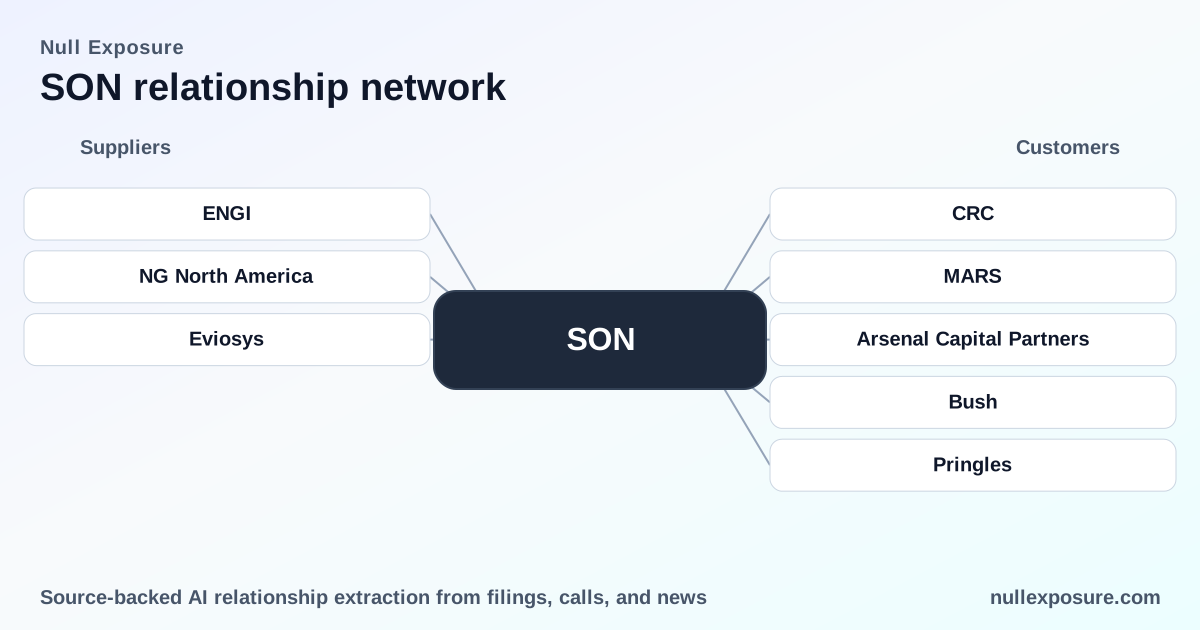
Sonoco’s Supplier Map: Power deals, a strategic acquisition, and what buyers should know
Thesis: Sonoco Products Company is a global packaging manufacturer that monetizes through the sale of industrial and consumer packaging across geographies, complemented by disciplined capital allocation and cost controls; the company uses long-term commercial arrangements (including energy virtual power purchase agreements) and targeted M&A to manage input costs and extend its product platform. Investors and operators should view recent supplier relationships as deliberate moves to stabilize manufacturing economics and broaden product scope while maintaining capital discipline.
Explore deeper supplier intelligence at https://nullexposure.com/.
Why supplier relationships matter for a packaging operator
Sonoco operates with thin but predictable manufacturing margins and a high dependence on commodity inputs (paper, resin, metal) and energy costs. Supplier relationships therefore translate directly into gross-margin volatility, continuity of production, and ESG positioning. Recent disclosures show Sonoco executing long-duration power purchases to lock in energy supply economics, and an acquisitive expansion into European metal packaging that changes its supplier and customer footprint.
Key business characteristics to note: Sonoco acts primarily as a buyer of raw materials and energy, uses vendor programs that allow short notice termination, and treats third-party providers as critical service partners for areas such as IT and risk management. These traits define contracting posture, concentration risk, and operational criticality for counterparties.
The relationships in plain English (each reported item)
- Engie SA — Finviz coverage reported Sonoco announced an integrated sustainability move tied to a VPPA with Engie’s Big Sampson Wind Project, highlighting the company’s effort to secure renewable power as part of its cost and ESG strategy (reported Mar 10, 2026 on Finviz).
- ENGIE North America — Simply Wall St noted Sonoco began receiving power under a 15‑year Virtual Power Purchase Agreement with ENGIE North America linked to Big Sampson Wind Project in Texas, underlining a long-duration hedge on power costs (Simply Wall St, Mar 10, 2026).
- ENGIE North America — A separate Simply Wall St piece reiterated Sonoco entered a 15‑year VPPA with ENGIE North America to source wind energy, framing the arrangement as both a sustainability and cost-management vehicle (Simply Wall St, Mar 10, 2026).
- NG North America — Sonoco’s Q4 2025 earnings-call transcript referred to a virtual power purchase agreement with NG North America that became operational and consists of 60 wind turbines in Crockett County, Texas, indicating active delivery of contracted renewable energy volumes (InsiderMonkey transcript of Q4 2025 earnings call, reported Mar 10, 2026).
- Eviosys — Pet Food Industry reported Sonoco agreed to acquire Eviosys, a European supplier of food cans, ends and closures, from KPS Capital Partners for $3.9 billion, signaling a material expansion of Sonoco’s metal packaging footprint in Europe (Pet Food Industry, Mar 10, 2026).
- ENGIE North America — Sahm Capital’s commentary linked Sonoco’s 15‑year VPPA with ENGIE to a broader leadership and execution focus, framing the deal as reframing Sonoco’s power-cost profile (Sahm Capital, Feb 3, 2026).
- ENGIE North America — Sahm Capital published a follow-up analysis arguing the VPPA with ENGIE recasts Sonoco’s power costs and sustainability narrative, reinforcing the strategic intent behind the long-duration energy contract (Sahm Capital, Feb 12, 2026).
- ENGIE — Simply Wall St in another article referenced Sonoco initiating a major VPPA with ENGIE’s Big Sampson project, emphasizing the scale and public visibility of the contract (Simply Wall St, Mar 10, 2026).
- ENGIE North America — Simply Wall St reiterated the long-term VPPA with ENGIE North America in an amplified piece, underlining market discussion around cost and sustainability impact (Simply Wall St, Mar 10, 2026).
Across these entries the dominant theme is identical: Sonoco is locking long-duration renewable power supply through multiple VPPA disclosures and commentary, while separately pursuing a large-scale industrial acquisition in Europe.
Operating-model constraints and what they imply
Treat the following as company-level operating signals derived from public excerpts — not relationship-level assignments unless explicitly named in the excerpt.
- Short-term contracting posture for certain programs: Sonoco’s voluntary supply‑chain financing programs include termination rights with 30 days’ notice, indicating flexibility but also potential short-term disruption risk for participating suppliers. This structure favors Sonoco’s cash and working-capital management while imposing operational uncertainty on suppliers.
- Buyer-centric role: The company is a significant purchaser of recovered paper, energy, steel, aluminum and plastic resin and typically procures commodities at market or fixed prices for expected consumption. This buyer posture concentrates negotiating leverage with vendors but creates exposure to commodity price swings.
- Third‑party service provider reliance: IT and supply-chain functions rely on third-party providers for onboarding and cybersecurity monitoring, signaling operational dependency on external service firms and the need for robust vendor risk management.
- Mid‑to‑high single-digit contract spend band: Sonoco discloses purchase commitments that aggregate to approximately $82,554 across multi-year schedules (per the disclosure), which places certain long-term sourcing items in the $10m–$100m spend band and signals material but manageable contractual exposure for suppliers.
Investment implications and risk profile
- Cost stability improves with long VPPA tenors. The 15‑year VPPA with ENGIE North America and operational wind volumes from NG North America provide Sonoco with price visibility on a meaningful portion of its energy needs, which directly supports operating-margin stability and cash-flow forecasting. This reduces one of the principal input-cost risks for manufacturing.
- Eviosys acquisition materially shifts product exposure. The $3.9 billion purchase of Eviosys expands Sonoco’s presence in European metal packaging and can diversify revenue and cross-sell opportunities, but it also increases integration risk and funding needs. Assess capital allocation and margin mix post-close.
- Contracting choices favor Sonoco’s balance-sheet flexibility but place counterparty risk on suppliers. Short notice termination in SCF programs and buyer-dominant procurement terms mean Sonoco can optimize working capital, while suppliers face concentration and liquidity pressures.
- Operational reliance on third-party service providers elevates intangible risk. Outsourced IT and cybersecurity monitoring are critical to continuity and compliance; failure or gaps in third-party control would translate into operational and reputational loss.
Explore how these supplier dynamics affect valuation and risk scoring at https://nullexposure.com/.
How operators and investors should act
- For buy-side analysts: Reassess energy-cost assumptions in models given multi-year VPPAs and the likely smoothing of energy-driven margin volatility. Reprice integration synergies and one-time costs related to the Eviosys acquisition.
- For procurement and operations teams: Audit supplier concentration and SCF participation among key vendors to understand downstream continuity risk from short-term termination clauses. Validate third-party cybersecurity controls supporting manufacturing and supply chain.
- For ESG-focused investors: The VPPA commitments materially upgrade the renewable-energy profile; track delivery volumes and any REC retirement strategy to confirm claims.
Final takeaway: Sonoco is executing a coordinated strategy to lock energy costs and expand product capability via acquisition—moves that strengthen margin resilience but require scrutiny around integration execution and supplier-side liquidity. For a deeper view of supplier exposures and contract-level signals, visit https://nullexposure.com/.