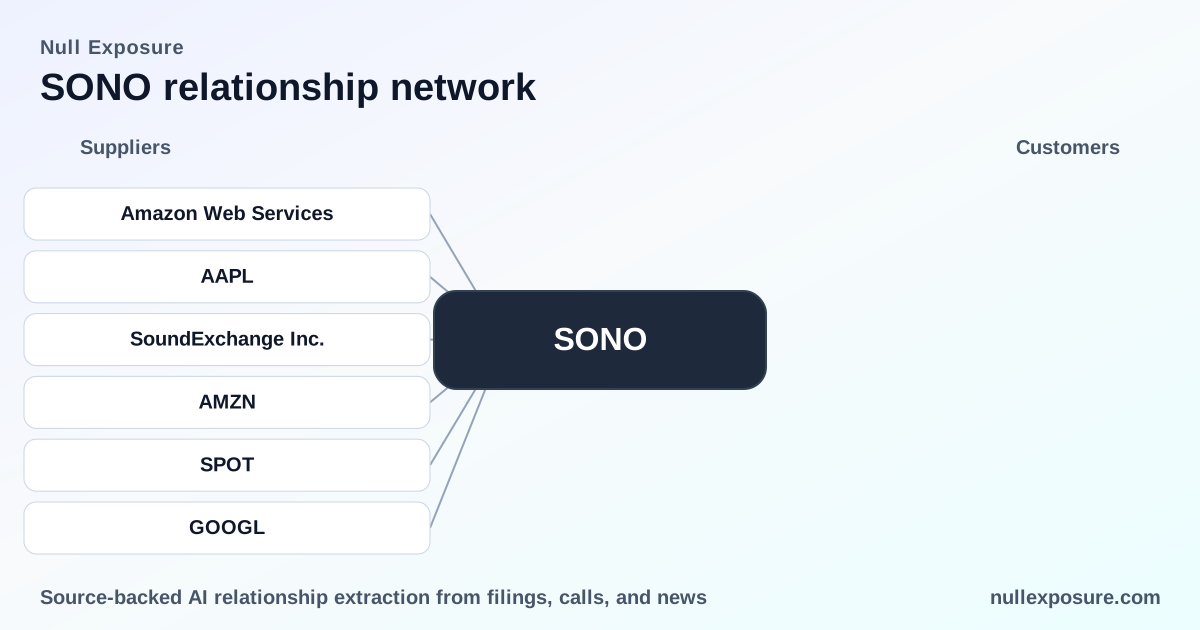
Sonos’ supplier footprint: concentration, cloud dependency, and streaming integrations
Sonos designs and monetizes a premium multi‑room audio ecosystem by selling hardware and software that integrate third‑party streaming services; the company outsources manufacturing and logistics while relying on cloud infrastructure to connect devices to content partners and end users. Revenue comes primarily from device sales augmented by an ecosystem strategy—integrations with streaming platforms and software features that reinforce device demand and user engagement. For investors evaluating supplier risk, the material facts are simple: manufacturing is outsourced at scale, supplier concentration is high, cloud services are central to product functionality, and content partnerships shape product competitiveness.
Learn more about supplier intelligence at https://nullexposure.com/ and how it informs investment diligence.
What the supplier map actually is, in plain English
Sonos’ external footprint breaks down into three practical buckets: cloud and software infrastructure (to run device connectivity and mobile apps), content/service partners (streaming platforms whose integrations drive user experience), and contract manufacturers/logistics (the physical supply chain for devices). Below I walk through every named relationship disclosed in public sources and then synthesize how the company’s supplier constraints shape operational risk.
Amazon Web Services (AWS)
Cloud infrastructure provider for Sonos’ connectivity stack. According to Sonos’ FY2025 Form 10‑K, the company uses Amazon Web Services to maintain the interconnectivity between its mobile app, Sonos servers, and the streaming services customers access through Sonos devices (FY2025 10‑K).
Apple (iOS Live Activities)
Platform-level integration to restore lock‑screen playback controls on iOS. A February 2026 report at 9to5Mac described Sonos’ plan to adopt Apple’s Live Activities feature to deliver lock‑screen playback controls to iOS users, improving parity with native playback experiences (9to5Mac, Feb 24, 2026).
SoundExchange Inc.
Counterparty in a royalty litigation matter currently stayed. Bloomberg Law reported in March 2026 that Sonos persuaded a federal judge to pause SoundExchange’s suit seeking unpaid royalties while SoundExchange appeals a related loss against Sirius XM, creating a temporary legal relief but preserving future litigation risk (Bloomberg Law, Mar 2026).
Amazon Music
Major streaming service integrated into Sonos’ platform. Sonos’ management cited the breadth of streaming partners—including Amazon Music—when discussing ecosystem reach in commentary around fiscal 2025 results (strata‑gee coverage, March 2026).
Apple Music
Core content partner for user experience on Sonos devices. Company commentary reported in March 2026 emphasized that Apple Music is among the large set of streaming services that “thrive on Sonos,” underscoring the importance of these integrations to product value (strata‑gee coverage, March 2026).
Spotify
Primary streaming integration that drives engagement on Sonos hardware. Management highlighted Spotify as a key service in the Sonos ecosystem during fiscal 2025 commentary, reflecting the product-level dependence on broad streaming compatibility (strata‑gee coverage, March 2026).
YouTube Music
Another major streaming integration supporting on‑device content access. Public remarks around Sonos’ FY2025 results listed YouTube Music among the substantial group of streaming partners that support Sonos’ value proposition (strata‑gee coverage, March 2026).
Supply‑chain and contracting characteristics that matter for investors
Sonos’ public filings and disclosures reveal a distinctive operating posture that directly informs supplier risk and bargaining leverage.
- Contracting posture: blanket purchase orders and framework relationships. Sonos confirms it acquires inventory through blanket purchase orders with manufacturers based on projected demand, indicating longer‑duration framework contracts rather than strictly spot buying (FY2025 10‑K).
- Geographic footprint: manufacturing concentrated in APAC; distribution is global. The company outsources production to contract manufacturers in Vietnam, China, and Malaysia while using third‑party warehouses across North America, Australia, Europe, and Asia to distribute finished goods (FY2025 10‑K).
- Concentration and criticality: a single vendor supplied ~53% of finished goods in FY2025. Sonos disclosed that approximately 53% of finished goods purchases in FY2025 came from one vendor, signaling high supplier concentration and elevated supply‑disruption risk (FY2025 10‑K).
- Scale and sunk commitments: materially large open purchase orders and component commitments. As of September 27, 2025, open purchase orders to contract manufacturers were about $173 million, and expected commitments to suppliers for components ranged $131–$149 million, indicating significant short‑term spend exposure (FY2025 10‑K).
- Relationship maturity and consolidation: active exit of a contract manufacturer. During Q3 FY2025 Sonos began exiting a partnership with one contract manufacturer to consolidate supply and improve efficiency; the company expected completion by Q2 FY2026, reflecting a strategic rebalancing of manufacturing relationships (FY2025 10‑K).
- Logistics reliance: small number of providers for delivery. Sonos uses a limited set of third‑party logistics providers for most deliveries, creating a concentrated service‑provider dependency that is operationally critical (FY2025 10‑K).
These elements combine into a coherent business model signal: Sonos operates with outsourced manufacturing and concentrated vendors at scale, uses cloud services for real‑time device/content connectivity, and depends on broad streaming integrations to sustain product value.
Explore supplier risk scoring and relationship detail at https://nullexposure.com/ to support engagement or investment decisions.
How to weigh the tradeoffs: risk versus strategic moat
- Upside: Broad integrations with Spotify, Apple Music, Amazon Music and others strengthen the Sonos product proposition and make device replacement less likely; planned iOS improvements (Live Activities) can reduce friction for iPhone users and improve retention (9to5Mac, Feb 2026; strata‑gee, Mar 2026).
- Downside: High supplier concentration and multi‑hundred‑million-dollar commitments create exposure to single‑vendor disruption and inventory risk; the ongoing legal matter with SoundExchange introduces a contingent cost and reputational consideration despite the current stay (FY2025 10‑K; Bloomberg Law, Mar 2026).
- Operational control levers: The exit of one contract manufacturer during FY2025 signals active supply‑chain management to reduce complexity and potentially reclaim negotiating leverage; however, the short‑term transition window raises execution risk through Q2 FY2026 (FY2025 10‑K).
Bottom line and a short diligence checklist
For investors or operators assessing Sonos supplier relationships, focus diligence on:
- Contract termination and renewal timing with the top vendor that supplied ~53% of finished goods.
- Delivery and payment terms embedded in the $173M open purchase orders and the $131–$149M in component commitments.
- Execution progress for the contract manufacturer consolidation announced in Q3 FY2025.
- AWS service dependence and contingency planning for cloud outages or cost escalations.
- Legal exposure from SoundExchange and related royalty disputes.
If you want a structured supplier risk report or a tailored diligence brief on Sonos’ third‑party exposures, visit https://nullexposure.com/ to request a deeper review.
Key takeaway: Sonos sells hardware powered by cloud connectivity and a broad set of streaming integrations, but its supply chain is outsourced, concentrated, and capital‑intensive, making supplier governance and transition execution the primary operational risks for investors to monitor.