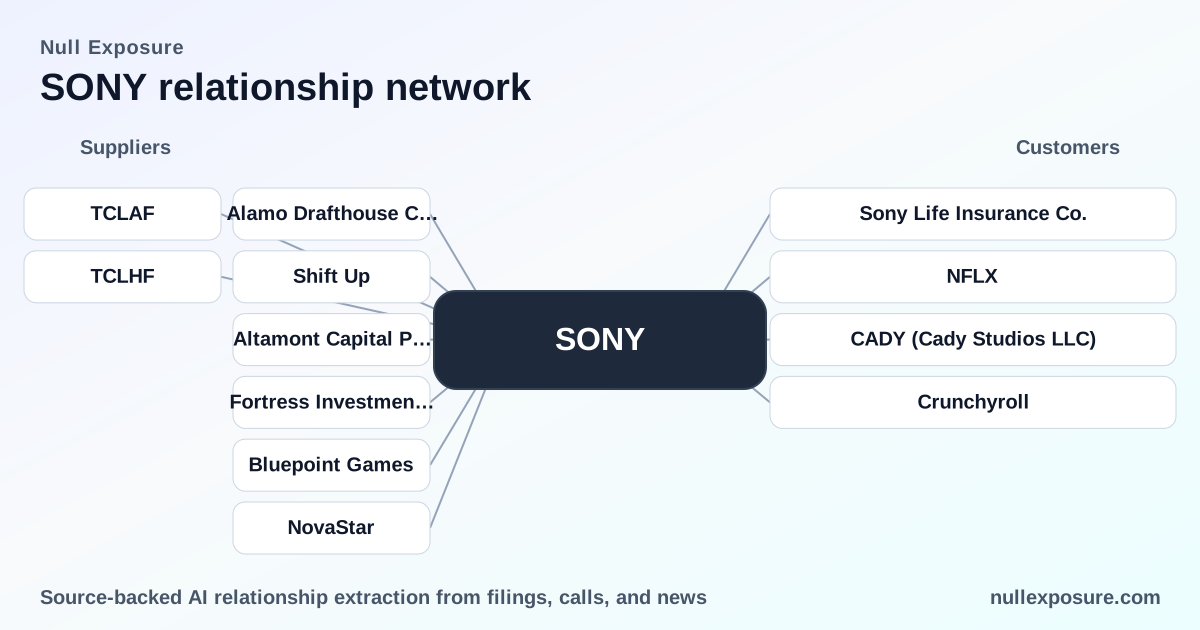
Sony Group (SONY): Supplier and Partner Map — What Investors Need to Know
Sony Group monetizes through a diversified media-and-hardware platform: consumer electronics and PlayStation hardware sales, content creation and licensing across movies, TV and music, and strategic distribution and manufacturing partnerships that control cost and market access. For investors, the critical lens is how Sony blends vertical integration with targeted third‑party relationships to protect margins, scale content, and manage capital intensity across geographies.
Explore deeper supplier and partner signals at https://nullexposure.com/.
Quick take: why these partner moves change the investment equation
Sony’s FY2026 supplier activity shows a purposeful mix of consolidation and selective outsourcing. Acquisitions and studio-level integration strengthen content control and distribution, while joint ventures and third‑party technology arrangements address local manufacturing cost structures and component expertise. That two-pronged posture reduces margin volatility on hardware while amplifying content monetization leverage — but it also concentrates operational exposure in a few strategic relationships and jurisdictions. Key investment levers: content ownership, supply concentration in display tech, and the company’s ability to convert studio assets into recurring revenue.
The full list — every relationship surfaced in FY2026 coverage
Below are plain-English summaries of each relationship mentioned in the FY2026 coverage, with source context for verification.
Alamo Drafthouse Cinema
Sony Pictures Entertainment acquired Alamo Drafthouse, the theatrical exhibitor, to expand direct distribution and premium theatrical experiences. This is an active move to control downstream distribution and theater programming (Celluloid Junkie, June 12, 2024).
Altamont Capital Partners
Altamont Capital Partners sold its stake in Alamo Drafthouse to Sony Pictures Entertainment as part of the acquisition consortium exit, transferring ownership to Sony’s studio arm (Celluloid Junkie, June 12, 2024).
Fortress Investment Group
Fortress Investment Group was one of the sellers in the Alamo Drafthouse deal, indicating Sony’s willingness to purchase assets from private‑equity owners to capture exhibition capability (Celluloid Junkie, June 12, 2024).
Shift Up (Stellar Blade team)
Reports flagged potential independence efforts by studios like Shift Up, which creates franchise and developer risk for PlayStation exclusives and content pipelines; this raises talent and IP continuity questions for Sony’s gaming arm (MarketBeat instant alert, March 5, 2026).
Bluepoint Games
Bluepoint — known for high-profile remakes such as Demon’s Souls and assistance on God of War: Ragnarok — is referenced as a strategic creative partner whose engineering work supports PlayStation product quality and launch cadence (WNHub coverage, 2026).
NovaStar
Sony’s Crystal LED S Series product line lists integration compatibility with NovaStar controllers (MX30, MX40 Pro), reflecting Sony’s reliance on third‑party control electronics for its direct‑view LED displays in mid‑market segments (PR Newswire announcement, 2026).
TCL
Sony and TCL have announced a joint venture leveraging Sony’s brand, image-processing and operational management with TCL’s display technology and vertical supply chain to produce Bravia TVs for the Chinese market, shifting production economics and local market access (InsiderMonkey Q3 FY2026 transcript; Japan Times reporting, January 2026).
TCL Electronics
The partners intend to begin joint‑venture operations in April 2027 to manufacture televisions carrying the Sony/Bravia names using TCL display tech, signaling a durable manufacturing and technology licensing arrangement in Greater China (Japan Times, January 20–21, 2026).
Operating model signals and supplier constraints (company‑level)
There are no explicit supplier constraints filed in the FY2026 summary; however, the relationship map produces clear company‑level signals:
-
Contracting posture: Sony pursues both vertical integration (acquisition of exhibition assets) and selective outsourcing/JV structures (TCL JV, NovaStar integrations). This hybrid approach preserves control over content and branding while optimizing capital allocation for manufacturing and component sourcing.
-
Concentration: The TCL arrangements indicate concentrated reliance on a single display partner for the China TV market, which alters cost structure and exposes Sony to execution and geopolitical risk tied to Chinese manufacturing and supply chains.
-
Criticality: Partnerships with studios and developers (Bluepoint, Shift Up) are critical to PlayStation’s content pipeline; loss or independence of creative partners could have outsized revenue implications for first-party exclusives and console lifecycle sales.
-
Maturity and transition: The Alamo Drafthouse acquisition and publicized JV with TCL are mature strategic moves rather than exploratory pilots — Sony is locking in distribution control and manufacturing scale for multi‑year benefit.
What investors should watch next
Sony’s supplier choices sharpen both upside and downside. On the positive side, owning exhibition channels and formalizing TV production with TCL de‑risks content monetization and local cost control. On the negative side, concentration in display sourcing and the fragility of studio-developer relationships create single‑point risks for hardware margins and exclusive content supply.
Consider these tactical checks when assessing Sony:
- Track execution milestones for the Sony–TCL JV leading into April 2027. Successful scale‑up implies improved TV margin capture.
- Monitor talent and studio contract renewals (Shift Up and similar partners) for signs of franchise volatility or exclusivity erosion.
- Watch sales mix and margin trends in displays and PlayStation content to gauge whether integration and partnerships are converting into predictable cash flow.
For a concise supplier risk dashboard and ongoing monitoring, visit https://nullexposure.com/.
Investment implications and recommended actions
- Bull case: If Sony converts the TCL JV and integrates NovaStar‑compatible components efficiently, expect improved gross margin on TVs and stronger control over Bravia channel economics. Content ownership (studios and exhibition) enables higher monetization per title across windows.
- Bear case: Developer attrition or supply concentration shocks could compress PlayStation software revenue and TV margins, respectively. Regulatory or geopolitical friction around China manufacturing would amplify that downside.
Actionable investor steps: maintain exposure if you prize diversified media/hardware upside and monitor JV execution and developer contract stability closely; hedge or reduce exposure if display concentration or studio independence accelerates.
Close the loop on supplier and partner exposure for Sony at https://nullexposure.com/.
Sony’s FY2026 partner activity is a strategic balancing act — acquiring distribution to capture content value while outsourcing or partnering for manufacturing efficiency. Investors should reward execution on the TCL JV and studio retention while pricing in concentration and talent risks into valuation.