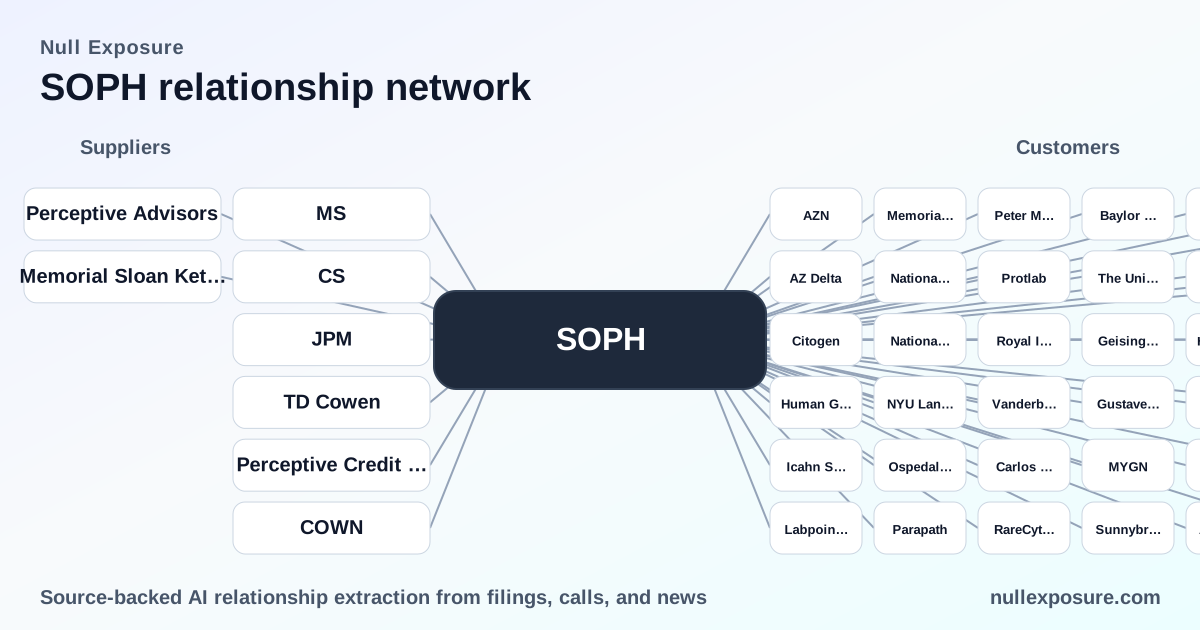
SOPH (Sophia Genetics) — supplier relationships and what they mean for investors
Sophia Genetics operates a data-driven genomic analytics platform sold to hospitals and laboratories to interpret complex genomic and clinical data; it monetizes through platform subscriptions, diagnostic service partnerships and ancillary lab workflows while using capital markets and credit facilities to finance growth. Investors should view SOPH as a technology-enabled healthcare supplier whose near-term valuation is governed as much by commercial adoption as by the durability of its financing relationships.
For a concise supplier intelligence view and ongoing partner tracking, visit https://nullexposure.com/.
Why the partner map matters: financing and clinical credibility drive optionality
Sophia Genetics’ partner footprint splits into two strategic buckets: investment / financing partners that underpin capital access, and clinical partners that validate and distribute the technology into the market. The company used a syndicate of global banks for its public listing, now operates an at-the-market (ATM) equity facility with TD Cowen, and has expanded a term loan commitment with Perceptive to boost liquidity. On the clinical side, Memorial Sloan Kettering (MSK) underpins product credibility through a co-branded ctDNA assay offering.
These relationships reveal an operating posture that blends active capital market engagement with validation by top-tier clinical institutions. The financing relationships are highly material to execution given negative EBITDA and continued investment in product and go-to-market: SOPH reported trailing revenue of roughly $77.3 million with negative operating margins and EBITDA losses. The clinical partnerships support adoption and pricing leverage in oncology — a critical commercial vector for the company.
Detailed partner roll call — every relationship in the record
Below are plain-English summaries for each identified partner, with source context.
J.P. Morgan
J.P. Morgan acted as a joint book-running manager for SOPHiA GENETICS’ initial public offering in 2021, positioning the firm among global banks that supported the listing. According to a GlobeNewswire release announcing the IPO pricing (July 22, 2021), J.P. Morgan was named alongside other lead managers.
Morgan Stanley
Morgan Stanley served as a joint book-running manager on the company’s 2021 IPO, lending distribution and underwriting capacity to the offering. This role is documented in the same GlobeNewswire IPO release from July 2021.
Credit Suisse
Credit Suisse was also a joint book-running manager for the July 2021 IPO, providing underwriting and capital markets support during the listing process. The GlobeNewswire IPO announcement lists Credit Suisse among the managing banks.
Cowen
Cowen participated as a joint book-running manager on SOPHiA GENETICS’ 2021 IPO, contributing to syndicate distribution and sell-side coverage at listing. The GlobeNewswire IPO release (July 2021) identifies Cowen in that capacity.
TD Cowen
TD Cowen is the counterparty for an at-the-market (ATM) equity facility activated in Q4 2025, which gives the company a flexible channel to raise equity into the market when conditions are favorable. The Q4 2025 earnings call transcript, published on InsiderMonkey, records management noting activation of the ATM with TD Cowen.
Perceptive Credit Holdings IV, LP
Perceptive Credit Holdings IV provided an amendment to SOPHiA GENETICS’ credit agreement on January 23, 2026, increasing term loan capacity by $25 million split into two $12.5 million tranches and adding warrant instruments as part of the package. The Globe and Mail press release covering the credit-facility expansion describes the January 2026 amendment.
Perceptive Advisors
Perceptive Advisors is referenced as the broader Perceptive sponsor in disclosures around the January 2026 credit expansion, effectively increasing the company’s available liquidity by $25 million according to management commentary. Management referenced the expansion in the Q4 2025 earnings call transcript (InsiderMonkey) and in related press coverage.
Memorial Sloan Kettering (MSK)
Memorial Sloan Kettering is a clinical partner whose MSK-ACCESS® assay is offered in a decentralized form powered by SOPHiA DDM™; this linkage positions Sophia’s platform within a validated ctDNA test used for oncology profiling. A Seeking Alpha press release and company materials from FY2023 describe MSK-ACCESS® powered with SOPHiA DDM™ as a collaborative deployment.
What these relationships imply about SOPH’s business model and constraints
- Contracting posture: SOPH relies on a mix of capital markets instruments (IPO underwriters, ATM), and structured credit (Perceptive term loans) rather than operating leases or vendor financing; that indicates an active, market-facing financing posture designed to maintain runway while scaling product adoption.
- Concentration: The financing relationships are diversified across multiple institutions (global banks for the IPO, TD Cowen for ATM, Perceptive for debt), which reduces single-counterparty concentration risk for capital access.
- Criticality: Financing partners are critical given the company’s negative EBITDA and ongoing investment needs; clinical partners like MSK are equally critical for product credibility and downstream revenue traction in oncology.
- Maturity: Relationships span multi-year commitments — the IPO syndicate dates to 2021 while Perceptive’s amendment and the TD Cowen ATM are recent (Q4 2025 and Jan 2026), indicating an evolution from public listing toward active liquidity management and structured credit layering.
There are no contractual constraints captured in the supplied relationship constraints — this is a company-level signal that the reviewed sources did not include explicit contractual caveats or restriction excerpts in the feed.
Investment implications: what operators and allocators should focus on
- Liquidity profile is the primary operational lever: the Perceptive term loan expansion and the TD Cowen ATM materially improve near-term flexibility; investors should weigh this against dilution risk from the ATM and warrant issuance tied to the Perceptive facility.
- Clinical validation supports pricing power: the MSK partnership strengthens SOPH’s product moat in oncology and supports commercialization in high-value molecular tests.
- Execution risk remains: negative operating margins and EBITDA losses require ongoing capital access; financing partners are not just conveniences, they are execution enablers.
- Ownership and market signal: institutional ownership is notable (about 47.7%), which aligns with active capital markets engagement and potential liquidity in the stock.
Key takeaways:
- SOPH’s platform-driven revenue model is complemented and amplified by strategic clinical partnerships and active financing.
- Financing relationships are material to growth planning; the presence of multiple capital counterparties reduces single-point failure risk but introduces dilution and covenant trade-offs.
- Clinical endorsements like MSK are value-accretive for product adoption in oncology.
For a vendor-focused intelligence briefing and supplier risk scoring, see https://nullexposure.com/.
Bottom line and next steps for investors and operators
Sophia Genetics combines a SaaS-like clinical analytics franchise with capital market dependence for growth finance. The company’s partner roster — IPO banks, ATM/ECM counterparty TD Cowen, Perceptive credit, and MSK as a clinical collaborator — collectively shape execution risk and commercial optionality. Monitor ATM activity, Perceptive covenant terms and warrant dilution, and adoption metrics tied to the MSK collaboration as the three levers that will most influence the equity case over the next 12–24 months.
To subscribe for ongoing supplier intelligence and deep-dive briefs on SOPH and comparable health-tech suppliers, visit https://nullexposure.com/.