SoundHound AI (SOUN): Supplier Relationships, Operational Constraints, and What Investors Should Price In
SoundHound AI builds a voice-first artificial intelligence platform and sells it to enterprises, OEMs and channel partners that want conversational interfaces in vehicles, TVs, and customer-facing services. The company monetizes through licensing, embedded OEM deals, usage-based platform arrangements and partnership integrations that extend commerce (reservations, payments) into voice experiences. For investors, the combination of rising revenue (Revenue TTM $168.9M) and continued negative operating metrics (EBITDA negative, operating margin heavily negative) frames a growth-at-scale story that is dependent on a small set of high-impact supplier and technology relationships. For more background on supplier exposure and deal flow, visit https://nullexposure.com/.
How SoundHound runs the platform and what that implies
SoundHound’s product strategy blends cloud-hosted voice services with an explicit push into edge and in-vehicle execution. The company discloses a material, long-term commitment to a cloud provider (a minimum $98.0 million commitment over seven years), which signals a deliberate, high-capacity cloud posture for core voice infrastructure. That commitment sits alongside explicit vendor management processes — the company conducts annual reviews of third‑party hosted applications and evaluates cybersecurity risks tied to service providers — which speaks to a formal vendor governance model rather than ad‑hoc sourcing.
Operationally this produces a set of company-level characteristics investors should note:
- Contracting posture: skewed toward multi-year and large-dollar commitments for core cloud infrastructure (evidence of a long-term cloud agreement and operating leases).
- Concentration and criticality: cloud provider exposure is a single, material line-item on future cash requirements and therefore a critical single point of operational risk.
- Maturity and scale: public references to automaker wins and platform integrations show enterprise go‑to‑market traction, but financials still reflect early-scale economics (negative EBITDA, slim operating margins).
- Vendor governance: structured reviews and explicit cybersecurity focus indicate enterprise readiness but also ongoing third-party risk management obligations.
Collectively, these constraints suggest SoundHound is transitioning from product development to scale operations in enterprise and OEM channels — a stage where supplier relationships are both strategic growth enablers and concentrated risk vectors.
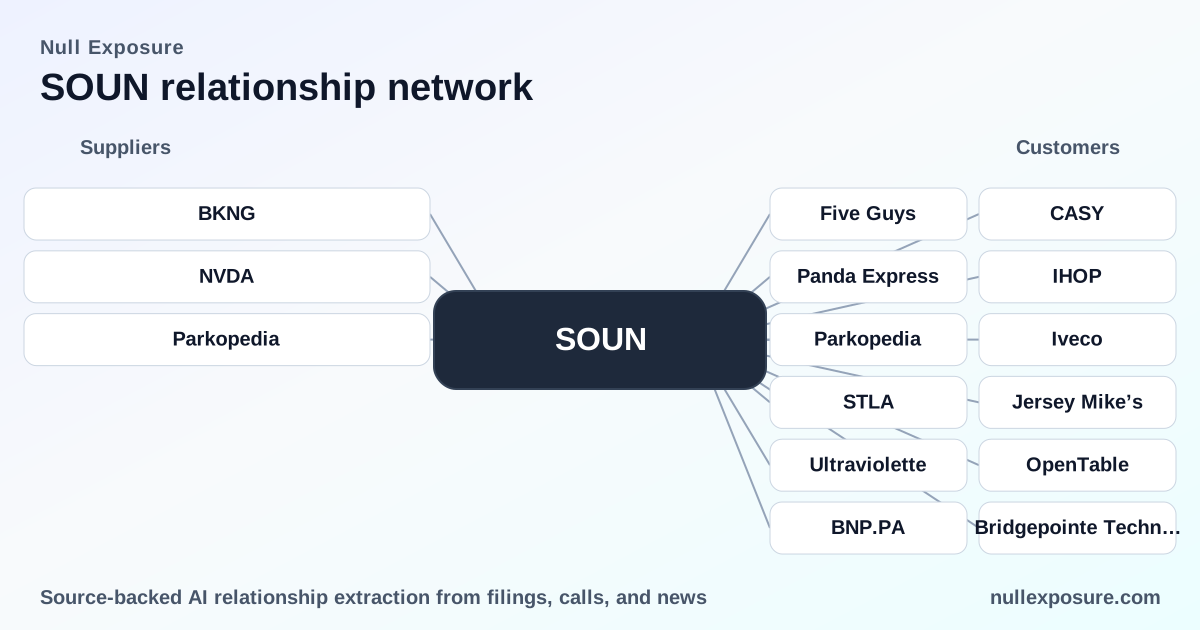
Supplier relationship rundown: OpenTable, NVIDIA, Parkopedia
Below are the supplier and partner relationships surfaced in recent coverage and company commentary. Each is summarized with the source context and timing.
OpenTable — enabling voice-driven restaurant reservations and commerce
SoundHound has integrated OpenTable to power restaurant reservations within its voice commerce features, allowing agents to book tables as part of multi-step voice interactions. A Sahm Capital CES 2026 report and an exclusive company commentary in late‑2025 both cite partnerships with OpenTable as foundational for the company’s consumer commerce ambitions (Sahm Capital, CES 2026 article and Dec 31, 2025 interview).
NVIDIA — edge compute and DRIVE AGX collaboration for in-vehicle AI
SoundHound is showcasing agentic AI running on the edge in collaboration with NVIDIA, demonstrating large‑language-model powered experiences on the NVIDIA DRIVE AGX platform to support multilingual and in-vehicle capabilities. This collaboration was highlighted at CES and is positioned as the vehicle-edge execution pathway for agentic voice commerce (Sahm Capital, CES 2026 coverage, Jan 2026).
Parkopedia — parking payments and location-based commerce
Parkopedia is integrated to power parking payments inside SoundHound’s agentic voice flows, extending the platform’s commerce toolkit to include location and payment interactions tied to parking services. Company commentary and CES coverage reference Parkopedia as a payment partner in the 2026 product showcase (Sahm Capital, CES 2026 and Dec 2025 company interview).
Constraints and their strategic consequences
The documented constraints are company-level signals that shape supplier strategy and risk calculus:
- Long-term contract exposure: The company disclosed a material cloud commitment (minimum $98.0M over seven years) alongside future operating lease obligations. This establishes a fixed-cost base that will influence gross margin leverage as usage scales. The disclosure of cash requirements was presented in the company’s financial schedules for periods after 2025.
- Vendor role and governance: SoundHound treats third-party vendors as critical service providers and conducts annual vendor reviews with a cybersecurity focus — an institutionalized process consistent with enterprise software vendors supporting regulated OEM channels.
- Mid-range spend band: The $98.0M minimum cloud commitment places the company’s cloud spend within a $10M–$100M band over the contract horizon, underscoring materiality without being on the scale of hyperscaler tenancy for large cloud-native giants.
These constraints imply a dual exposure: a fixed-cost commitment to a cloud infrastructure provider that is critical to operations, and a deliberate push to mitigate some cloud dependency through edge/vehicle integrations with partners such as NVIDIA. Investors should model for a fixed base of cloud cost, potential step-ups in usage charges, and operational risk tied to third-party security posture.
Operational risk and upside — what to watch next
Key operational indicators and catalyst events to watch:
- Adoption metrics and OEM rollouts that shift voice processing from cloud to edge (NVIDIA/DRIVE AGX activations). Edge adoption reduces per‑transaction cloud cost but increases integration complexity.
- Monetization of commerce flows (OpenTable, Parkopedia and similar integrations) — proof that voice interactions convert to paid transactions and recurring revenue.
- Cloud spend trajectory versus committed minimums; any renegotiation or acceleration of usage that raises the absolute spend.
- Vendor governance outcomes and third‑party audit disclosures that affect customer confidence in safety- and privacy-sensitive deployments.
Practical risks and opportunities for investors
- Risk: Concentrated cloud commitment creates downside if growth stalls; operating leverage will be impaired by sunk minimums.
- Risk: Integration complexity with OEMs and edge vendors increases implementation timelines and delivery risk.
- Opportunity: Successful edge adoption with NVIDIA and repeated OEM wins could materially reduce variable cloud expense and enable higher gross margins.
- Opportunity: Commercialization of reservation/payment flows with OpenTable and Parkopedia can create recurring, platform-driven commerce revenue.
If you want a deeper read on SoundHound’s supplier exposures or to benchmark supplier concentration against peers, start with a supplier-focused view at https://nullexposure.com/.
Conclusions and investor actions
SoundHound is executing a hybrid cloud/edge strategy that couples material long-term cloud commitments with strategic partnerships (NVIDIA, OpenTable, Parkopedia) to broaden monetization avenues. The core investment thesis hinges on whether enterprise and OEM deployments scale fast enough to absorb the fixed cloud commitments and drive margin improvement. For investors, prioritize tracking OEM rollouts, edge activation milestones with NVIDIA, and early monetization evidence from commerce integrations.
For a vendor-exposure dashboard and supplier risk scoring that maps directly to these relationships, visit https://nullexposure.com/ and review supplier intelligence tailored for investors and operators.