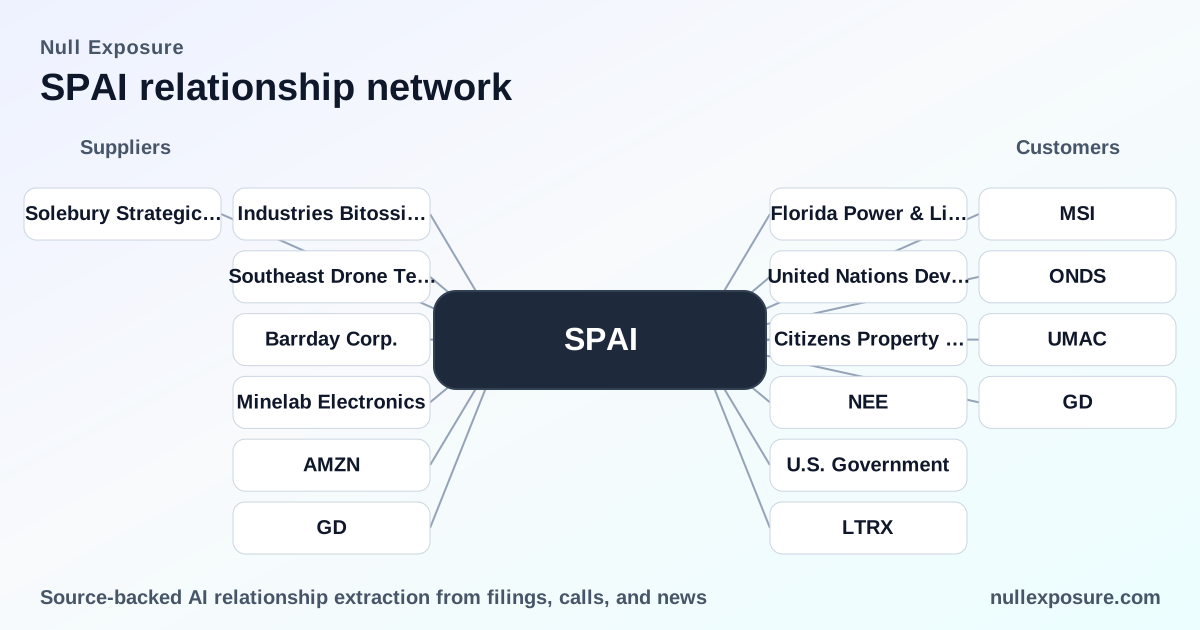
Safe Pro Group (SPAI): supplier map and the investment implications
Safe Pro Group sells ballistic and protective gear while building an AI-enabled platform and drone services that it monetizes through product sales, services and government subcontracts—backed operationally by third‑party hardware suppliers for protective equipment and by cloud and software providers for its Safe Pro AI offering. Revenue today is skewed toward hardware and government contract wins, while the software/cloud play supports scaling and recurring service economics. For investors and operator-partners, the supplier footprint is the single clearest indicator of short-term delivery risk and the levers for margin improvement. Read more on supplier analytics at NullExposure.
Quick take: concentrated suppliers, mixed contract economics
Safe Pro’s procurement profile is highly concentrated. The company discloses that a small group of vendors supplied the majority of inventory and services in FY2024, creating measurable counterparty and supply continuity risk. At the same time, the company classifies many of its applications as SaaS and relies on cloud infrastructure, which introduces recurring subscription-like costs and operational dependency on hyperscalers. These two dynamics—hardware procurement concentration and software/cloud dependency—define the company’s immediate operational vulnerabilities and the path to recurring revenue.
- According to Safe Pro’s 2024 Form 10‑K, two suppliers accounted for 56.8% of inventory and services in the period, and another two suppliers accounted for 35.7% in the same comparative window. The filing explicitly warns that the loss of these suppliers could have a material adverse effect on operations and financial condition.
- The company also states, in the same disclosure set, that all the applications it uses are SaaS offerings, signaling a subscription-like cost profile and the central role of cloud providers in delivering its AI services.
Supplier-by-supplier: what investors should know
Below is a concise, source‑backed description of every supplier relationship cited in public materials.
Barrday Corp.
Barrday is named in Safe Pro’s 2024 Form 10‑K as one of the two suppliers responsible for 56.8% of inventory and services during the year, making it a material supplier whose disruption would be operationally significant. According to the 2024 Form 10‑K, the company flags the potential for material adverse effects if these suppliers are lost.
Industries Bitossi Inc.
Industries Bitossi is the other supplier listed alongside Barrday in the 2024 Form 10‑K that contributes to the 56.8% concentration, and therefore is similarly material to short‑term supply continuity. The 10‑K identifies the concentration explicitly as a company-level risk for FY2024.
Minelab Electronics
Minelab Electronics is disclosed in the 2024 Form 10‑K as one of two suppliers that together accounted for 35.7% of purchases during the reporting period, marking it as a major procurement source for components or finished goods. The filing lists Minelab alongside Southeast Drone Technologies in that contributory bracket.
Southeast Drone Technologies
Southeast Drone Technologies is identified in the 2024 Form 10‑K as a supplier contributing to the 35.7% concentration of inventory and services, indicating its importance to Safe Pro’s drone and service offerings and the company’s supply footprint.
Amazon Web Services (AWS)
Multiple press releases and investor communications in Feb–Mar 2026, including GlobeNewswire, The Globe and Mail and Digital Journal, state that Safe Pro’s platform is built on and powered by Amazon Web Services, with the company citing AWS as the cloud backbone for Safe Pro AI, edge processing and scalable deployments. These communications also reference Safe Pro’s U.S. government subcontract work that leverages AWS infrastructure (press releases Feb–Mar 2026).
General Dynamics Mission Systems
A March 2026 industry article referenced by investor media notes that Safe Pro planned to demonstrate its AI Navigation, Observation & Detection Engine integrated with General Dynamics Mission Systems’ GeoSuite at a U.S. Army event, indicating a technology integration relationship for demonstration and potential fielding (InvestorBrandNetwork / Digital Journal, March 2026).
Solebury Strategic Communications
Solebury is listed as Safe Pro’s investor relations contact in GlobeNewswire press materials (Feb 20–23, 2026), indicating a PR/IR services role rather than a supply-chain function. The company names Ankit Hira, Managing Director at Solebury, as the investor contact in those press releases.
(Each supplier note above is drawn from Safe Pro’s publicly filed 2024 Form 10‑K and subsequent press releases and investor communications published in Feb–Mar 2026.)
What the constraints tell us about the business model
Safe Pro’s disclosure set and press materials reveal several company-level operating characteristics that matter for valuation and partner negotiations:
- Contracting posture — mixed: Hardware and inventory purchases are one‑off or order-based, while the company’s internal software stack runs on SaaS and cloud services that introduce recurring obligations. This mix compresses gross margins on goods-sold but supports higher lifetime value if software-driven services scale.
- Concentration — high: Two supplier pairs accounted for 56.8% and 35.7% of purchases, respectively, in FY2024, an elevated concentration that increases execution risk on production, delivery timelines and pricing leverage.
- Criticality — material: Safe Pro itself discloses that the loss of these suppliers could be material to operations, so supplier continuity is a direct driver of near-term revenue volatility.
- Maturity — transitional: The company is moving from primarily product sales toward a platform offering that leverages cloud (AWS) and edge compute; that transition lowers incremental distribution cost if successful, but heightens dependence on third‑party cloud and integration partners.
These constraints are company-level signals unless explicitly named otherwise in the filings; where the 10‑K names specific suppliers, the materiality characterization applies directly to those firms.
For a deeper supplier risk assessment and counterparty monitoring, visit NullExposure.
Investment implications and recommended actions
Safe Pro’s supplier map creates a clear set of tradeoffs for investors and operators:
- Upside: Government subcontracts and AWS-backed AI capabilities create a path to scale and recurring revenue if the company transitions successfully from hardware sales to service-led contracts.
- Downside: Immediate supply concentration is the most tangible near-term risk—loss or disruption at Barrday, Industries Bitossi, Minelab or Southeast Drone would hit revenue and margins directly. The company’s reliance on SaaS/cloud also creates outsized dependency on hyperscalers for performance and compliance in government deployments.
- Operational actions for management/operators: Prioritize supplier diversification for critical components, negotiate contingency terms with material vendors, and formalize cloud‑service SLAs tied to government contracting requirements.
- Investor actions: Monitor quarterly procurement disclosures and government contract pipelines; re-evaluate exposure if supplier concentration metrics remain unchanged or if AWS dependency becomes a single point of failure for classified/secure deployments.
For tailored due diligence on supplier concentration and third‑party risk, see offerings at NullExposure.
Bottom line
Safe Pro sits at the intersection of defense hardware and AI-enabled services. Its near-term growth story depends on managing supplier concentration while converting pay-as-produced hardware revenue into recurring, cloud-delivered services. The 2024 Form 10‑K and February–March 2026 press activity provide a consistent narrative: material supplier concentration today, growing cloud dependency tomorrow. Investors should treat supplier continuity and cloud-partner integration as principal determinants of valuation over the next 12–24 months.