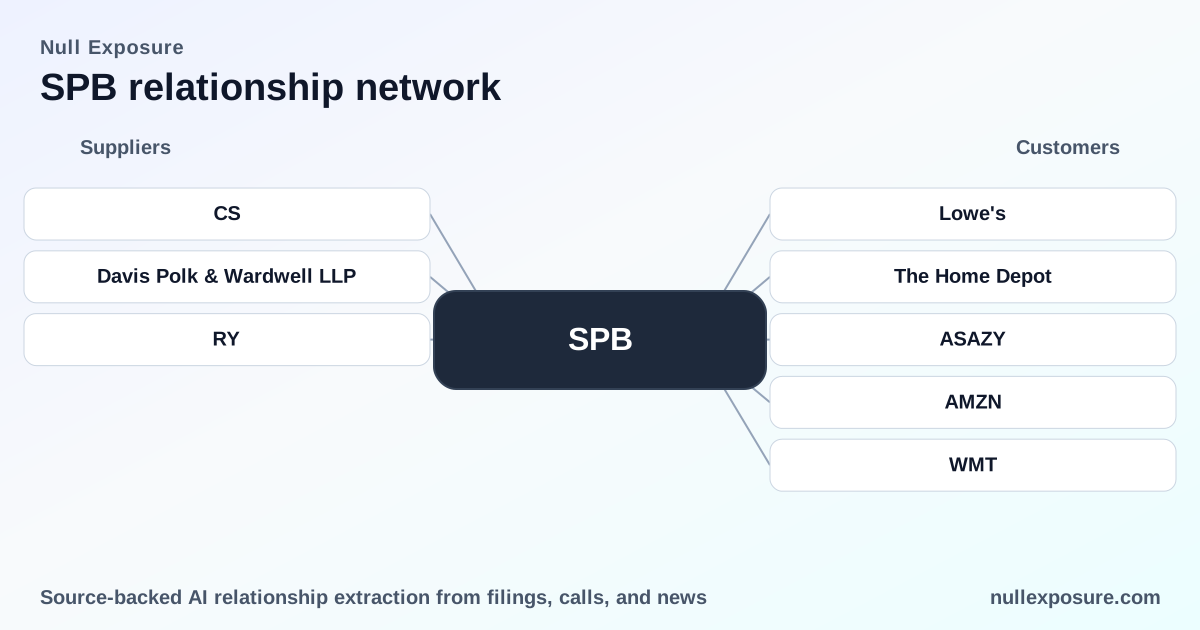
Spectrum Brands (SPB): supplier relationships, deal advisors, and operational constraints investors should price in
Spectrum Brands is a global branded consumer-products company that monetizes through retail sales of household and personal products, trademark licensing, and channel distribution, with much of manufacturing outsourced to third parties in the APAC region. For investors and procurement leads, the key operating levers are brand licensing economics, third-party manufacturing concentration, and the firm's contractual footprints with advisors and service providers that supported material portfolio transactions. Learn more about how we surface supplier signals at https://nullexposure.com/.
Quick investor thesis: how Spectrum makes money and where supplier risk sits
Spectrum earns most revenue by selling branded consumer products and managing brand relationships (including license arrangements that generate royalty-like obligations). The company keeps capital-light manufacturing by sourcing substantially all segment products from third-party suppliers in APAC, and uses third-party logistics and service vendors to operate distribution and cybersecurity programs. This operating model delivers margin leverage through brand and channel management, but concentrates operational risk in a handful of external suppliers and long-dated license commitments.
Who advised Spectrum in the hardware divestiture — and why it matters
A March 2026 report on a sale of Spectrum’s hardware and home-improvement business provides the explicit names of deal advisors and legal counsel used in that process. These relationships are short-term in duration but high-impact for corporate strategy, valuation and eventual supplier alignment with new owners.
- Credit Suisse Securities LLC acted as a financial advisor to Spectrum Brands during the hardware-and-home-improvement transaction process in FY2021, supporting deal marketing and valuation execution; Law Street Media reported on the advisers in a March 10, 2026 article (LawStreetMedia, 2026-03-10: https://lawstreetmedia.com/deals/assa-abloy-set-to-acquire-spectrum-brands-hardware-and-home-improvement-business-for-4-3-billion/).
- Davis Polk & Wardwell LLP served as Spectrum’s legal counsel for the transaction, providing representation on the deal structure and documentation in FY2021, as cited in the same Law Street Media coverage (LawStreetMedia, 2026-03-10: https://lawstreetmedia.com/deals/assa-abloy-set-to-acquire-spectrum-brands-hardware-and-home-improvement-business-for-4-3-billion/).
- RBC Capital Markets, LLC was also retained as a financial advisor alongside Credit Suisse for the FY2021 sale, contributing to the competitive process and buyer engagement cited by Law Street Media (LawStreetMedia, 2026-03-10: https://lawstreetmedia.com/deals/assa-abloy-set-to-acquire-spectrum-brands-hardware-and-home-improvement-business-for-4-3-billion/).
These advisor relationships are transactional but signal Spectrum’s willingness to engage top-tier banks and law firms to monetize non-core businesses, a pattern investors should watch for future portfolio optimization events. For a deeper view of supplier and counterparty relationships, visit https://nullexposure.com/.
Supplier and contracting posture: company-level constraints that shape execution
The documented constraints in Spectrum’s public disclosures describe a deliberate, externally-oriented operating model:
- Long-term licensing posture: The B+D trademark license (with Stanley Black+Decker identified as the license holder in the disclosure) runs through December 31, 2027 with two optional four-year renewal periods contingent on sales metrics, potentially extending to December 31, 2035. This creates multi-year visibility but also embedded royalty commitments and renewal conditions that affect margins and product strategy.
- APAC manufacturing concentration: Substantially all segment products are manufactured by third-party suppliers in the APAC region, exposing Spectrum to transportation cost swings, tariffs, regulatory changes, and currency risk that directly influence COGS and supply-chain resilience.
- Mixed role relationships across the supply base: Company-level signals show Spectrum acts as a licensee (for B+D), licenses trademarks from third parties (licensor relationships), relies on third-party manufacturers, and uses third-party logistics providers for distribution. The firm also engages outside cybersecurity assessors and consultants, indicating reliance on external service providers for critical security operations.
- Distribution and logistics footprint: Spectrum operates a global network using owned and leased properties alongside third-party distribution centers and 3PLs across its ~37-country footprint; this hybrid model supports scale but increases counterparty and operational complexity.
These constraints are company-level structural facts — they define how Spectrum contracts, where concentration risk lives, how critical those partners are to operations, and how mature the relationships are (long-dated license vs. ongoing manufacturing service).
What this means for investors and operators: risk, governance, and commercial levers
Given Spectrum’s profile — market cap roughly $1.73B and trailing revenue of about $2.79B (TTM) — the supplier picture produces clear lines of action:
- Commercial and renewal risk: The B+D license’s multi-year renewals provide stability but create dependency on meeting sales metrics to secure extension windows; procurement and commercial teams should model royalty escalators into long-range forecasts.
- Geographic concentration risk: Heavy APAC manufacturing means shocks in shipping, tariffs or regional regulation can compress margins quickly; investors should look for supplier diversification plans or contingency inventory strategies.
- Operational criticality of service providers: Outsourced cybersecurity and 3PL relationships are operationally critical; governance processes and vendor SLAs are value drivers that protect cash flow and reputational capital.
- Transaction-era advisors influence: The use of prominent financial and legal advisors in FY2021 underscores the company’s capability to execute strategic portfolio moves, which can unlock value but also shift supplier responsibilities when assets change hands.
Practical monitoring checklist for relationship risk
- Track key license expirations and renewal conditions (B+D through 2027 with renewals to 2035).
- Monitor APAC supplier concentration and transportation-cost trends.
- Review vendor governance for cybersecurity providers and 3PLs.
- Watch corporate filings and press on advisor engagements — deal teams (banks and law firms) can presage meaningful asset exits or reorganizations.
If you want a structured supplier-risk brief for SPB, view our supplier intelligence tools at https://nullexposure.com/ to build actionable monitoring and engagement plans.
Final takeaways
Spectrum Brands operates a brand-driven, outsourced-manufacturing model where long-term licenses and APAC supplier concentration are the primary operational constraints. The FY2021 deal roster shows management's ability to deploy top-tier advisors to reshape the portfolio, and the company-level constraint set — licensing commitments, regional manufacturing dependency, and reliance on external service providers — defines where investor attention should concentrate.
For a tailored analysis of SPB counterparty risk or to commission a supplier resilience brief, start at https://nullexposure.com/ — we convert public disclosures into actionable oversight for investors and operators.