Simon Property Group (SPG): Why the $5.0B bank syndicate matters for investors and operators
Simon Property Group is the largest U.S. mall REIT that monetizes a national portfolio of shopping malls, outlets and lifestyle centers by leasing space, extracting ancillary retail revenue, and recycling capital through dispositions and redevelopment. The company finances growth and liquidity through secured and unsecured credit facilities and public debt, and its latest financing activity—a $5.0 billion revolving credit facility—directly affects short‑term funding flexibility and cost of capital for the portfolio. For investors and operating partners, the composition and role of the lending syndicate is an active governance signal about liquidity access and counterparty exposure. Visit the NullExposure homepage for a broader supplier‑risk view: https://nullexposure.com/.
Big picture: what the new credit facility does to SPG's balance sheet
Simon announced an expansion and amendment to its revolving credit structure that increases committed liquidity and refreshes bank underwriting relationships. The $5.0 billion facility, plus amendment to an existing $3.5 billion facility, boosts near‑term liquidity and spreads syndication across a diverse lender group, which reduces single‑bank concentration and gives Simon optionality ahead of capital cycles or redevelopment capital needs. In a capital‑intensive, asset‑heavy business like a mall REIT, bank syndicates are a core operating counterparty, not an incidental supplier.
The named counterparties and their roles
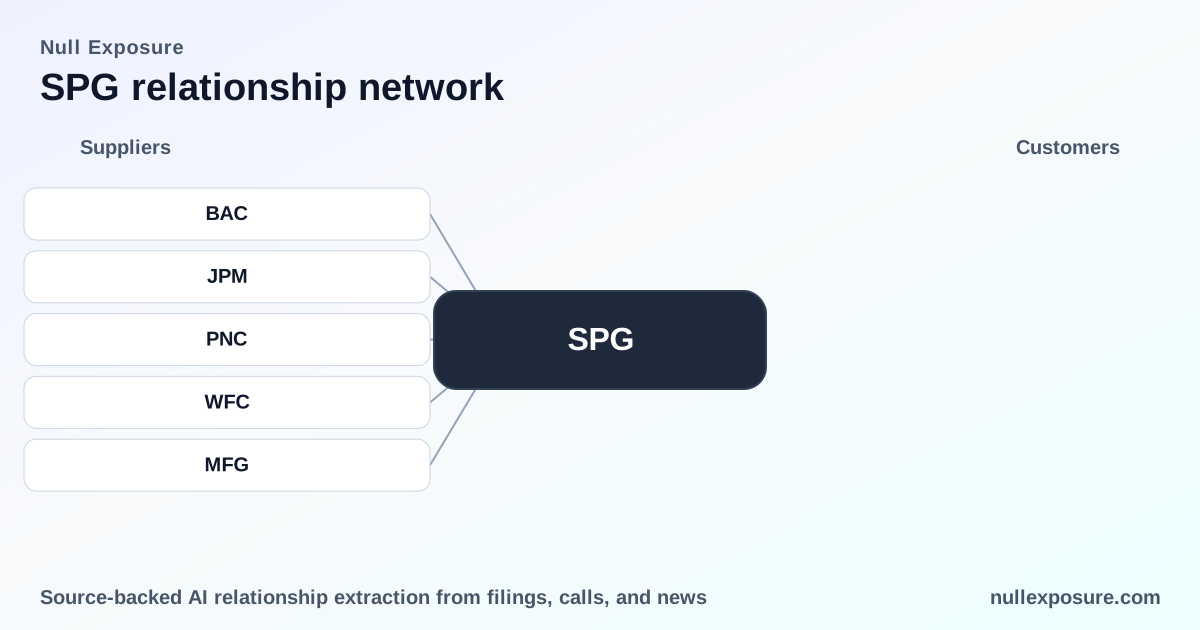
Simon disclosed the lender group and identified the joint lead arrangers and bookrunners in a corporate release dated March 10, 2026. Below are plain‑English summaries of every named relationship in the disclosure with the source cited.
JPMorgan Chase (JPM)
JPMorgan served as one of the Joint Lead Arrangers and Joint Bookrunners for Simon’s syndicated $5.0 billion revolving credit facility, anchoring the deal and coordinating distribution across the lender group. According to the PR Newswire release on March 10, 2026, JPMorgan was one of the five lead institutions on the transaction.
BofA Securities (BAC)
BofA Securities acted as a Joint Lead Arranger and Joint Bookrunner on the facility, providing underwriting capacity and market reach to place commitments with the broader bank group. The company’s March 10, 2026 PR Newswire announcement lists BofA among the lead arrangers.
PNC Capital Markets (PNC)
PNC Capital Markets was named as a Joint Lead Arranger and Joint Bookrunner, contributing structuring and distribution support to the syndicated credit line. The March 10, 2026 PR Newswire release identifies PNC in that role.
Wells Fargo Securities (WFC)
Wells Fargo Securities participated as a Joint Lead Arranger and Joint Bookrunner, reflecting its role in arranging and underwriting the revolving facility. This role is documented in Simon’s PR Newswire release dated March 10, 2026.
Mizuho Bank (MFG)
Mizuho Bank also served as a Joint Lead Arranger and Joint Bookrunner, giving the syndicate global banking reach and signalling participation from an international commercial bank. Simon’s March 10, 2026 announcement includes Mizuho among the lead banks.
(Primary source for all above relationship summaries: Simon Property Group press release distributed via PR Newswire, March 10, 2026: “Simon Announces $5.0 Billion Revolving Credit Facility and Amendment to $3.5 Billion Revolving Credit Facility.”)
What the counterparties tell you about counterparty risk and concentration
The syndicate comprises 28 banks overall, but the transaction is led by a small group of major global and national banks, which is standard market practice to ensure placement and pricing discipline. That structure delivers two investor‑level takeaways: diluted single‑bank concentration risk across many lenders, and greater negotiating leverage for Simon because lead arrangers compete to place commitments. For operators, the lead banks are the primary relationship managers for covenant negotiations and amendment mechanics.
Visit NullExposure to map similar supplier and counterparty footprints across portfolios: https://nullexposure.com/.
Company‑level governance signals and operational constraints
Simon’s corporate disclosures describe a centralized Cybersecurity Incident Response Team (CSIRT) that both supervises internal security personnel and coordinates external cybersecurity service providers. The CSIRT is explicitly responsible for assessing and managing material cybersecurity risks, which is presented in company governance language as a material control function. This is a company‑level signal that yields operational inferences:
- Contracting posture: central governance and supervision of external vendors by a CSIRT indicates contracts and vendor oversight are centrally managed rather than ad hoc at the property level.
- Criticality: labeling cybersecurity risk management as a material function suggests vendor services in that domain are critical to operations and regulatory posture.
- Maturity: explicit CSIRT duties and supervisory language indicate a mature vendor governance program with formal reporting lines.
- Concentration and segmentation: while the CSIRT text does not name specific vendors, the disclosure implies external providers are integrated into incident management workflows and reporting.
(Disclosure context: company governance/risk descriptions covering CSIRT responsibilities; these are presented as company‑level constraints in Simon’s supplier risk profile.)
Financial context investors need to remember
Simon’s scale—market capitalization around $61.5 billion and solid profitability metrics—supports access to a broad syndicate and competitive pricing, but the REIT model is capital‑intensive and interest‑rate sensitive. A refreshed revolving facility reduces near‑term refinancing risk and preserves capacity for redevelopment, yet investors should track covenant mechanics, pricing margins, and any usage conditions that could accelerate liquidity stress under recessionary traffic declines.
Actionable next steps for investors and operating managers
- For investment teams: review covenant language and pricing schedules from the March 10, 2026 credit announcement and confirm how the facility interacts with outstanding secured borrowings. For a centralized supplier‑risk lens, use NullExposure to correlate bank syndicate participation across portfolios: https://nullexposure.com/.
- For operators and asset managers: formalize communication protocols with the company’s finance desk so property redevelopment and capex timelines align with available liquidity and lender consent periods.
Bottom line
Simon’s $5.0 billion revolving credit facility—led by JPMorgan, BofA Securities, PNC Capital Markets, Wells Fargo Securities, and Mizuho Bank—is a clear liquidity and governance signal: the REIT preserves capital flexibility through a broad syndicate while centralizing oversight of critical vendor functions such as cybersecurity. Investors should evaluate the facility’s covenant and pricing terms relative to Simon’s asset recycling plans and operational cash flow resilience; operators should align project timelines to the company’s financing cadence.