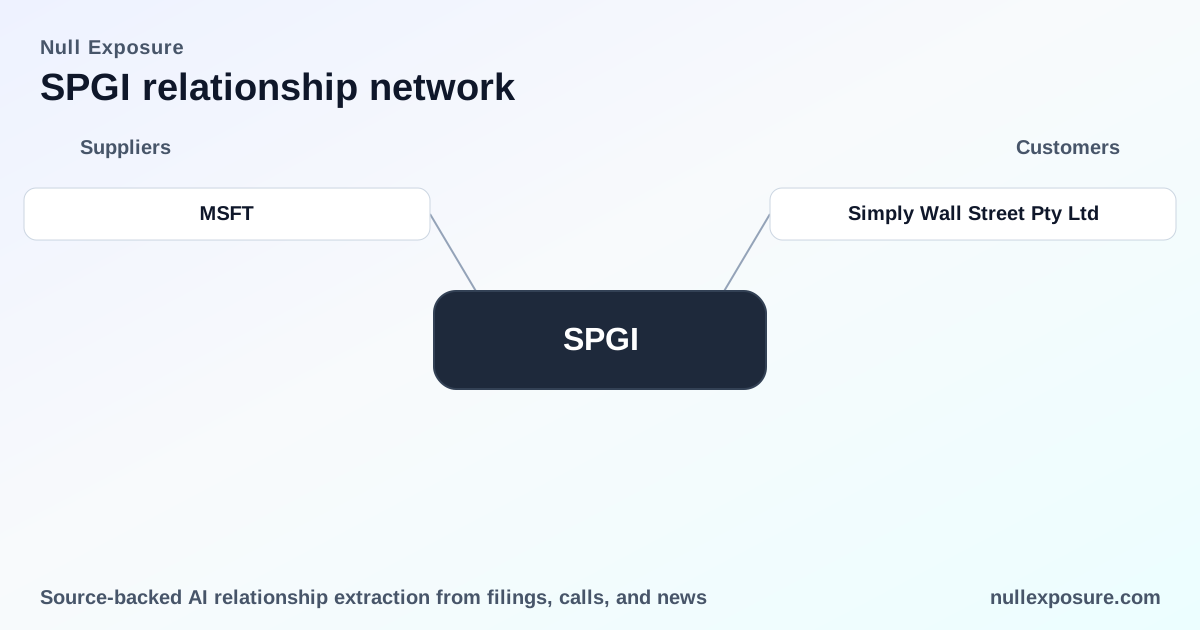
S&P Global (SPGI) — supplier footprint, strategic posture, and what it means for investors
S&P Global operates as a high-margin provider of financial information, analytics, indices and ratings, monetizing primarily through enterprise subscriptions, licensing and professional services to corporations, asset managers and financial institutions. The company’s revenue profile is recurring and platform-driven: large-scale contracts with cloud and technology partners accelerate product delivery, while ongoing data and software relationships supply critical inputs to S&P’s commercial products. Investors should evaluate supplier relationships for concentration risk, contract maturity and the availability of alternatives because those dynamics feed directly into service continuity and margin stability.
If you are benchmarking supplier risk for investment or procurement decisions, start with a clear view of partners and contract types — our portal aggregates these signals. Visit https://nullexposure.com/ to see the full supplier landscape.
How S&P Global uses third parties: a practical view
S&P Global relies on a mix of strategic, long-term technology partners and a broader ecosystem of data and service providers. That mix is an explicit part of the company’s operating model: large strategic bets (cloud providers) accelerate product innovation and scale, while shorter-term data agreements supply content that is essential to many products. S&P’s scale — roughly $15.3B revenue TTM and $129B market capitalization according to the latest public data — magnifies both the benefits and the risks of these supplier relationships.
Supplier relationships in the public record
Microsoft (MSFT)
S&P Global has integrated Microsoft capabilities across divisions, including Document Intelligence in Market Intelligence and energy research integration with Microsoft Copilot, signaling a broad AI and productivity overlay on S&P Global products. This represents technology and go-to-market collaboration aimed at embedding S&P content into Microsoft-enhanced workflows. (Source: tikr blog commentary, March 10, 2026 — https://www.tikr.com/blog/down-12-in-last-12-months-can-sp-global-nyse-stock-give-better-results-in-2026)
This is the full relationship set disclosed in the sourced results; the integration with Microsoft highlights strategic product-level partnerships beyond raw data licensing.
What the disclosed constraints reveal about SPGI’s supplier posture
S&P Global’s disclosures and evidence excerpts provide a layered picture of supplier risk characteristics. Read these as company-level signals unless a constraint directly names a counterparty.
- Long-term strategic commitments exist at scale. According to S&P Global’s Q1 2023 filing, the company entered a multi-year strategic collaboration with Amazon Web Services that included a purchase obligation of roughly $1.0 billion over five years, before credits — a signal of significant committed spend and strategic cloud reliance. (Source: S&P Global Q1 2023 filing)
- Not all agreements are long-term. S&P also discloses that some agreements with data suppliers allow cancellation on short notice, indicating a mix of contract tenors and potential supplier churn. (Source: S&P Global filings)
- Certain external inputs are designated critical. The company states that some third-party sources provide critical content for which suitable alternatives are not readily available; this elevates operational risk if a supplier disrupts service. (Source: S&P Global filings)
- Role as a service consumer is explicit. S&P describes itself as reliant on a set of data, software and service suppliers; the company also identifies AWS as its preferred cloud provider used to accelerate infrastructure and innovation. Where a constraint excerpt names a relationship (AWS), attribute that detail to the partner specifically. (Source: S&P Global filings)
- Big-ticket spend is concentrated. The AWS collaboration excerpt supports a >$100 million spend band signal, demonstrating materiality for select partners. (Source: S&P Global Q1 2023 filing)
Key takeaway: S&P Global’s supplier posture combines strategic, high-commitment cloud partnerships and a flexible pool of content suppliers — a mix that supports rapid product development but creates exposure where data inputs are uniquely critical.
If you want supplier-level detail tied to risk signals and contract tenor, start your analysis at https://nullexposure.com/ for an investor-focused view.
Operational implications: concentration, negotiating leverage and continuity
- Concentration risk: The AWS multi-year commitment shows S&P Global accepts concentrated, high-dollar relationships when the partner delivers scale, reliability and global infrastructure. That concentration is a deliberate trade-off: operational leverage and faster product rollouts in exchange for counterparty concentration.
- Negotiating leverage is asymmetric across partners. For strategic cloud providers with integrated services, S&P Global has less near-term leverage; for smaller data suppliers that can be canceled on short notice, S&P retains more flexibility but must manage content continuity.
- Criticality raises replacement cost and switching risk. Where the company relies on third-party content with few substitutes, a disruption would be expensive and potentially customer-facing, so continuity plans and vendor risk management must be prioritized.
- Contract maturity and predictability: The presence of both long-term purchase obligations and cancelable agreements implies a hybrid contracting posture—financial predictability on the big platform bets, and commercial agility on content sourcing.
S&P’s financial scale (notably ~29x trailing P/E and strong operating margin) underscores why these supplier dynamics matter: even modest disruptions or margin pressure from increased supplier costs can have outsized impacts on valuation multiples.
What investors and procurement teams should watch next
- Monitor quarterly filings for any expansion or renewal of multi-year cloud commitments (AWS or other hyperscalers) since these define long-term fixed-cost trajectories.
- Track disclosures about critical content providers and any reported substitution strategies; evidence of active redundancy planning materially reduces operational risk.
- Watch integration cadence with major technology partners (Microsoft, AWS) because these collaborations convert supplier relationships into customer-facing functionality and potential revenue acceleration.
For a deeper, supplier-centric risk view tailored to investment due diligence, visit https://nullexposure.com/ and see how supply signals map to financial outcomes.
Bottom line
S&P Global runs a deliberate two-track supplier strategy: big, strategic cloud partnerships that drive scale and product expansion paired with shorter-term, renewable content agreements that preserve commercial flexibility. That combination supports growth and margins but requires active management of concentration and critical-content exposures. For investors, the focal questions are whether S&P’s strategic partners sustain reliability and whether management continues to mitigate single-source content risk — answers that will show up in filings and product rollout disclosures. For procurement and ops teams, the priority is ensuring redundancy for critical inputs and negotiating favorable terms on both long-term commitments and cancellable agreements.
Final note: for organized supplier intelligence and signals mapped to investment impact, check https://nullexposure.com/.