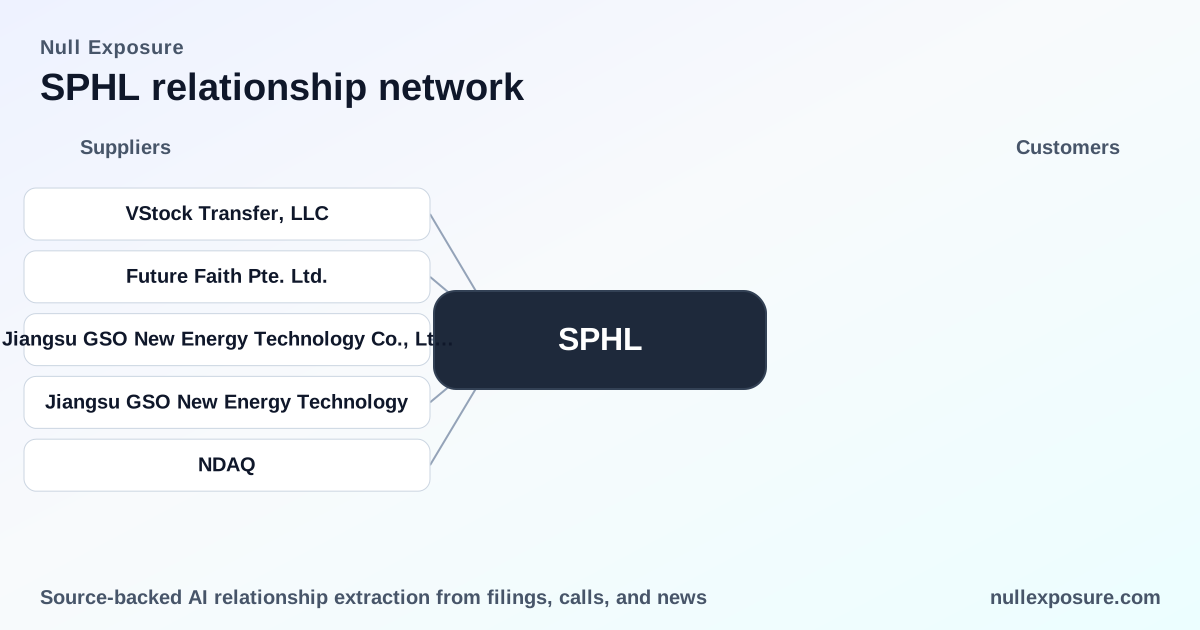
Springview Holdings Ltd (SPHL): supplier relationships and what they mean for investors
Springview Holdings Ltd operates as a Singapore-focused residential and commercial builder and monetizes primarily through project contracting, construction management and an expanding set of asset-light distribution and technology partnerships that extend its service offering without large capex. The company supplements traditional design-and-build revenue with distribution arrangements and memoranda of understanding to sell premium building materials and optional rooftop solar/energy-efficiency packages, while maintaining a Nasdaq-listed microcap balance sheet. For investors, the business model is a hybrid of project revenue and fee-based channel activities that leverage Springview’s local delivery capability rather than inventory ownership. Learn more about Springview coverage at https://nullexposure.com/.
What to know at a glance: positioning, scale, and the deal logic
Springview is a microcap construction operator: revenue of roughly $7.6 million TTM and negative profitability metrics (negative EBITDA and EPS). Insider control is dominant (about 75.7% insider ownership) and institutional ownership is negligible, which concentrates governance and leaves public liquidity thin. The company’s strategic moves in FY2025–FY2026 reflect two clear priorities: (1) expand services offered to homeowners via third‑party partners (timber distribution, solar systems), and (2) preserve a low-capex footprint through asset-light distribution and MOU structures that shift product risk to suppliers.
- Operating posture: asset-light partnerships and MOUs that position Springview as integrator and customer-facing project manager rather than product owner.
- Concentration and governance: high insider ownership and minimal institutional stake create execution control but raise liquidity and governance questions for outside investors.
- Maturity and scale risk: sub-$10M market cap and negative margins imply business is still nascent; supplier tie-ups are strategic growth levers rather than core revenue drivers today.
If you evaluate supplier risk and partner-criticality for portfolio decisions, these are the essential structural signals to track. For deeper company-level intelligence visit https://nullexposure.com/.
Supplier relationships — who they are and why they matter
Future Faith Pte. Ltd.
Springview’s Singapore operating unit signed an exclusive distribution agreement with Future Faith to distribute premium hardwood and sawn timber products in Singapore, structured as an asset‑light arrangement: Springview handles marketing and customer development while Future Faith supplies inventory. This positions Springview to capture higher-margin materials sales without inventory financing; the agreement was announced in FY2026 (coverage on sahmcapital and supplementary mentions on TradingView and crypto-finance outlets). Source: sahmcapital announcement dated January 2026 and TradingView coverage in FY2026 (https://www.sahmcapital.com/news/content/springview-holdings-ltd-announces-exclusive-singapore-distribution-agreement-marking-entry-into-the-building-materials-market-2026-01-05; https://www.tradingview.com/news/invezz:a71817e4b094b:0-this-penny-stock-is-up-over-200-today-should-you-buy-now/).
Jiangsu GSO New Energy Technology Co., Ltd.
Springview confirmed an MOU with China-based Jiangsu GSO to introduce rooftop solar PV and energy-efficiency systems for residential projects in Singapore; GSO provides product, engineering and technical support while Springview manages delivery, regulatory coordination and homeowner engagement. The arrangement is non-exclusive and framed as an add-on to Springview’s construction projects, effectively enabling cross-sell of energy solutions without Springview holding manufacturing exposure; widely reported in January 2026 (Finance.yahoo, Benzinga, Parameter). Source: finance.yahoo press release and multiple media reports in January 2026 (https://finance.yahoo.com/news/springview-holdings-ltd-announces-strategic-120000737.html; https://www.benzinga.com/trading-ideas/movers/26/01/49963910/springview-shares-volatile-after-solar-partnership-announcement).
VStock Transfer, LLC
VStock Transfer serves as the company’s transfer agent and acted as the exchange agent for Springview’s 1-for-8 reverse share split effective December 2, 2025; this is an administrative relationship relevant to corporate actions and securities processing rather than project delivery. The reverse split and agent role were disclosed in the company’s FY2025 press communications. Source: Globenewswire / ManilaTimes coverage of the December 2025 reverse split (https://www.globenewswire.com/news-release/2025/11/26/3195416/0/en/Springview-Announces-1-for-8-Reverse-Share-Split-Effective-December-2-2025.html; https://www.manilatimes.net/2025/11/27/tmt-newswire/globenewswire/springview-announces-1-for-8-reverse-share-split-effective-december-2-2025/2232429).
Nasdaq Capital Market (Nasdaq)
Springview’s Class A ordinary shares continue to trade on the Nasdaq Capital Market under the ticker SPHL and a new post-split CUSIP; the continued listing preserves public market access and trading liquidity following the reverse split disclosed in FY2025. Public listing status impacts investor exit options and the company’s ability to raise capital on U.S. markets. Source: FY2025 Nasdaq listing notice included in the reverse split disclosures (GlobeNewswire / ManilaTimes, November 2025).
Operational implications for investors: risk and upside distilled
Springview is executing a deliberate strategy of selling higher-value service bundles to homeowners (construction + premium materials + solar options) while avoiding large inventory or manufacturing commitments. That lowers capital intensity but increases reliance on third-party suppliers for product quality and supply continuity. Key investor implications:
- Opportunity: asset-light distribution and solar MOUs can expand revenue per project and improve gross margin contribution without requiring large working-capital outlays.
- Risk: concentrated insider control, limited institutional oversight, and microcap scale create execution and governance risk; supplier performance and regulatory approvals for solar projects are single-event drivers for short-term revenue volatility.
- Volatility vector: press-driven stock movement following partnership announcements is already evident; the firm’s financials (negative EBITDA, sub-$10M market cap) mean operational news will continue to move the share price materially.
If you want a focused supplier-risk and partner-criticality briefing tailored for portfolio work, see our company intelligence hub at https://nullexposure.com/.
What to watch next
Track three near-term indicators as linchpins of execution: (1) actual revenue recognition tied to the Future Faith distribution agreement; (2) signed implementation contracts (not just an MOU) with Jiangsu GSO for rooftop solar projects; and (3) any changes to capital structure or additional corporate actions given the reverse split and microcap status. Investors should treat current partnerships as growth options that require execution confirmation to convert into material, recurring revenue.
Conclusion: Springview’s supplier relationships are strategic, non-capital-intensive extensions of its construction business that provide potential margin upside while transferring product risk to partners; they improve service breadth today but do not, on their own, resolve the company’s scale and profitability constraints. For ongoing coverage and supplier relationship intelligence, visit https://nullexposure.com/.