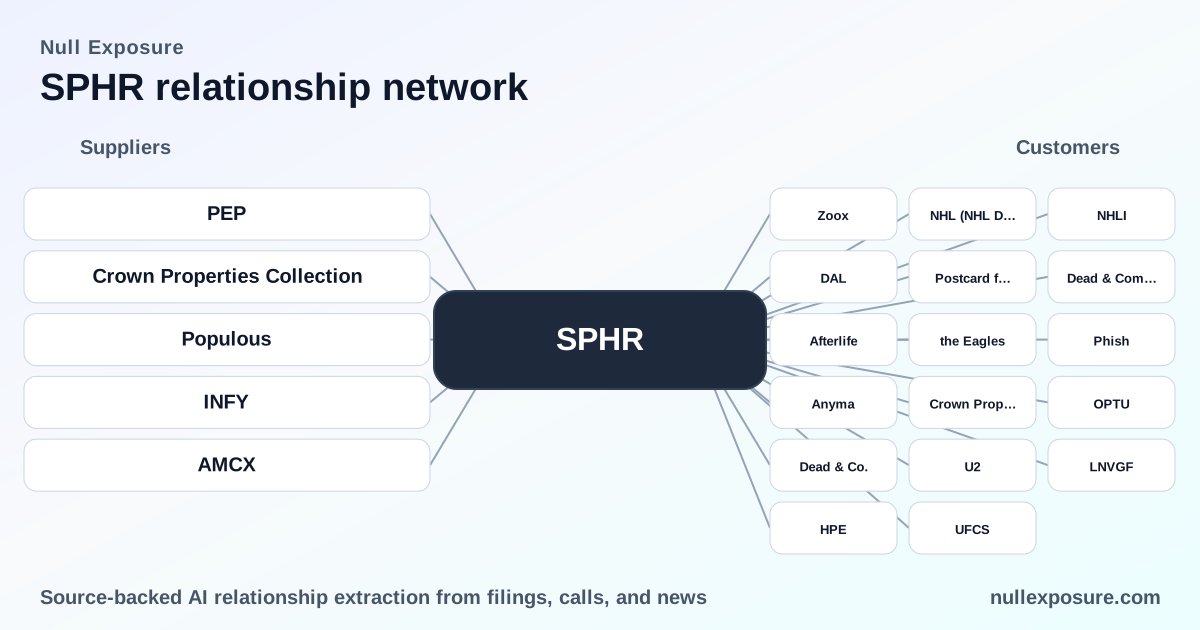
Sphere Entertainment (SPHR): supplier map and what it means for investors
Sphere Entertainment operates and monetizes a concentrated portfolio of large, asset-heavy live-entertainment venues — most notably the Las Vegas Sphere — through ticket sales, premium hospitality, concessions, sponsorships, venue management and media-related services tied to the MSG family of assets. Revenue drivers are venue operations, concessions and strategic commercial partnerships; the company also leverages long-term real-estate commitments and service agreements to lock in operating capacity and brand relationships. For investors evaluating supplier exposure, the mix of strategic brand partners (brands and tech providers), architectural and media vendors, and long-term property agreements defines both revenue upside and operational rigidity.
Explore more supplier intelligence at https://nullexposure.com/.
Why suppliers matter for SPHR investors: concentrated physical scale, high fixed costs
Sphere is a capital-intensive operator: the Las Vegas venue and related MSG assets create high operating leverage and require coordinated supplier ecosystems — concessions partners, technical media vendors, architects and IT integrators. The company reports roughly $1.22 billion in trailing revenue and $182 million in EBITDA, so supplier arrangements directly affect margin capture and guest experience. Public filings describe structural constraints important to underwrite supply risk: for example, the Las Vegas Sphere sits on land leased from Venetian Venue Propco, LLC with a 50-year lease term, signaling a long-term capital commitment and limited short-term flexibility. The firm also receives IT services from MSG Entertainment under a services agreement and contracts with promoters and other third parties to deliver shows and events, which sets a framework-style reliance on internal group services and external promoters (company filings, FY2025).
If you want a full supplier view integrated into investment workflows, see https://nullexposure.com/.
Key supplier relationships and why each matters
Below are the discrete supplier and partner mentions captured in public sources. Each line includes a one- to two-sentence plain-English summary and a source note.
-
PepsiCo — Sphere will exclusively offer an expanded range of PepsiCo Foods brands, including Lay’s, Doritos, Cheetos, SunChips and Funyuns, across its venue concessions; that relationship underwrites concession-level revenue and brand activation opportunities at events (Sphere corporate announcement, March 2026, sphereentertainmentco.com).
-
Crown Properties Collection — As a founding partner alongside Oak View Group and MSG Entertainment, Crown Properties Collection will act as a central manager for global partnership and sponsorship representation across the MSG family (including Sphere), consolidating commercial representation and sponsorship sales across the group (MSG/Sphere press release, FY2023 investor website).
-
Populous — The Las Vegas Sphere’s auditorium design was executed by architect Populous, which is the principal design firm responsible for the venue’s capacity and guest-layout specifications; that architectural relationship is material to venue operating characteristics and event capabilities (industry coverage on the Las Vegas Sphere debut, Leisure Opportunities, FY2023).
-
Infosys — Infosys, together with MSG Entertainment and Madison Square Garden Sports, renewed and expanded a multi-year digital innovation partnership with Sphere; the agreement supports digital systems and innovation across the group, tying IT and digital operations to an external global systems integrator (market press coverage, MarketScreener and investor-call materials, FY2025–FY2026).
-
AMC Networks — Through the MSG Networks segment, Sphere has commercial and technical arrangements with AMC Networks that cover origination, master control and technical services as well as consulting services, supporting the company’s media-distribution and broadcast-related capabilities (Sphere Form 10‑K, FY2025).
What the relationship set tells you about operational posture
The mix of suppliers points to a three-part operating model characteristic:
-
Long-horizon real-estate commitment. The disclosed 50-year ground lease for the Las Vegas site signals very low near-term site flexibility but preserves venue rights and signaling power in a marquee market; that feeds high fixed-cost risk but stable location economics.
-
Integrated group service framework. The company receives IT services from MSG Entertainment under a services agreement, which shows an internal/external hybrid delivery model that concentrates IT responsibility within the MSG family while permitting external partners like Infosys to run strategic digital programs.
-
Outsourced event execution. The company explicitly contracts with promoters and third parties to supply performers and events, which makes promoter relationships a core operating dependency for programming volume and scheduling — an operational lever for revenue but also a risk if promoter capacity or pricing shifts.
These are company-level signals drawn from public disclosures and the supplier facts above, not isolated to any single vendor.
Investment implications: upside, fragility, and risk vectors
-
Upside: brand partnerships and concession deals (for example, the expanded PepsiCo concessions) increase per-attendee monetization and create visible daily revenue levers that scale with attendance. The Crown Properties Collection arrangement centralizes sponsorship sales, which should drive commercial efficiency across the MSG family.
-
Fragility: high fixed costs and long leases amplify downside if venue utilization falls; the 50-year lease commits cash flow to a specific site while limiting relocation or rapid repositioning. Reliance on promoters for content means programming gaps or promoter disputes directly depress revenue.
-
Operational leverage: outsourced technical and media services (AMC Networks) and strategic IT partners (Infosys) improve the company’s ability to scale broadcast and digital initiatives, but they also create single points of technical dependency for home-grown media products and live streaming revenue channels.
Practical takeaways for due diligence
-
Prioritize review of commercial terms for the PepsiCo concessions and Crown Properties sponsorship mandates: exclusivity windows, revenue share, and activation rights determine how much upside flows to Sphere versus partners.
-
Verify the scope and SLA structure of the Infosys partnership and the MSG services agreement to understand the degree of external dependency for critical IT and digital infrastructure.
-
Stress-test occupancy and promoter pipelines against fixed-cost commitments to quantify downside under demand shocks given the long-term lease profile disclosed in filings.
Final view and next step
Sphere’s supplier footprint combines marquee consumer brands, technical media providers and architectural legacy that together enable a premium live-entertainment product. Investors should treat this as a high-operational-leverage business with concentrated supplier dependencies: commercial partnerships amplify revenue when utilization is strong but contractual and fixed-cost structures raise directional downside. For a deeper supplier map and sourcing intelligence tailored to investor workflows, visit https://nullexposure.com/.
Assess supplier contract terms and promoter pipelines as near-term catalysts for margin expansion; if you want a custom supplier-risk brief for SPHR, start at https://nullexposure.com/ and we will tailor the analysis to your investment horizon.