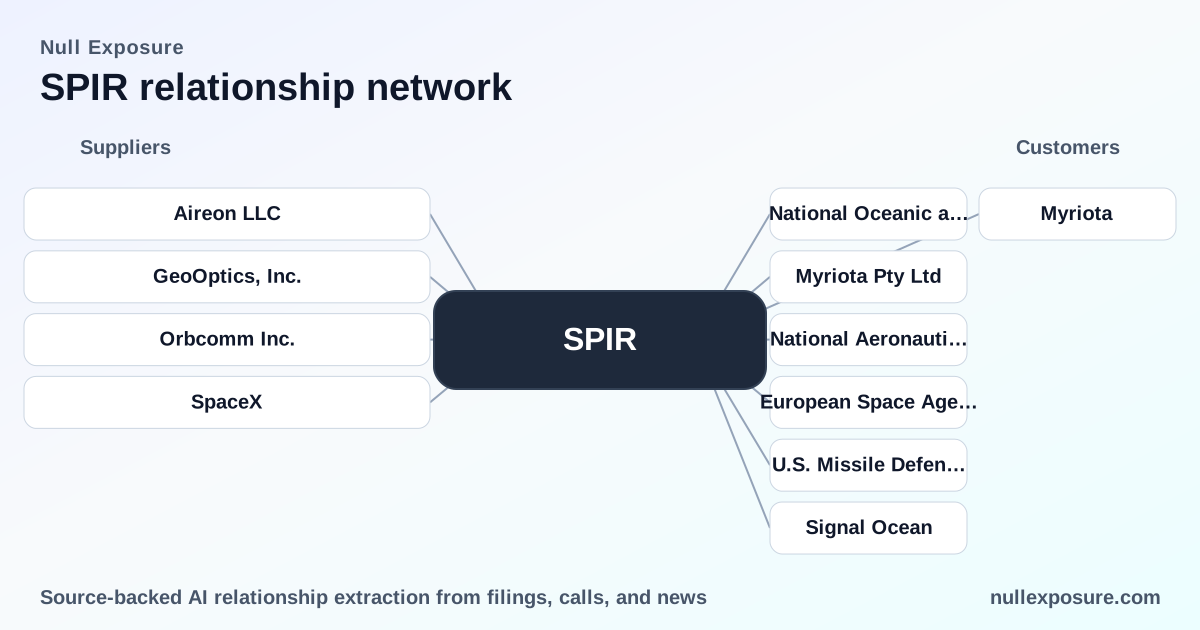
Spire Global (SPIR): Supplier relationships, operating constraints, and what they mean for investors
Spire Global operates a vertically integrated satellite data and analytics business that monetizes through recurring data subscriptions, analytics products across aviation, maritime and weather verticals, and satellite services. The company builds and operates small-satellite constellations, aggregates third-party data where necessary, and sells intelligence products to commercial and government customers. For investors evaluating SPIR as a supplier partner, the critical considerations are Spire’s supplier and competitor mix across data verticals, the company-level financial pressure tied to near-term financing, and its dependence on long-term outsourcing for infrastructure and launches. Learn more or request a tailored supplier-risk briefing at https://nullexposure.com/.
Big-picture financial and operating snapshot investors need to hold in mind
Spire is a small-cap operator with a market capitalization around $353 million and trailing twelve-month revenue of $77.4 million, while reporting negative EBITDA (–$78.6 million) in the latest reported period. Quarterly revenue declined significantly year-over-year, with the 10-K showing quarterly revenue growth YOY of –55.7%, underscoring revenue volatility as the business transitions product mixes. The company outsources a large portion of infrastructure (cloud and launch/telecom support) and relies on third parties for certain data and satellite components; this is integral to how Spire scales but also concentrates operational risk. These dynamics create a profile of high operational leverage, concentrated third‑party dependency, and financing sensitivity that investors and counterparties must price into contracts and supplier negotiations.
How Spire’s supplier and competitor relationships slot into its model
Spire’s Go‑to‑Market rests on three practical elements: its own satellite fleet, outsourced infrastructure and launch services, and selective third‑party data acquisitions that fill gaps in coverage. Contracting posture is mixed — the company holds some long‑term agreements, uses cloud providers for core platform hosting, and pays modest amounts for exclusive data rights where necessary. These traits indicate a business that is operationally mature in concept but commercially fragile given its cash position and revenue shrinkage.
- The 10-K explicitly states that Spire outsources substantially all infrastructure to AWS and that third parties are used for launch and telecom support (company filing, Form 10‑K, FY2024).
- The filing also discloses a long-term amended agreement with L3Harris that contains a fixed monthly fee and runs to 2031, indicating some extended contractual commitments to suppliers (Form 10‑K, FY2024).
- The 10‑K warns of going‑concern risk tied to a Blue Torch financing maturity in June 2026, which makes near-term liquidity central to supplier negotiations and counterparty credit assessment (Form 10‑K, FY2024).
If you need a concise supplier‑risk scoring framework built from these signals, see our resources at https://nullexposure.com/.
What the filings and coverage show about specific relationships
Aireon LLC — aviation data tie
Spire references Aireon LLC in its aviation data vertical, indicating either data collaboration or a competitive/partner relationship to support global flight-tracking services. This mention comes from Spire’s FY2024 Form 10‑K disclosure describing its aviation data vertical (Form 10‑K, FY2024).
GeoOptics, Inc. — radio occultation for weather and climate
GeoOptics is cited in the 10‑K with respect to radio occultation data services used in Spire’s weather and climate offerings, implying that Spire supplements its own sensors with third‑party occultation data to enhance atmospheric models. The reference is drawn directly from the company’s FY2024 10‑K (Form 10‑K, FY2024).
Orbcomm Inc. — maritime vertical competitor
Spire lists Orbcomm Inc. as a primary competitor in the maritime data vertical, signaling direct competitive overlap in vessel tracking, AIS services, or related maritime telematics. This competitive identification is explicit in the FY2024 10‑K (Form 10‑K, FY2024).
SpaceX — launch partner for recent mission
A March 2026 news release reported that Spire launched nine satellites aboard SpaceX’s Twilight mission from Vandenberg, confirming SpaceX’s role as a launch provider for Spire’s constellation replenishment and expansion initiatives (news release via Yahoo Finance, March 10, 2026).
Constraints and what they imply for supplier relationships
The company filing surfaces several constraints that shape Spire’s contracting and operational posture:
- Long-term contracting posture: The 10‑K cites an Amended and Restated L3Harris Agreement with a fixed monthly fee and a contract term through August 7, 2031, indicating Spire accepts multi‑year supplier commitments where strategic (Form 10‑K, FY2024).
- Critical financial sensitivity: The filing identifies substantial doubt about Spire’s ability to continue as a going concern for the next 12 months due to maturing Blue Torch financing and cash needs, creating acute counterparty risk and pressing the need for conservative supplier terms and payment protections (Form 10‑K, FY2024).
- Material third‑party dependence: The company acknowledges reliance on third parties for data, equipment, satellite components, software, and services — a material operational dependency that makes supplier continuity and diversification priorities (Form 10‑K, FY2024).
- Service provider role (outsourcing): Spire explicitly outsources platform infrastructure to AWS and uses third parties for launches and telecom support, framing those suppliers as operationally critical but replaceable with cost and timing penalties (Form 10‑K, FY2024).
- Spend scale signals: Spire’s recognized costs to acquire exclusive satellite data rights were small dollar amounts in FY2024 ($4,952) and FY2023 ($5,059) in cost of revenue, suggesting selective and limited exclusive data spend relative to total operating budget (Form 10‑K, FY2024).
These constraints mean suppliers should negotiate with the assumption of tight liquidity, high criticality for certain outsourced services, and selective long-term commitments.
Investment and operating implications for potential partners
- For investors: Spire’s revenue contraction, negative EBITDA and financing maturity in mid‑2026 make it a high‑risk / high‑optionality situation; upside depends on revenue stabilization and financing resolution. Expect higher volatility in counterparties’ receivables and contract collections.
- For suppliers and operators: Prioritize contractual protection — milestone payments, escrow, or short payment cycles — especially for launch, telecom and critical cloud services. Insurance, performance bonds, and termination-for-cause clauses should be standard given the going‑concern disclosure.
- For procurement teams: Treat Spire as a strategic but financially constrained partner: negotiate flexibility for capacity scaling, but require clarity on payment mechanics and contingency plans for service continuity.
If you want a bespoke counterparty briefing that maps these risk levers into supplier contract language, start a project at https://nullexposure.com/.
Bottom line
Spire’s business model combines proprietary satellites and analytics with strategic third‑party data and outsourced infrastructure; that hybrid model enables rapid coverage but concentrates operational and financing risk. The FY2024 10‑K and recent launch coverage define the universe of critical relationships — Aireon and GeoOptics as data collaborators or suppliers in core verticals, Orbcomm as a named competitor in maritime, and SpaceX as a functioning launch partner — while the filing’s constraints require counterparties to price in liquidity and continuity risk. For investors and supplier managers, the opportunity is clear: participate with disciplined contract terms and active monitoring, capturing upside from Spire’s technology while protecting against near‑term financing and third‑party continuity exposures. Learn how to operationalize these protections at https://nullexposure.com/.