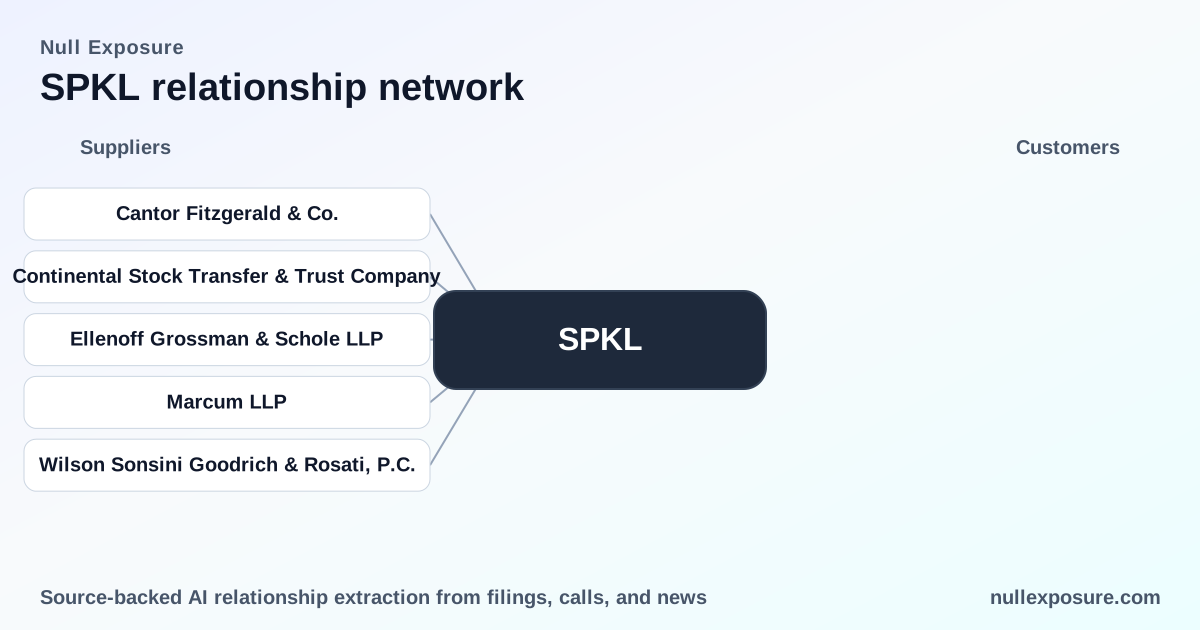
Spark I Acquisition Corp. (SPKL) — supplier map and operating constraints for investors
Spark I Acquisition Corp. (SPKL) is a Nasdaq-listed blank-check company that monetizes principally by raising and holding IPO proceeds in trust while sourcing a business combination; it generates no operating revenue today and its value realization depends on the success and terms of a de‑SPAC transaction or sponsor-driven liquidity events. For investor scrutiny, the relevant suppliers are the underwriting, trust, audit and legal firms that enable transaction execution and regulatory compliance — these firms determine execution risk and cost profile more than recurring sales. Learn more about how counterparty relationships affect capital markets deals at https://nullexposure.com/.
The SPAC operating model in one paragraph investors can use
SPKL is a capital-raising vehicle: it issues units to public investors, places the gross proceeds in a trustee‑maintained trust, and uses external underwriters, auditors and counsel to complete a qualifying business combination. There is no product revenue; cash is primarily held in trust and governed by trustee agreements and underwriting arrangements, so counterparties that administer the trust, certify financials, and structure the offering are critical to value preservation and timing. The sponsor provides working capital and office services under modest, finite contracts that limit near-term cash burn but concentrate administrative functions with a small set of providers.
Why supplier relationships matter for a SPAC
For SPACs, the supplier profile is a proxy for execution capability and regulatory hygiene. A credible underwriter reduces market risk for the IPO and the over‑allotment option; a reliable trustee preserves investor funds and redemption mechanics; top‑tier counsel and auditors reduce the risk of disclosure or accounting issues that would hamper a deal. Conversely, concentrated or immature service relationships increase execution risk and can compress deal optionality.
Who Spark I is working with — a concise roll call
Below I cover every supplier relationship surfaced in recent reporting and what each party delivers.
Cantor Fitzgerald & Co.
Cantor Fitzgerald acted as sole book-running manager for SPKL’s offering, responsible for pricing, distribution and the underwriter over-allotment mechanics. According to SPACInsider reporting on March 10, 2026, Cantor also received the customary 45‑day option to purchase up to 1,500,000 additional units to cover over‑allotments, reinforcing its central role in execution. (Source: SPACInsider, March 10, 2026.)
Continental Stock Transfer & Trust Company
Continental is the trustee that holds the IPO proceeds in the trust account for the benefit of public shareholders, a function that preserves principal and administers redemptions. SPACInsider documents the trust arrangement tied to the $100.5 million placed in the trustee account on October 11, 2023. (Source: SPACInsider, March 10, 2026.)
Wilson Sonsini Goodrich & Rosati, P.C.
Wilson Sonsini served as issuer’s counsel, handling SPKL’s legal disclosure, securities filings and regulatory interactions that enable the IPO and prospective business combinations. The role is documented in the same offering coverage that lists underwriter and trustee appointments. (Source: SPACInsider, March 10, 2026.)
Ellenoff Grossman & Schole LLP
Ellenoff Grossman functioned as underwriter’s counsel, advising the underwriter on transaction documents and the legal framework for distribution. That role was reported alongside other counsel assignments in the SPACInsider article. (Source: SPACInsider, March 10, 2026.)
Marcum LLP
Marcum LLP is SPKL’s auditor, responsible for the financial statements and audit signoffs required for ongoing SEC disclosures and any de‑SPAC diligence. The auditor appointment is cited in the offering coverage that accompanied the IPO announcement. (Source: SPACInsider, March 10, 2026.)
Operating constraints and what they imply for procurement risk
The public disclosures and excerpts provide clear signals about SPKL’s vendor posture and contract footprint:
- Contract tenor is mixed: disclosures reference a $300,000 arrangement for office and administrative services that covers up to 36 months, described in language consistent with both short‑term and extended terms; the firm amended an agreement on January 1, 2023, to extend a 36‑month term without fee change. This indicates a disciplined, pre‑defined cost commitment for back‑office support rather than open-ended outsourcing obligations.
- Spend is modest and concentrated: the office/services arrangement sits in the $100k–$1m band, suggesting vendors are important for operations but not a material ongoing cash drain compared to the trust principal.
- Geographic footprint includes APAC: SPKL maintains a sublease or lease in Seoul, Korea, which introduces cross-border administrative complexity and potential governance requirements for localized vendors.
- Role concentration is high: the trustee and lead underwriter are absolutely critical — the trustee safeguards public funds and the underwriter structures market distribution and the over‑allotment option; both are single points of failure for transaction timing and investor protections. The filings explicitly name Continental as trustee and Cantor as representative of the underwriters, reinforcing their strategic importance.
- Service orientation and maturity: relationships are transactional and services‑oriented (audit, legal, trustee, underwriting) rather than R&D or manufacturing partnerships; this implies low technology risk but high compliance dependence.
These constraints indicate an operational posture optimized for a short lifecycle focused on capital preservation and deal execution, with moderate vendor concentration risk and limited recurring spend.
Explore how supplier concentration affects risk-adjusted returns on SPACs: https://nullexposure.com/.
Investment implications — the pragmatic checklist
- Capital preservation is primary: with cash in a trustee account, the upside depends on deal economics, not operating growth.
- Counterparty risk is execution risk: trustee, underwriter, auditor and counsel determine whether a deal closes cleanly and on time; any disruption can materially affect shareholder value.
- Low operational burn limits downside from vendor obligations, but sponsorship concentration and APAC sublease exposure create governance and jurisdictional complexity.
- Institutional ownership (~44%) and low float are supportive of secondary liquidity dynamics but do not substitute for de‑SPAC execution.
Use this checklist to weight counterparties when modeling downside scenarios.
Final recommendation and next steps
For investors and operators evaluating SPKL supplier relationships, the priority is to monitor the trustee's administration of redemption mechanics, underwriter commitment and over‑allotment exercise, and auditor/counsel readiness for de‑SPAC diligence. These relationships are the gating factors for value realization. For a concise supplier-risk scorecard and deeper counterparty analysis, visit https://nullexposure.com/ to see how these relationships map to deal execution risk.
In summary: SPKL is a capital vehicle where suppliers determine the probability of value capture, not revenue growth — treat trustee and underwriter concentration as core inputs to any investment decision and track legal/audit readiness ahead of any announced business combination.