Sound Point Meridian Capital (SPME): Supplier risk and what investors should price
Sound Point Meridian Capital, Inc. is a closed-end, externally managed investment company that monetizes for shareholders through net investment income and realized gains, while outsourcing portfolio management and day-to-day operations to an external adviser that is paid fees for services. Investors should value SPME as a yield vehicle whose economic performance and operational continuity depend materially on a single external manager relationship and the governance of that outsourcing contract. For a focused supplier-risk review and tailored counterparty intelligence, visit https://nullexposure.com/.
Thesis: how SPME operates and where value comes from
SPME operates as a traditional closed-end fund: it holds a portfolio that produces interest/dividends and capital gains, distributes income to shareholders, and reports book value per share. The company is externally managed and advised, which concentrates execution risk and fee economics off the balance sheet. Recent data show trailing twelve‑month revenue of approximately $96.2 million, a book value per share of $14.02, and a reported dividend per share of $3.296 (dividend yield ~13% on the quoted figures and dates), all of which underscore the fund’s role as an income product dependent on active management and distribution policy (latest quarter 2024-09-30).
For a complete supplier-risk profile and benchmarking of SPME’s adviser relationships, engage with our platform at https://nullexposure.com/.
Why the external manager matters to investors
The external manager is not a peripheral vendor — it is the operational and investment engine. That relationship shapes:
- Fee economics: Management and advisory fees reduce net investment return to shareholders and create direct incentives for the adviser’s behavior.
- Operational continuity: Outsourced custody, trading, and portfolio construction mean a single counterparty failure or strategic withdrawal would be immediately material.
- Governance leverage: Board oversight and the terms of the advisory agreement determine termination costs, notice periods, and replacement options.
These are not academic points: the market value of closed-end vehicles like SPME is sensitive to confidence in the manager and the enforceability of governance safeguards. Investors should treat the adviser as the company’s most consequential supplier when modeling downside scenarios.
Counterparty roster: the single supplier you must evaluate
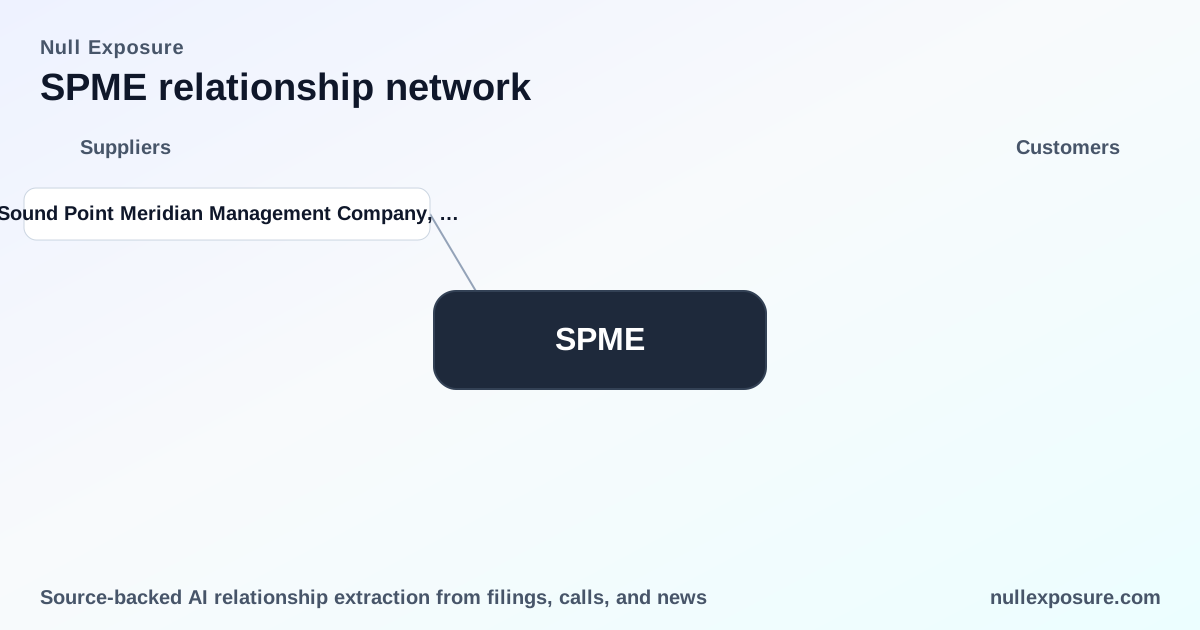
Sound Point Meridian Management Company, LLC is the external manager and adviser to SPME. According to a market notice published on March 10, 2026, the company is externally managed and advised by Sound Point Meridian Management Company, LLC, a Delaware limited liability company (news item published on Yahoo Finance, March 10, 2026: https://finance.yahoo.com/news/sound-point-meridian-capital-inc-120000454.html). This is the only supplier relationship called out in the public results set provided for supplier analysis.
What the numbers say about resilience and exposure
SPME’s published operating figures show it is a modestly sized, income-focused closed-end vehicle: $96.2M of revenue (TTM) and a book value of $14.02 per share, with a substantial per-share dividend. Those figures imply a strategy calibrated to distribute income rather than to accumulate capital internally, which increases reliance on the adviser to keep portfolio yields and leverage in line with distribution policy. The company’s profit margin and operating margin indicators reflect an asset-management style business where operating decisions and leverage levels will drive performance volatility for shareholders.
Operating-model constraints and business-model signals investors should price
The supplier data set does not include specific contractual excerpts beyond the external-management designation, but company-level signals are clear and actionable:
- Contracting posture — outsourced core functions. SPME’s structure places investment discretion, execution, and many operational responsibilities with the external adviser rather than in-house capacity. This creates a principal-agent dynamic investors must monitor.
- Concentration — single-manager dependency. With one named adviser, SPME carries single‑point supplier risk; replacing the manager would be operationally complex and potentially expensive.
- Criticality — adviser is high-impact. Investment performance, distribution sustainability, and regulatory compliance are all strongly tied to the adviser’s competence and systems.
- Maturity — established fund structure, but governance is decisive. The closed-end format is well-understood; the differentiator for investors is the robustness of the adviser agreement and board oversight rather than novelty of the product.
These company-level signals justify a focused diligence checklist on the advisory contract, fee schedules, and termination provisions before underwriting downside scenarios.
Due diligence checklist investors should execute
When evaluating SPME as a counterparty-exposed investment, prioritize:
- Review of the advisory agreement: termination clauses, notice periods, fee variability, and indemnities.
- Analysis of fee alignment: incentive fee structures, revenue share, and potential conflicts with affiliated entities.
- Confirmation of business continuity: backup service providers, disaster recovery, and connectivity for trading and custody.
- Governance review: board independence, frequency of committee oversight, and historical responsiveness to underperformance.
Completing these steps reduces model risk and provides a clear line of sight into how supplier dynamics will influence NAV volatility and distribution sustainability.
For institutional supplier diligence and comparative supplier scoring on asset managers, view our research products at https://nullexposure.com/.
Conclusion and action for investors
Sound Point Meridian Management Company, LLC is the singular supplier risk for SPME and therefore the most material factor for valuation and downside planning. Investors should treat SPME’s external-management structure as a levered operational exposure: strong historical yield numbers are encouraging, but they rest on the continuation and performance of one external adviser under contract terms that will determine the cost and speed of any management transition.
Your next step is targeted legal and operational review of the advisory agreement and a board‑governance assessment. For an investor-grade supplier-risk report and ongoing monitoring tailored to closed-end funds, start at https://nullexposure.com/.