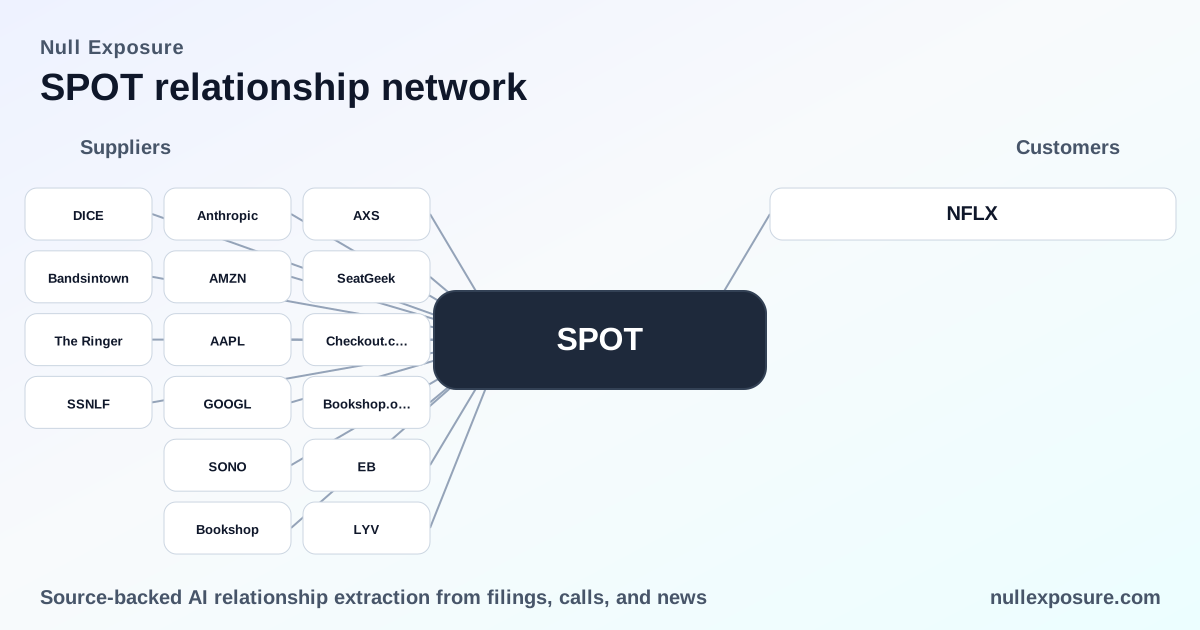
Spotify supplier map: what investors need to know about SPOT’s partner ecosystem
Thesis: Spotify operates a two-sided audio and content platform that monetizes through subscription revenue, advertising, and expanding commerce and payments flows inside its app; supplier relationships extend beyond content licensing to payments, ticketing, device integration and commerce, each relationship shaping margin expansion and product defensibility. For investors, the supplier book highlights revenue diversification opportunities (ticketing, commerce, payments) and operational dependencies (payments acquiring, device OEMs) that materially influence margin stability and execution risk. Learn more on the NullExposure homepage: https://nullexposure.com/
How Spotify runs its supplier strategy and why it matters to returns
Spotify’s operating model binds three business vectors: recurring subscribers, ad monetization, and in‑app commerce. The company outsources specialized functions—payments acquiring, ticketing fulfillment, physical goods fulfillment, and device/platform integrations—so Spotify focuses capital on product, personalization, and content economics. That posture produces three measurable characteristics for investors:
- Contracting posture: Spotify favors partner integration over ownership for adjacent commerce (ticketing, physical goods) to accelerate feature rollouts and limit capex.
- Concentration: Payments and device integrations are strategically concentrated; a global payments partner reduces fragmentation but increases counterparty risk if the relationship is large.
- Criticality: Payments and device OEM relationships are high‑criticality for revenue capture and experience continuity; ticketing and commerce partners are strategically important for ARPU upside.
- Maturity: Device and platform integrations (Apple, Google, Samsung, Amazon, Sonos) are mature and long‑running; newer commerce and payments arrangements (Checkout.com, SeatGeek, Bookshop.org) are expansionary.
For a deeper view of supplier exposure across sectors and counterparties, visit https://nullexposure.com/
Supplier roster and concise takeaways
Below I cover every supplier relationship flagged in recent reporting. Each entry includes a one- to two‑sentence plain‑English description and the source context.
Ticketing ecosystem: AXS, SeatGeek, Eventbrite, Ticketmaster, DICE, Bandsintown
- AXS — Spotify lists AXS among more than 45 ticketing partners used to surface and sell live event tickets inside the app; this expands commerce revenue without building a ticketing stack internally. Source: MLQ.ai coverage of Spotify’s in‑app ticketing launch (March 10, 2026).
- SeatGeek — Spotify integrated SeatGeek’s ticketing platform directly into its app, enabling discovery and purchase of official concert tickets without leaving Spotify, increasing conversion and user engagement. Source: MLQ.ai reporting on the SeatGeek integration (March 10, 2026).
- Eventbrite — Eventbrite appears on Spotify’s partner roster alongside other ticketing platforms, reflecting a multi‑partner, non‑exclusive approach to live event commerce. Source: MLQ.ai reporting on Spotify’s ticketing partnerships (March 10, 2026).
- Ticketmaster — Ticketmaster is listed among the ticketing companies Spotify works with, providing access to large venue inventories and mainstream artist events. Source: MLQ.ai reporting (March 10, 2026).
- DICE — DICE is named as a partner in Spotify’s ticketing rollout, reinforcing Spotify’s strategy of aggregating multiple ticket vendors to broaden supply. Source: MLQ.ai reporting (March 10, 2026).
- Bandsintown — Bandsintown is included in the partner list used to surface live shows and drive ticket purchases within Spotify’s experience. Source: MLQ.ai reporting (March 10, 2026).
Payments and merchant acquiring: Checkout.com
- Checkout.com — Checkout.com announced an expanded deal to provide card acquiring for Spotify across more than 180 countries, centralizing Spotify’s global payments processing and reducing regional complexity in subscription and commerce flows. Source: Checkout.com partnership coverage in TS2.tech and follow‑on mentions across Finviz news outlets (March 2026).
Commerce and physical goods: Bookshop.org / Bookshop
- Bookshop.org / Bookshop — Spotify is adding an option for users to buy physical books through the app with fulfillment managed by Bookshop.org, extending Spotify’s commerce experimentation into books and audiobooks. Source: TS2.tech and Spotify earnings transcript references (March 2026 and Q4 2025 transcript).
Devices and platform partners: Apple, Google, Amazon, Samsung, Sonos
- Apple — Apple remains a platform and device partner referenced in Spotify’s Q4 2025 earnings discussion, representing a critical distribution and compatibility relationship across iOS and Apple hardware. Source: Q4 2025 earnings call transcript as covered by InsiderMonkey (Q4 2025).
- Google — Google is cited alongside other major platforms as a device and OS partner, indicating continued Android distribution and integration relevance. Source: InsiderMonkey transcript coverage (Q4 2025).
- Amazon — Amazon is noted in the company’s platform roll call, reflecting Alexa and Fire device reach for Spotify’s streaming and voice experiences. Source: InsiderMonkey transcript (Q4 2025).
- Samsung — Samsung is listed as a device partner, relevant for preloads, embedded apps, and reach in high‑volume OEM channels. Source: InsiderMonkey transcript (Q4 2025).
- Sonos — Sonos is referenced as a key smart‑speaker partner, important for home audio and high‑engagement listening sessions. Source: InsiderMonkey transcript (Q4 2025).
AI/tooling and media relationships: Anthropic, The Ringer
- Anthropic — Reporting references a tool called “Honk” working with Anthropic’s Claude Code, signaling Spotify’s experimentation with third‑party AI tooling for product or content workflows. Source: TS2.tech article summarizing related tooling references (March 2026).
- The Ringer — The Ringer, a media brand inside Spotify’s content portfolio, is cited in earnings commentary around podcast awards and content recognition, underscoring content‑brand value inside the ecosystem. Source: InsiderMonkey transcript covering Q4 2025 call highlights (Q4 2025).
Strategic implications for investors
- Revenue diversification: Ticketing partners and in‑app commerce introduce non‑subscription monetization channels that scale with engagement without heavy capex. The SeatGeek/AXS/Eventbrite mix increases supply and reduces single‑vendor constraints on ticket inventory.
- Operational dependency: Centralizing acquiring with Checkout.com simplifies global payments but concentrates a critical operational function; that supplier becomes a counterparty risk to monitor closely in commercial filings and operational disclosures.
- Distribution moat: Long‑standing device and platform relationships with Apple, Google, Amazon, Samsung and Sonos preserve reach and listening continuity; those agreements underpin ad and subscription revenue durability.
- Execution focus: Commerce experiments such as Bookshop.org and AI tooling partnerships broaden product offerings but require execution discipline to convert engagement into sustainable ARPU uplift.
For a supplier‑level risk dashboard and prioritized monitoring of counterparties, visit https://nullexposure.com/ to see how these relationships map to operational risk and value creation.
Final takeaways and near‑term watchlist
Spotify’s supplier footprint shows a deliberate trade: outsourced specialization for scale and speed, balanced against concentration in payments and dependence on major device platforms. Investors should watch the Checkout.com rollout for payment stability and fee impacts, track SeatGeek/AXS conversion metrics for commerce ARPU upside, and monitor device/OS negotiations for any distribution friction. For ongoing supplier intelligence and impact analysis on SPOT, return to the NullExposure homepage: https://nullexposure.com/
Bold takeaway: Spotify is pushing beyond streaming into commerce and payments—these supplier relationships are now core drivers of margin expansion and execution risk.