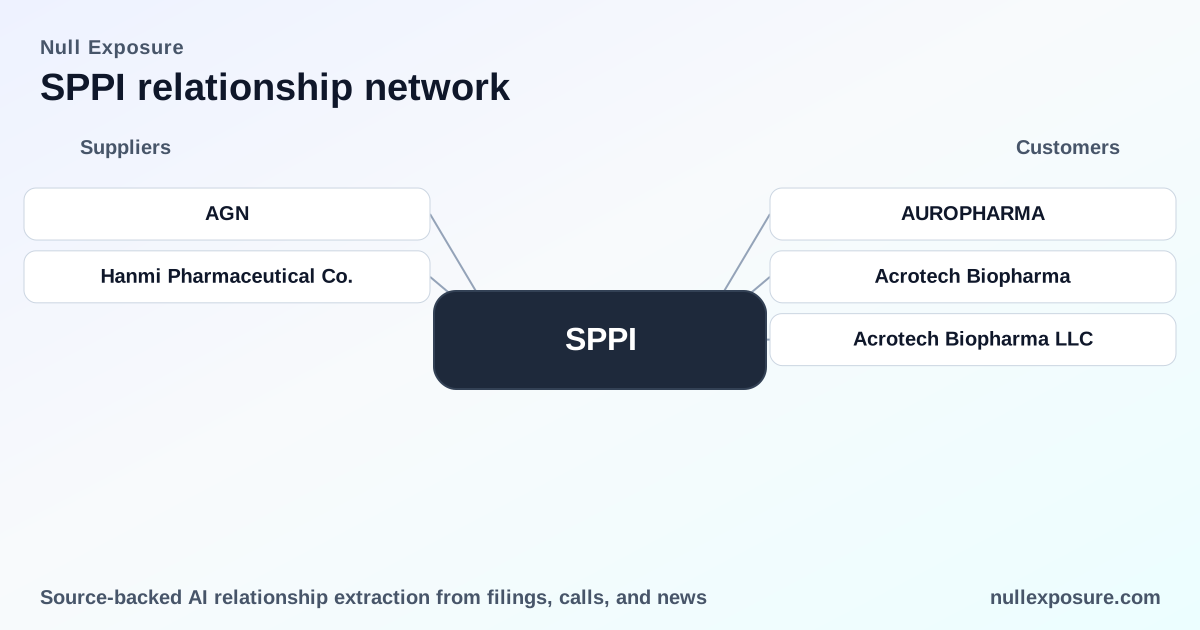
Spectrum Pharmaceuticals (SPPI) — Supplier Relationship Briefing
Spectrum Pharmaceuticals operates as a specialty pharmaceutical developer that monetizes through licensing, co-development partnerships, and downstream commercialization of curated oncology and hematology assets. The company’s commercial profile is driven less by in-house manufacturing scale and more by intellectual property transactions, milestone receipts, and revenue-sharing arrangements tied to partner execution. For investors and operators evaluating SPPI supplier relationships, the relevant lens is partnership quality, clinical and commercial risk transfer, and the timing of contingent cash flows tied to partner milestones.
Learn more at NullExposure homepage.
Why supplier relationships matter for SPPI’s economics
SPPI’s operating model is fundamentally partnership-driven: the company cultivates, licenses, or co-develops molecules and then relies on third parties to carry clinical development or commercialization risk. That creates a financial profile where upside is concentrated in discrete program outcomes and downside is partially transferred to counterparties. From an investor perspective, two features are most important:
- Revenue volatility: cash flow is lumpy and tied to milestones and royalties rather than steady manufacturing sales.
- Counterparty execution risk: the company’s realized value depends on the development and commercialization competence of named suppliers and partners.
These relationships therefore function as de facto extension of SPPI’s R&D and go-to-market engine. Capital allocation and valuation should weight partner pipelines, historical partner performance, and contract economics more heavily than in vertically integrated pharmas.
A compact inventory of supplier relationships you need to know
Below are all supplier/partner references present in the available results, each summarized plainly with source context.
Allergan Inc (AGN) — development collaborator (FY2012)
Spectrum was developing a drug in collaboration with Allergan, and clinical data failed to show a statistically significant reduction in tumor recurrence at the two‑year endpoint versus placebo. This outcome demonstrates how clinical readouts with a partner can extinguish an asset’s near-term commercial prospects and terminate expected milestone streams. (Industry Leaders Magazine, FY2012).
Hanmi Pharmaceutical Co. — licensor / Rolontis origin (licensed 2012; referenced FY2022)
Rolontis, an agent for chemotherapy‑induced neutropenia, was licensed out to Spectrum in 2012 and is noted in later reporting as a program tied to that licensing history; the product represents an example of SPPI’s strategy to in-license or acquire rights to development‑stage assets and then pursue further development or commercialization. (KED Global, FY2022).
What these relationships collectively reveal about SPPI’s constraints and operating posture
The available relationship evidence shows a consistent business pattern rather than isolated vendor interactions:
- Contracting posture: SPPI operates with a licensing/co-development bias — it structures agreements that transfer development and commercialization responsibilities to larger or specialized partners. This reduces fixed cost exposure but concentrates receipts into milestones and royalties.
- Concentration signal: The public record here mentions a small number of meaningful partners, indicating concentration risk where a few counterparties drive a disproportionate share of potential upside.
- Criticality of partners: Partners are mission‑critical — clinical failures or partner strategic shifts directly affect SPPI’s revenue trajectory, as illustrated by the Allergan collaboration outcome.
- Maturity of relationships: References date back to 2012, suggesting SPPI manages legacy assets and long‑standing license arrangements, which create multi‑year timing uncertainty for cash realization.
Because there are no explicit corporate constraint documents in the provided material, these items should be treated as company‑level operating signals rather than contractual facts tied to a specific supplier.
Investment implications: revenue drivers, concentration and downside scenarios
The relationship set supports several actionable investment conclusions:
- Catalyst-driven valuation: SPPI’s upside is event‑driven. Clinical readouts, regulatory decisions, and partner commercialization launches are the primary re‑rating levers.
- High execution leverage to partners: The company’s ability to generate revenue is highly leveraged to partner execution, so investors should underwrite partner pipelines and balance sheets as part of SPPI due diligence.
- Downside protection is limited: Clinical failures like the Allergan‑linked readout materially reduce expected cash flows; downside for shareholders is therefore pronounced if multiple partner programs underperform.
- Monitoring priorities: Prioritize monitoring milestone timing, royalty pools, and any transfer or termination clauses that could accelerate or truncate expected receipts.
If you want deeper mapping of SPPI’s partner economics and event calendar, visit NullExposure homepage for structured supplier intelligence.
Operational signals operators should track now
Operators assessing supplier risk and contract negotiation posture should focus on operational metrics that drive SPPI’s financial outcomes:
- Milestone cadence and probability weighting: Track scheduled readouts and regulatory filings from named partners.
- Counterparty commercial capacity: Evaluate partners’ commercialization footprints in the therapeutic area — limited reach reduces royalty potential.
- Contract flexibility: Seek visibility into termination triggers, royalty floors, and sublicensing rights when negotiating or auditing deals.
- Legacy program erosion: Review asset transfer dates and historical readout performance to assess whether remaining rights are high‑value or residual.
Key checklist for near-term action: obtain partner trial timelines, validate milestone schedules, confirm revenue waterfall mechanics, and stress-test scenarios for clinical failure.
What investors and operators should do next
For investors: re‑underwrite SPPI’s forward cash flows explicitly by partner and program; weight downside scenarios where partners deprioritize or fail development programs; and push for transparency on milestone waterfalls in investor communications. For operators: structure agreements that preserve upside but create faster cash realization triggers (e.g., partial upfronts, defined milestones, and escrowed payments).
If you are actively evaluating supplier relationships for SPPI or comparable specialty pharmas, consider subscribing to ongoing supplier intelligence at NullExposure homepage.
Bold takeaway: SPPI’s financial fate is tied to a small set of partner outcomes — clinical readouts and licensing economics matter as much as product science. Monitor partner execution, contractual protections, and milestone timing to price risk correctly.