SPPL (SIMPPLE LTD.) — supplier relationships and what they mean for investors
Simpple Ltd. operates as a Singapore-based technology provider that sells and deploys autonomous robotics and related services to commercial customers; it monetizes through hardware sales, recurring service arrangements and deployment contracts tied to its robotic cleaning platforms and support services. Revenue generation is product-plus-service: upfront equipment sales are augmented by service, maintenance and fleet management contracts that convert transactional sales into recurring cashflows over time. For investors evaluating supplier posture and counterparty risk, the company’s small market capitalization, negative operating margins and low institutional ownership are central to commercial and contracting risk assessment. Explore a structured supplier view for SPPL at https://nullexposure.com/.
What to know up front: size, margin profile, and contracting posture
Simpple is a micro-cap operator (market cap roughly $12.7 million) with trailing revenue near $5.85 million and a negative operating margin. Profitability is not established—EBITDA and EPS are negative—so counterparty relationships frequently double as revenue-validation events rather than purely procurement items. The company’s commercial posture will therefore be distribution- and partnership-driven, relying on third-party deployers and channel partners to scale installations and service footprints without expanding fixed cost base too quickly.
Operationally, this produces several company-level signals investors should treat as constraints on execution:
- Concentration and maturity: Small scale and negative margins indicate an early commercial stage where individual partner wins materially affect quarterly revenues and perceived traction.
- Contracting posture: Simpple is likely to favor flexible, partner-friendly contracts that shift implementation burdens and working capital to third parties rather than absorb large capital expenditures in-house.
- Criticality of partners: Large deployment partners or system integrators that deliver fleets (for example national rollouts) are operationally critical; their engagement converts product capability into repeatable revenue.
- Governance and audit visibility: Recent auditor appointments suggest governance normalization as the company matures as a listed entity, reducing financial disclosure execution risk.
If you are benchmarking supplier risk or mapping strategic dependency for SPPL, a concise supplier map and historical deal references are essential—find a persistent supplier view at https://nullexposure.com/ to integrate this into your investment or vendor-risk model.
Supplier and partner relationships — what the public record shows
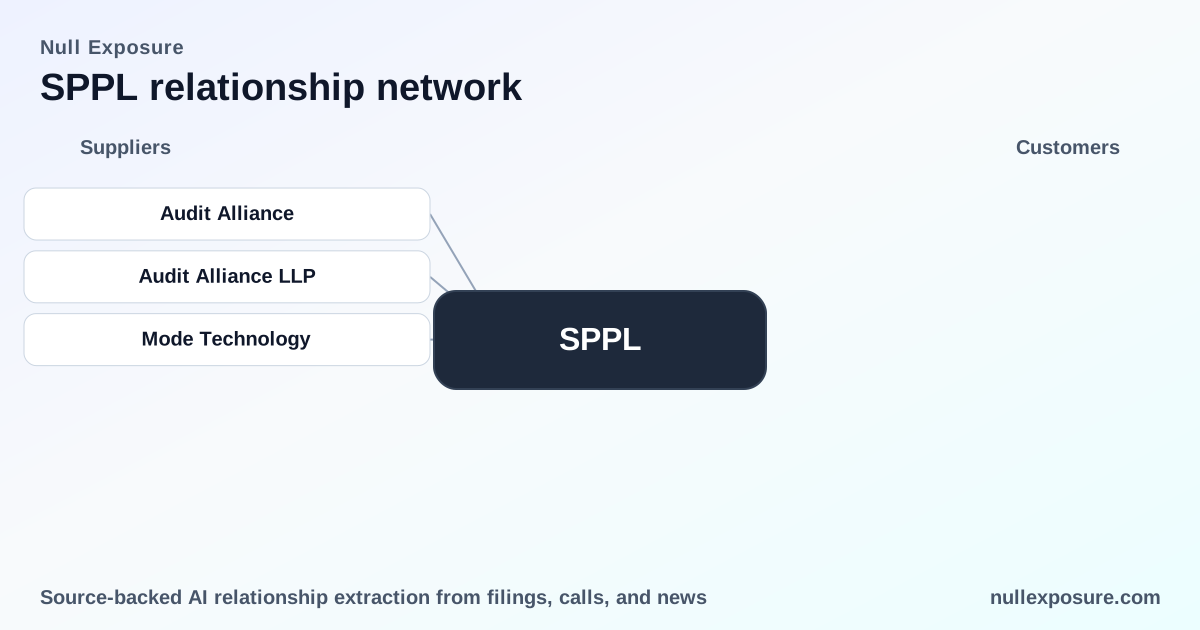
Below are every supplier/partner mention returned in the recent relationship extraction, with concise takeaways and source references.
Audit Alliance (news entry, FY2026)
Simpple disclosed the appointment of Audit Alliance as independent auditor through the next AGM, with the board delegated to fix auditors’ remuneration; this is a governance-level relationship that indicates an external audit provider for fiscal validation. According to a news aggregation entry dated March 2026, the auditor appointment was noted as a corporate governance action. (Source: Intellectia news feed, March 2026.)
Audit Alliance LLP (company press release, FY2025)
The company announced the appointment of Audit Alliance LLP as its independent auditor in an AGM disclosure published July 2025, confirming continuity of external audit oversight and indicating the board’s delegation of fee-setting authority. This formal AGM release signals standardization of statutory controls as Simpple navigates public-company reporting obligations. (Source: GlobeNewswire press release, July 2025.)
Mode Technology (commercial partner, FY2025)
Simpple partnered with New Zealand-based Mode Technology to sell and deploy a nationwide fleet of autonomous cleaning robots into the retirement-living sector, described as the largest robotic fleet implemented in that sector in New Zealand. This is a commercial go-to-market relationship that validates Simpple’s product channel strategy and demonstrates partner-led scale deployment capability. (Source: GlobeNewswire press release, August 2025.)
How these relationships map to commercial risk and upside
- Audit appointments reduce financial disclosure risk. The two auditor notices—one reported in mid-2025 and captured in market news in early 2026—show the company is formalizing external oversight; that reduces operational opacity and is positive for investors who require audited financials before underwriting larger exposure.
- Mode Technology demonstrates go-to-market leverage. The New Zealand fleet deployment with Mode Technology is a clear proof point for Simpple’s ability to convert product development into large-scale installations through partners, which is critically important given the company’s limited in-house scale.
- Counterparty concentration is still a company-level exposure. With Simpple’s revenue base and market cap, any single large partner or failed rollout would disproportionately affect near-term financials; investors should treat major partner wins as binary growth triggers rather than gradual de-risking.
For deeper supplier risk benchmarking or to integrate these relationship signals into a portfolio due-diligence workflow, see the supplier intelligence hub at https://nullexposure.com/.
Investment implications and risk checklist
- Short-term revenue sensitivity: Early-stage revenue with negative margins makes SPPL vulnerable to execution slippage on partner deployments.
- Governance improving: Auditor appointments are constructive and lower disclosure risk, supporting more confident financial modeling.
- Partner dependence: Mode Technology’s national rollout is a positive commercial validation, but the company’s overall success depends on replicating such partner-led rollouts across regions and verticals.
- Liquidity and market risk: Small float, low institutional ownership and elevated beta create stock-price volatility independent of operating performance.
Final read: what an investor should do next
SPPL’s public supplier signals are a mix of governance normalization and selective commercial validation. Audit appointments remove a key governance unknown, while the Mode Technology deployment serves as a tangible scaling event; however, the company’s small scale and negative margins keep execution risk high. If your mandate includes small-cap technology exposure with partner-driven revenue models, add SPPL to a watchlist and prioritize monitoring partner rollouts, audited financials, and evidence of recurring service revenue.
If you need a consolidated supplier-risk profile or want to track additional third-party relationships impacting SPPL, start a tailored supplier-monitoring project at https://nullexposure.com/.