Spruce Power Holding (SPRU): Asset-owner thesis and supplier map for investors
Spruce Power is a U.S. residential solar owner-operator that monetizes through buying residential portfolios, operating and servicing systems, and extracting recurring cash flow from rooftop solar assets rather than originating loans. The company generates revenue from power production, service contracts, and portfolio-level economics after portfolio acquisitions; Spruce’s public metrics show a $108M revenue base and positive operating margin but a negative net EPS, reflecting asset-level profitability alongside financing and non-operating costs. For an investor evaluating supplier and counterparty exposure, the relationships below reveal Spruce’s acquisition-led growth model, a servicing backbone, and a portfolio concentration pattern that drives operational risk and upside. Learn more from the Spruce supplier map at https://nullexposure.com/.
How Spruce’s business model reads to an investor
Spruce transitioned from a finance-originator to an owner/operator model following restructurings and outside investment. The company buys existing residential solar portfolios and integrates them into its operating platform, capturing installation-era value through ongoing service revenue and output. Financially, Spruce reported Revenue (TTM) of $108.0M and Gross Profit of $66.6M with Operating Margin (TTM) of +27.5%, while EPS remains negative at -$1.25 — signaling operational scale with capital structure or non-operational drag. Market capitalization is roughly $70.1M with EV/Revenue ~6.6x and EV/EBITDA ~14.1x, consistent with a growth-stage asset-ownership vehicle in the distributed solar space.
- Key driver: acquisition cadence—buy and integrate installed systems to grow recurring cash flows.
- Capital dynamic: portfolio purchases are capital-intensive and create leverage and financing sensitivity.
- Operational backbone: an in-house servicing entity supports long-term system uptime and customer retention.
Explore Spruce supplier relationships and signals in depth at https://nullexposure.com/.
The supplier and counterparty list — what each relationship means for Spruce
-
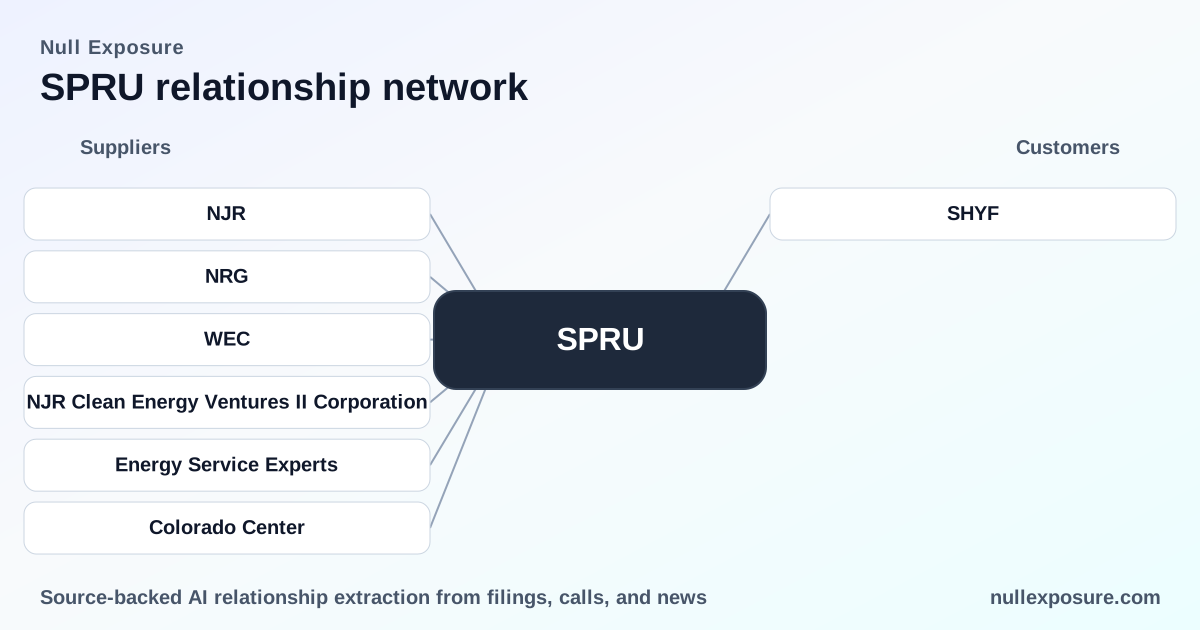
NJR Clean Energy Ventures — Spruce acquired roughly 9,800 residential solar systems from NJR Clean Energy Ventures for $132.5 million, a sizable bolt-on that expands Spruce’s installed base and immediate revenue runway. According to Yahoo Finance reporting (Mar 10, 2026), this transaction materially increased portfolio scale and is a clear example of Spruce’s acquisition-driven growth. Source: Yahoo Finance, March 10, 2026.
-
NJR Clean Energy Ventures II Corporation — In a related corridor of activity, Spruce acquired a 91 MW residential solar portfolio from NJR Clean Energy Ventures II for approximately $130 million, reinforcing a repeatable play: acquire large multi-MW portfolios to scale production and service revenues. Simply Wall St documented the deal in late 2023 (Nov 26, FY2023). Source: Simply Wall St, November 2023.
-
NRG — Spruce has previously purchased entire residential portfolios that included assets originating with NRG; in 2020 Spruce’s activity included acquiring the balance of NRG’s residential holdings as part of multi-portfolio purchases, demonstrating Spruce’s willingness to transact with major energy incumbents to consolidate rooftop assets. Source: Solar Power World, November 2020.
-
WEC Energy Group — Spruce acquired a portfolio of 1,047 systems from WEC Energy Group, a set of assets Spruce previously managed through its servicing arm; this transaction highlights the conversion of managed portfolios into owned assets, strengthening recurring revenue capture. Source: Solar Power World, November 2020.
-
Energy Service Experts (ESE) — ESE is Spruce’s servicing subsidiary created after Spruce pivoted to asset ownership; ESE operates as the servicing and maintenance arm that supports Spruce’s installed systems and aftermarket offerings (including battery and EV charger options added to financing packages). Solar Power World reported on ESE’s central role in Spruce’s operating model in early 2021. Source: Solar Power World, February 2021.
-
Colorado Center (Denver headquarters) — Spruce relocated its Denver corporate headquarters to the Colorado Center at 2000 S. Colorado Blvd., reflecting a corporate consolidation and local footprint consistent with its asset operations and administrative needs; the move was announced in 2023 and is relevant to local operations and talent access. Source: Mile High CRE, FY2023.
What these relationships collectively say about risk and opportunity
The relationship map shows two clear strategic facts: Spruce pursues inorganic growth through portfolio acquisitions from utilities and energy firms, and Spruce retains an internal servicing capability (ESE) to extract long-duration value from those purchases. Acquisitions from NJR, NRG, and WEC convert counterparty-originated installer or utility portfolios into Spruce-owned revenue streams, improving visibility into production but concentrating capital deployment.
- Concentration and scaling: Repeated, large purchases (e.g., NJR deals) create fast scale but concentrate balance-sheet exposure in residential solar assets; valuation is therefore sensitive to realized production and maintenance costs.
- Contracting posture: The company operates as a buyer of existing asset portfolios and as an operator via ESE; contracting is transactional at acquisition and long-term at the service level.
- Criticality of servicing: ESE is operationally critical; ownership and control over servicing reduces counterparty dependency and supports margin preservation.
- Portfolio maturity: Many acquired systems are post-installation, so short-term upside depends on production optimization and long-term upside on contract longevity and customer retention.
If you want an investor-focused supplier risk dashboard or to map this exposure visually, review Spruce’s supplier page at https://nullexposure.com/.
Financial and strategic implications for investors
Spruce’s operating profit picture and acquisition behavior imply a classical asset-operator profile: operational margins can be strong once assets are integrated, but net profitability is impacted by capital costs and financing terms. With Price-to-Sales of ~0.65 and EV/EBITDA ~14x, the market prices Spruce as a higher-cost capital structure or growth risk asset rather than a fully de-risked utility-style owner.
- Upside: Aggregation of third-party portfolios can rapidly increase revenue per share if financing is optimized and service costs are controlled.
- Downside: Capital intensity of acquisitions, reliance on external sellers for growth, and exposure to system performance and maintenance costs create execution risk.
For hands-on diligence and to see how each supplier relationship maps to Spruce’s exposure, go to https://nullexposure.com/.
Conclusion: what to watch next
Monitor near-term acquisition activity, ESE’s service performance metrics, and financing terms that drive net EPS volatility. Key near-term indicators are acquisition size and pricing, service uptime trends via ESE, and the company’s capital structure actions. The supplier relationships cataloged above provide a clear lens into how Spruce grows: it buys portfolios from established energy companies, consolidates operations under ESE, and monetizes through operating revenues — a model that offers both scalable upside and balance-sheet sensitivity.
For an actionable supplier risk briefing or a deeper counterparty analysis, visit the Spruce supplier hub at https://nullexposure.com/.