SPS Commerce (SPSC) — supplier relationships and what they tell investors
SPS Commerce operates a cloud-native supply-chain platform that connects retailers, suppliers and logistics partners, monetizing primarily through recurring subscription services and integration/transactional fees that leverage its network effects across retail ecosystems. For investors, the key operating leverage is predictable recurring revenue underpinned by regional infrastructure and a portfolio of third‑party service contracts that support uptime, security and customer integrations.
Explore deeper supplier and contract signals at https://nullexposure.com/ to map vendor concentration and operational exposure.
What the commercial footprint and contracts reveal about operating posture
SPS Commerce’s public disclosures and supplier evidence describe a mature SaaS operator with multi-year commitments and multi-region infrastructure dependencies. Several company-level constraints together outline an explicit contracting posture:
- The company occupies a long-term headquarters lease in Minneapolis covering roughly 200,000 square feet with an expiration in 2027, which signals fixed occupancy cost and an administrative footprint tied to that location (company disclosure). This creates a near-term lease renewal or relocation decision that investors should track as a potential cash-flow and real-estate cost item.
- SPS uses third-party data centers across North America, Europe (EMEA) and Australia (APAC) and provisions services with cloud providers, indicating a deliberate multi-region hosting strategy that reduces single-site risk while expanding regulatory and cross-border compliance exposure (company disclosure).
- The company has noncancelable agreements for computing infrastructure, productivity software, CRM and analytics vendors through 2026, which reflects a vendor relationship maturity profile with locked-in supplier costs and limited short-term renegotiation leverage (company disclosure).
Taken together, these signals describe a supplier posture that is service-provider heavy, geographically diversified, contractually sticky, and operationally critical: infrastructure and SaaS-delivery vendors are essential to core revenue delivery and are governed by medium-term contracts.
The public supplier relationships you need to know about
SPS’s public relationship traces in available reporting are limited but informative about its vendor ecosystem and communications posture.
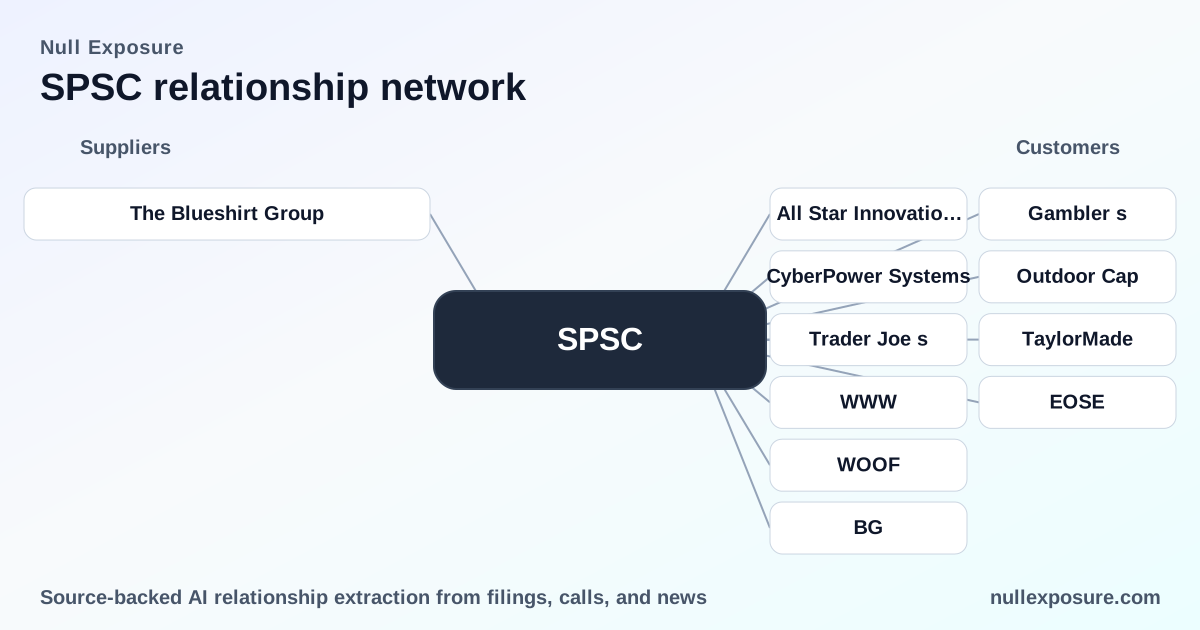
- The Blueshirt Group — A press release distributed on March 10, 2026 included an investor relations contact listing for The Blueshirt Group as SPS’s media/investor-relations contact, indicating the company uses an external communications firm for investor engagement and press dissemination (press release on The Globe and Mail, March 10, 2026). This relationship is primarily a communications/IR engagement rather than core infrastructure supply, but it is material for market access and narrative control.
(That completes the set of relationships surfaced in available reporting for the supplier scope.)
Why these relationship details matter for investors and operators
The mix of long-term real-estate commitments, regional third‑party hosting, and locked-in vendor services creates specific investment and operational implications:
- Concentration and criticality: The company’s delivery of cloud services depends on external hosting and infrastructure vendors — these are high-criticality relationships where outages or contract disruptions would hit revenue quickly. Geographic spread into NA/EMEA/APAC reduces single-region concentration risk but increases vendor management complexity and compliance scope.
- Contracting leverage and margin pressure: Noncancelable agreements through 2026 and a HQ lease to 2027 limit SPS’s near-term ability to negotiate down costs, creating a temporary headwind to margin expansion until renewals are available. Investors should model vendor cost inflation and renewal timing into forward margins.
- Operational maturity and predictability: Multi-year commitments are consistent with a mature SaaS operator that prioritizes stability and uptime over short-term cost flexibility. That supports predictable revenue flows but requires active vendor management to protect EBITDA conversion.
- Communications strategy: Engagement with a professional IR/PR firm like The Blueshirt Group demonstrates management’s focus on market-facing communications and control of the narrative around earnings and strategy — a useful operational signal for public-company governance and investor relations effectiveness.
Use the company’s financial context to color risk assessment: SPS Commerce reports trailing revenue of approximately $751.5M and EBITDA of $176.6M, with a market capitalization near $2.24B, indicating meaningful scale where vendor contracts and real-estate commitments are non-trivial to operating cost structure.
Explore supplier-level risk mapping and vendor concentration visuals at https://nullexposure.com/ to quantify likely renewal exposures.
Practical due diligence checklist for investors and procurement teams
When evaluating SPS Commerce supplier relationships, prioritize the following actions:
- Confirm renewal windows and termination clauses for major infrastructure and software vendors — contracts locked through 2026 imply renewal risk during that cycle.
- Assess geographic compliance posture, particularly for EMEA and APAC hosting, around data residency, privacy law obligations and cross-border transfer mechanisms.
- Model scenarios that stress vendor costs and real-estate occupancy (lease expiry 2027) against free cash flow and operating margin sensitivity.
- Review SLA terms and incident history for third-party data centers and cloud providers given the criticality of uptime to transaction volumes.
Each of these actions translates supplier contract language into investor-grade risk factors that affect valuation and operational resilience.
Final perspective and next steps
SPS Commerce’s supplier footprint is operationally essential and contractually sticky: a blend of third-party hosting across regions, fixed real-estate commitments, and multi-year service agreements that together support a predictable SaaS platform but limit near-term cost flexibility. The public relationship trace — an investor-relations engagement with The Blueshirt Group — reinforces a management emphasis on market communication rather than infrastructure outsourcing per se.
For investors tracking vendor concentration and contract maturity timelines, the most material upcoming inflection points are the 2026 vendor expiry window and the 2027 HQ lease renewal; these will determine whether cost structure improves or compresses. For procurement and operations teams, the priority is negotiating favorable renewals and ensuring cross-border compliance.
If you want a structured vendor-risk scorecard and renewal timeline tailored to SPS Commerce, start here: https://nullexposure.com/. For a deeper supplier network map and contract-clause analysis for public software suppliers, visit https://nullexposure.com/ to request an institutional briefing.