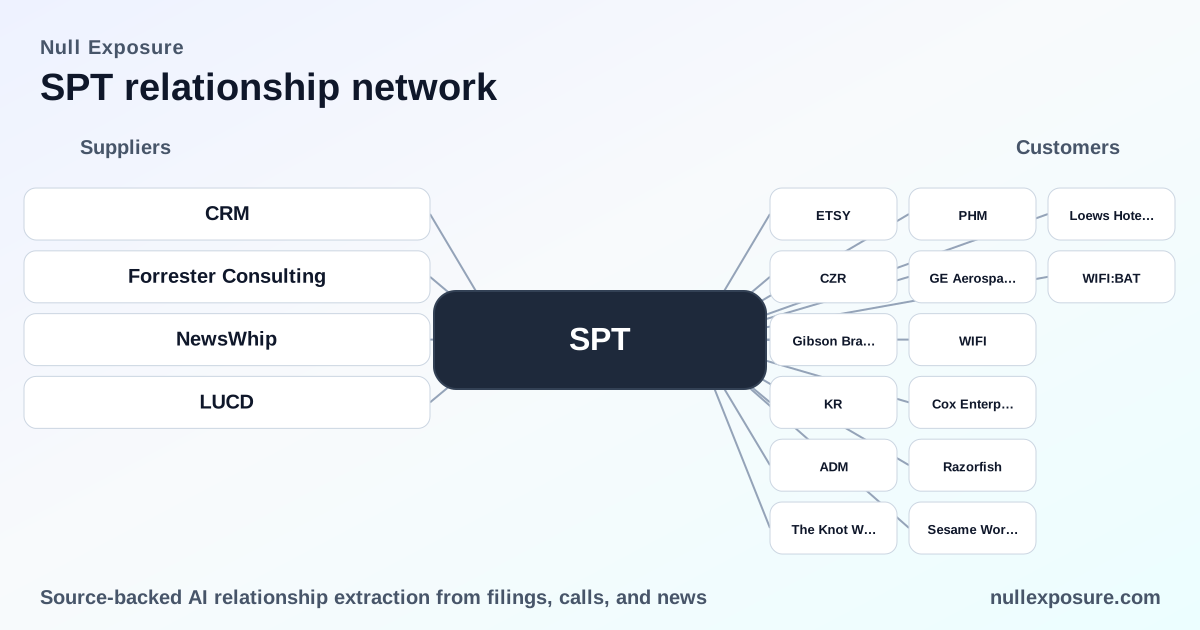
SPT Supplier Network: Partnerships, Cost Profile, and Operational Constraints Investors Should Price In
Sprout Social (SPT) operates a subscription-based SaaS platform for social media management, monetizing through tiered recurring licenses, enterprise add-ons (analytics, influencer tools) and strategic integrations that drive platform stickiness and cross-sell. Revenue on a trailing-twelve-month basis is ~$457.5M with gross profit of ~$355.3M, and the firm advances product capability both organically and via targeted acquisitions and third‑party partnerships. Investors should evaluate suppliers as both enablers of feature velocity and as potential concentration or cost risks to margins and uptime.
Explore deeper supplier intelligence at https://nullexposure.com/ to map how these relationships influence commercial and operational outcomes.
Why suppliers and partners move Sprout’s P&L and go‑to‑market
Sprout’s product strategy intentionally layers third‑party capabilities and data into its core UI: integrations amplify enterprise value, acquisitions plug capability gaps, and consulting endorsements accelerate adoption. Key commercial partners amplify distribution and data breadth; third‑party service providers underwrite uptime and hosting costs. This dual dynamic means supplier shifts can hit growth and margins in equal measure — either by enabling faster cross-sell or by increasing fixed/variable cost pressure.
Investors should treat supplier signals as inputs to both revenue durability and cost structure forecasts. For a quick company-level map, see https://nullexposure.com/.
Supplier-by-supplier review (complete coverage)
Salesforce (CRM) — a strategic integration that extends CRM-to-social workflows
Sprout maintains a public, multi-year partnership with Salesforce designed to deliver a 360-degree customer view by linking social care and engagement data into Salesforce workflows, supporting enterprise social customer care and channel unification (references on Sprout’s insights pages). According to Sprout Social content spanning FY2022–FY2026, the partnership is positioned globally to accelerate adoption among Salesforce customers and embed Sprout in enterprise service and marketing stacks (see Sprout Social insights pages, various FY2022–FY2026 postings: https://sproutsocial.com/insights/social-media-and-hospitality/ and related posts).
Forrester Consulting — third‑party validation for product ROI
Sprout commissioned a Forrester Consulting Total Economic Impact™ study in FY2025 that quantified productivity benefits: customers using Sprout’s Influencer Marketing solution realized average time savings of 25% in discovering and managing influencers, an outcome Sprout cites to support its enterprise value proposition and sales positioning (QuiverQuant reporting of the Forrester study, FY2025: https://www.quiverquant.com/news/Sprout+Social+Launches+Rebranded+Influencer+Marketing+Platform+to+Enhance+Brand+Campaigns).
NewsWhip — capability acquisition to boost predictive media intelligence
In FY2025 Sprout acquired NewsWhip, integrating AI-powered predictive media intelligence into Sprout’s platform to strengthen content discovery and engagement forecasting — a capability that directly supports higher‑value analytics and upsell into enterprise accounts (company acquisition announcement reported via QuiverQuant, FY2025: https://www.quiverquant.com/news/Sprout+Social+Acquires+NewsWhip+to+Enhance+Predictive+Media+Intelligence+and+Social+Engagement+Solutions).
Lucid — market research sourcing for category insights
Sprout has cited Lucid-run consumer and marketer surveys (conducted in 2020 and cited in FY2021 materials) to frame the competitive landscape and the criticality of social for brands; these research relationships underpin content marketing and go‑to‑market narratives rather than direct product integration (GlobeNewswire distribution of Lucid survey findings, FY2021: https://www.globenewswire.com/news-release/2021/06/15/2247376/0/en/New-research-shows-social-media-has-created-a-more-competitive-landscape-for-brands-but-is-simultaneously-key-for-staying-ahead-in-their-industry.html).
What the company‑level constraints reveal about operating posture
Sprout’s supplier signals are complemented by three visible constraints that shape the supplier risk profile:
-
Contracting posture — long‑term debt facility in place. The company discloses a $100 million senior secured revolving credit facility maturing August 1, 2028, indicating a multi‑year financing runway for working capital and M&A activity rather than reliance on short-term commercial paper. This underwrites capacity to fund strategic acquisitions like NewsWhip without forcing asset sales.
-
Role of third‑party service providers — operational dependency. Filings identify extensive use of third‑party service providers for application hosting and other critical operations, and an office lease amendment that alters real estate commitments through December 31, 2032. This signals that uptime, vendor SLAs, and service‑provider negotiation leverage are central operational levers for the business.
-
Spend magnitude and contractual maturity. Material contractual commitments disclosed as of December 31, 2024 total $11,736 (in thousands) — roughly $11.7M in contractual obligations — placing Sprout into the mid‑tier spend band for supplier commitments and indicating a measurable but not outsized fixed‑commitment base.
These constraints combine into a clear operational profile: financial flexibility to transact, reliance on external hosting and services for critical operations, and a modest base of contractual fixed obligations that investors should model into both margin and liquidity scenarios.
Explore contract-level supplier analytics and scenario modeling at https://nullexposure.com/.
Investment implications and risk checklist
-
Upside pathway: Integrations with enterprise platforms (Salesforce) and the NewsWhip acquisition accelerate higher‑ARPU enterprise adoption and provide cross‑sell opportunities into CRM and analytics budgets. For investors modeling growth, treat these as tangible drivers of enterprise expansion and retention.
-
Margin pressure vectors: Dependence on third‑party hosting and service providers creates variable spend and potential fee inflation; also, continued product investment and acquisition integration will pressure operating margins near term (operating margin TTM ≈ -7.55%).
-
Concentration and distribution risk: The Salesforce partnership increases channel reach but also concentrates GTM reliance on a large CRM ecosystem; monitor renewals, integration depth, and co‑selling metrics to assess durability.
-
Liquidity and capital allocation: The $100M revolver provides optionality for tuck‑ins and working capital; contractual obligations (~$11.7M) are manageable but not trivial. Track covenant terms and draw patterns on the revolver for balance‑sheet risk.
Bottom line and next steps
Sprout Social runs a supplier strategy that balances third‑party operational dependency with partner‑driven go‑to‑market expansion and selective M&A to buy capability. For investors, the key questions are whether integrations and acquisitions convert to durable enterprise ARR growth and whether operating leverage moves from negative to positive as scale offsets hosting and integration costs.
For a practical supplier risk map and to see how these relationships affect valuation scenarios, visit https://nullexposure.com/.
If you want a customized supplier impact brief for SPT — tying these relationships to revenue scenarios, margin sensitivity, and covenant stress tests — start an enquiry at https://nullexposure.com/ and we will prepare a tailored note.