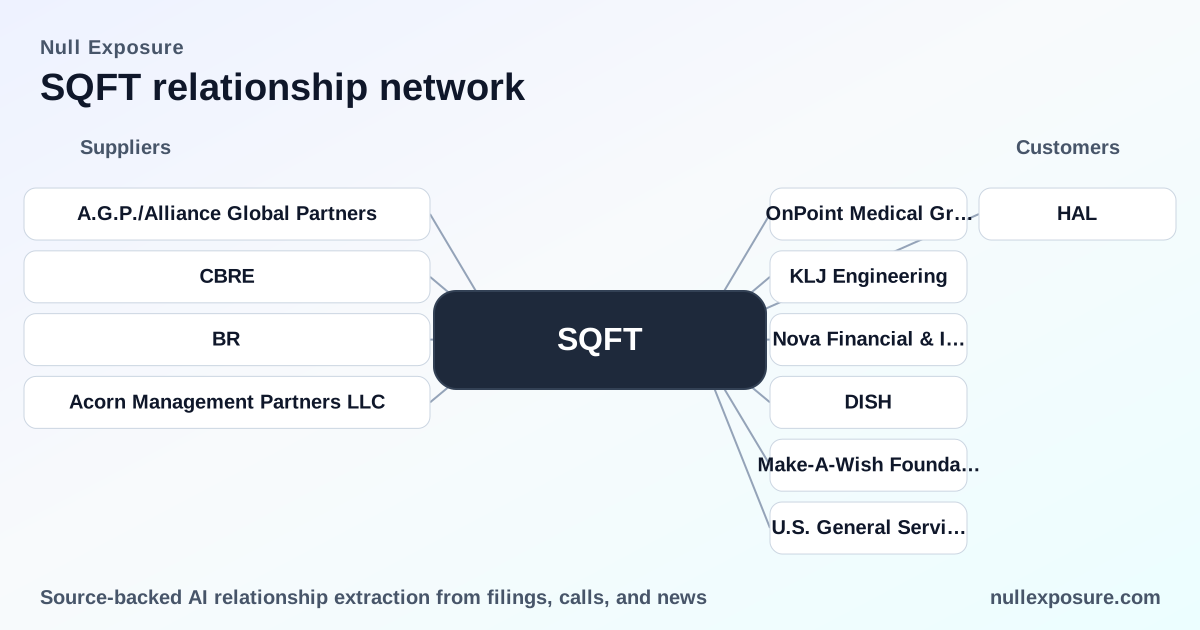
Presidio Property Trust (SQFT) — supplier relationships and what they mean for investors
Presidio Property Trust is an internally managed diversified REIT that generates cash flow from rental income and property-related services while selectively tapping public capital markets for balance-sheet repairs and liquidity. The company operates its own management arm (NTR Property Management) and subcontracts local on-site management, uses external leasing brokers and placement agents for capital raises, and relies on standard investor-services vendors for corporate actions. These supplier choices drive both operational efficiency and concentrated vendor risk for investors evaluating counterparty exposure. For further supplier intelligence and model-backed supplier maps visit https://nullexposure.com/.
Why supplier relationships matter for a small, internally managed REIT
Presidio’s supplier list is not academic — it directly links to how properties are leased, how capital is raised, and how shareholder communications are handled. Capital markets providers, leasing brokers, and property-management contractors are functionally critical suppliers; disruption or unfavorable economics with a single supplier can influence occupancy, liquidity, and governance outcomes. Given Presidio’s reported small market capitalization and negative EPS, supplier execution and access to placement agents are material to valuation.
Supplier relationships: the counterparties on record
Below are every supplier relationship disclosed in the available results, each described in plain English with the source cited.
- A.G.P./Alliance Global Partners — A.G.P. acted as the sole placement agent for a $2.05 million registered direct offering for Presidio in FY2025, highlighting Presidio’s reliance on third-party investment banks to execute near-term equity capital raises. This was reported in a QuiverQuant news item dated March 10, 2026.
- CBRE — Leasing for certain assets is handled by CBRE, with a specific leasing agent (Mitch Bradley) named in FY2022 communications; this demonstrates use of established national brokerage platforms for tenant sourcing and lease negotiation. (Markets.FinancialContent / Pawtucket Times, FY2022.)
- Broadridge N.A. — Broadridge served as the information agent for Presidio’s self-tender offer in FY2025, providing investor communications and tender administration services during a corporate action. (GlobeNewswire, May 7, 2025.)
- Acorn Management Partners LLC — Presidio engaged Acorn Management Partners LLC in FY2020, indicating prior advisory or management relationships with smaller management firms. (Finviz/Accesswire, FY2020.)
What these relationships tell you about Presidio’s operating model
These vendor ties, combined with the company profile, translate into a set of operational characteristics investors should price into SQFT.
- Contracting posture: recurring + outsourced. Evidence of an almost-exclusive SaaS IT environment and a primary in-house property manager that subcontracts on-site services implies a mix of subscription-style platform contracts for corporate IT and outsourced, vendor-specific property management agreements. The SaaS signal is based on company-level information and carries moderate confidence.
- Concentration and criticality: vendor dependencies are concentrated. The use of single-agent placement for capital raises and named national brokers for leasing shows dependence on a small number of specialist suppliers for higher-impact activities (capital and leasing), elevating counterparty concentration risk.
- Geographic focus and operational footprint: U.S.-centric with state-level outsourcing. The company discloses subcontracting in California and North Dakota while self-managing properties in Colorado, Maryland, and Texas, which positions operational exposure squarely in North America and creates regional vendor concentration.
- Maturity and scale: small public company with limited institutional coverage. Presidio’s reported market capitalization and revenue base, negative EPS, low institutional ownership (~15.5%), and relatively high insider ownership (~24.6%) indicate a smaller, less-liquid equity with significant insider influence; that structure amplifies the importance of reliable supplier execution for both operations and capital markets access.
- Third-party risk and cyber considerations: recognized and material. The company explicitly evaluates cybersecurity risks tied to third-party service providers, which makes vendor controls and contractual security clauses an active governance focus.
Investment implications and a practical risk checklist
Presidio’s supplier map yields a clear set of investor actions and risks to monitor.
- Capital-raise dependency: Reliance on a placement agent for a $2.05M offering signals active use of external capital markets; track future placement-agency engagements and fee terms. (QuiverQuant, 2026.)
- Operational outsourcing risk: On-site property management is subcontracted in specific states, creating single-state operational dependencies that can affect occupancy and net operating income if local vendors underperform.
- Service continuity for corporate actions: Broadridge’s role in tender administration shows standard use of market infrastructure, but also means that shareholder-facing events are outsourced—monitor vendor SLAs and proxy timelines. (GlobeNewswire, 2025.)
- Broker dependence for leasing: Using CBRE for leasing ties asset cash flow to the efficacy of a national brokerage relationship; improvements or degradations in that relationship will influence lease velocity. (Markets.FinancialContent, FY2022.)
- Governance and liquidity concerns: Small market cap, limited institutional ownership, and elevated insider ownership concentrate control and limit market liquidity — factors that increase the valuation sensitivity to vendor and capital market execution.
If you’re mapping counterparty concentration or building an exposure heatmap for portfolio due diligence, start with the named partners above and layer contract terms and SLA enforcement histories. For a deeper vendor-exposure view and supplier risk scoring, visit https://nullexposure.com/.
Tactical next steps for investors and operators
- Request copies of material vendor contracts for CBRE, property-management subcontractors, and any placement-agency engagement letters to verify exclusivity, termination rights, and fee escalation clauses.
- Review Broadridge engagement terms and the timeline for past corporate actions to assess operational reliability for future tender offers or buybacks. (GlobeNewswire, 2025.)
- Monitor capital-raising cadence and the use of placement agents as a leading indicator of liquidity stress or strategic recapitalization.
For an investor-grade supplier map and ongoing monitoring of counterparties, see https://nullexposure.com/.
Bottom line
Presidio Property Trust runs a compact, internally managed REIT structure that leverages external partners for leasing, capital raises, shareholder services, and localized property management. That model offers operational leverage but creates concentrated supplier risk that is material given the company’s small market capitalization, negative EPS, and limited institutional ownership. Investors and operators should prioritize contract access, vendor performance history, and capital-market counterparties in any diligence or operational remediation plan. For supplier intelligence and structured counterparty scoring tailored to REITs, go to https://nullexposure.com/.