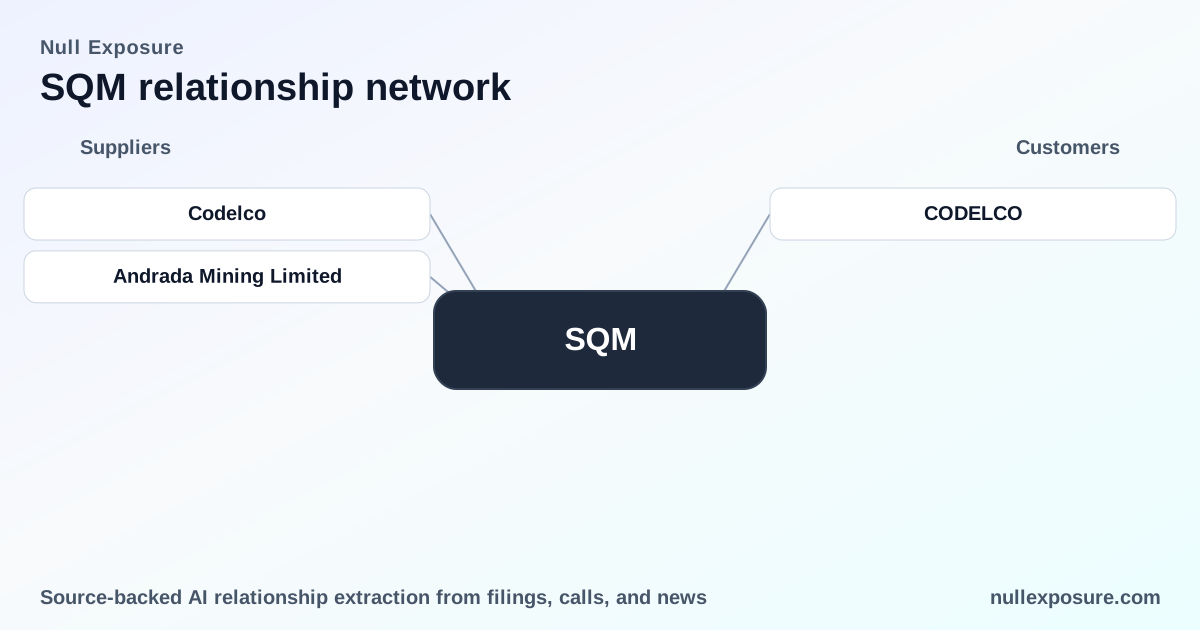
SQM as a Supplier Partner: commercial profile, counterparties, and what investors should watch
Sociedad Química y Minera de Chile (SQM) operates as an integrated producer of specialty chemicals and critical battery materials, monetizing through the extraction, refinement, and sale of lithium and its derivatives, specialty plant nutrients, iodine products, and industrial salts. Revenue derives from large-scale commodity and specialty product sales to industrial, agricultural and battery markets, with SQM capturing margin through upstream access to salar resources and downstream processing capability—evidenced by $4.58 billion in trailing revenue and a 28.3% operating margin. For investors evaluating supplier and partner exposure, the commercial logic is clear: control of feedstock (lithium brine, potassium) plus long-term commercial arrangements drive cashflow stability and strategic optionality. Learn more about our supplier intelligence at https://nullexposure.com/.
How SQM’s commercial model converts geology into cash
SQM’s business model is straightforward and vertically aligned. The company extracts salar resources, processes those into marketable chemical products and sells directly into global supply chains for fertilizers, pharmaceuticals/iodine, and EV battery manufacturing. Key revenue drivers are lithium volumes, pricing for specialty nutrients, and integrated processing margins. Financials reinforce the model: EBITDA of roughly $1.48 billion supports capital-intensive mining operations while a trailing EPS of $2.06 and Forward P/E around 15 reflect market expectations for earnings growth tied to lithium demand.
Operationally SQM exhibits a contracting posture that blends long-term strategic partnerships, joint ventures and project-level participation agreements rather than pure spot-sales exposure. That posture supports offtake predictability for battery customers and secures feedstock access necessary to sustain production. The company’s share profile (roughly 35% institutional ownership) and low insider holding point to a widely followed commodity-growth story with significant external governance and analyst coverage.
Supplier and partner relationships investors should track
Below I list the supplier/partner relationships surfaced in recent coverage. Each relationship has a concise investment-oriented summary and the reporting source.
Codelco — Nova Andino Litio joint arrangement
SQM finalized an association agreement with Chile’s state miner Codelco to form Nova Andino Litio, giving SQM long-term access to Salar de Atacama lithium resources and reinforcing lithium sales as a central earnings driver. Source: Simply Wall St coverage reporting on the arrangement and related FY2026 commentary (March 2026).
Andrada Mining Limited — Namibia participation agreement
SQM agreed to pay Andrada Mining an initial US$500,000 participation fee on signing and an additional US$1.5 million upon satisfaction of conditions precedent as part of a development partnership for a Namibia lithium asset — a low-cost deal structure that preserves optionality while limiting upfront capital exposure. Source: Global Mining Review, reporting on the September 2024 agreement.
What those relationships imply for supply strategy and risk
These relationships illustrate SQM’s two-pronged supplier strategy: (1) secure large, high-quality salar feedstocks through capital partnerships and joint ventures, and (2) buy or option access to exploration-stage assets via low-commitment payments to expand resource optionality. The Codelco JV signals a deliberate alignment with a sovereign counterparty that increases resource security; the Andrada terms demonstrate measured, staged exposure to frontier assets.
Investor takeaway: SQM’s partner mix balances resource control with capital discipline—state-level joint ventures for core salar access and modest participation in early-stage projects to broaden the pipeline. That balance directly influences future production guidance, reserve life estimates, and capital allocation.
Constraints and operating-model signals (company-level)
The dataset contains no explicit supplier constraints flagged as formal restrictions; that absence itself is an informative company-level signal. From the company profile and relationship activity, the operating-model characteristics are:
- Contracting posture: long-term and JV-heavy — SQM structures deals that secure resource access and spread development risk with partners rather than relying solely on spot acquisitions.
- Concentration: resource concentration is high — a meaningful portion of SQM’s lithium economics is tied to salar resources, so operating outcomes correlate closely with specific sites and regional permitting.
- Criticality: lithium and iodine are strategically critical — these products place SQM at the intersection of industrial stability (fertilizers, iodine derivatives) and high-growth battery supply chains.
- Maturity: established producer with diversified product lines, enabling cash generation from non-lithium segments while scaling lithium capacity.
- Counterparty profile: mix of sovereign/state partners and junior explorers, which reduces capital intensity but increases political and execution complexity.
These are company-level signals intended to inform supplier and counterparty risk assessment rather than relationship-specific constraints.
Investment implications and risk checklist
- Upside lever: control of salar feedstock and downstream processing positions SQM to capture rising lithium pricing and EV-driven volume growth.
- Margin resilience: strong operating margins from specialty chemicals buffer commodity volatility in lithium cycles.
- Geopolitical & regulatory risk: partnerships with state entities and concentration in Chile expose SQM to sovereign policy shifts and permitting timelines.
- Execution risk on expansions: staged participation agreements protect capital, but development timelines for new assets (and JV integrations) determine near-term capacity growth.
- Counterparty credit and commercial risk: partner performance (e.g., Codelco operational delivery) affects feedstock availability and project timelines.
How to monitor supply-side developments
Track three vectors closely: (1) announcements of JV capacity targets and definitive agreements, (2) staged payments or milestone confirmations on exploration partnerships, and (3) production/volume disclosures tied to salar operations. For continuous supplier intelligence and real-time relationship signals, visit https://nullexposure.com/ to subscribe and configure alerts.
Final read: what investors should conclude now
SQM operates as a vertically integrated chemical and battery-materials platform that monetizes through production scale and downstream processing. Its supplier relationships reflect a deliberate strategy: lock-in core salar resources via strong partner ties while preserving upside through low-cost participation in frontier projects. For investors, that structure delivers both stability from diversified product lines and asymmetric upside from lithium upside, offset by political and execution risk inherent to large-scale mining partnerships. For ongoing tracking of supplier relationships and counterparty exposure, consult our platform at https://nullexposure.com/.