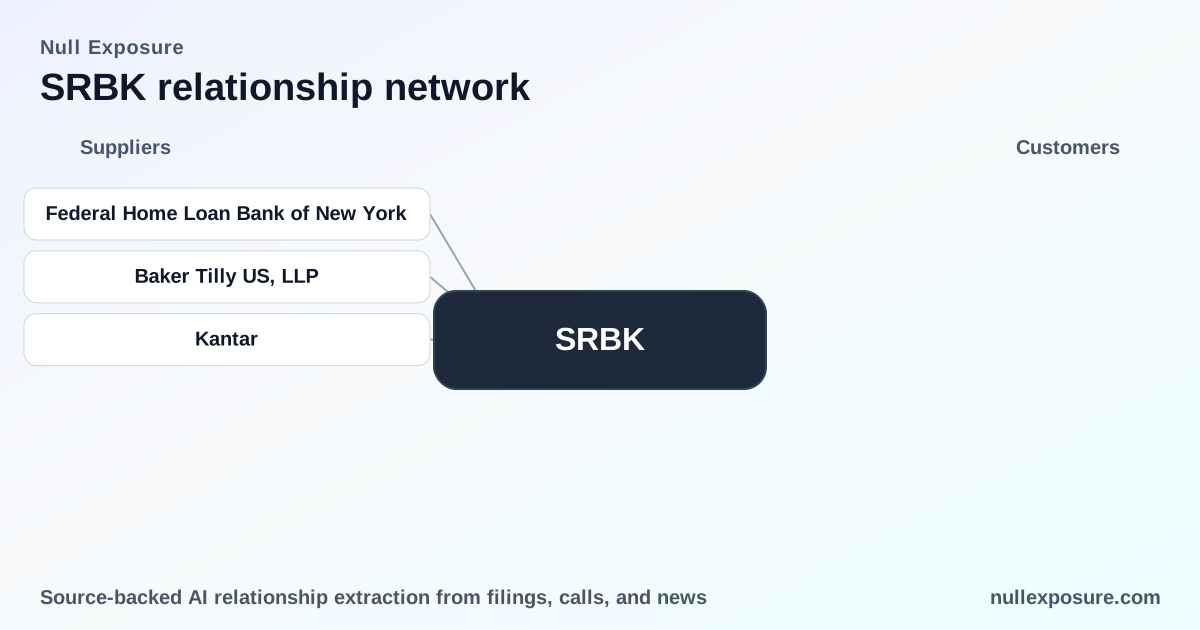
SR Bancorp (SRBK) — supplier map, liquidity partners and operational signals
SR Bancorp operates as a small regional bank through Somerset Savings Bank, monetizing primarily through net interest margin on originated and purchased loans, transactional and service fees, and modest dividend distributions to shareholders. With a market capitalization of roughly $135.5 million and a price-to-book below 1.0, SRBK is a capital-light, community-oriented lender that leverages both customer deposits and short-term wholesale funding to support loan growth. For a structured view of supplier exposure and third‑party dependencies, visit https://nullexposure.com/.
The big-picture operating posture investors should track
SR Bancorp’s supplier relationships reveal a mixed contracting posture: long-term commitments for branch and office real estate, combined with short-term wholesale liquidity and loan-by-loan purchases from mortgage brokers. The company leases branch and office space under operating leases with original terms of five to ten years, creating a predictable fixed-cost base; lease expense associated with two branch facilities tied to a director totaled about $236,000 for FY2025, signaling modest related‑party spend. At the same time, borrowings are secured and generally overnight, backed by pledges of qualifying loan assets — a classic short-term liquidity posture that increases counterparty reliance on wholesale sources for growth.
SRBK also relies on third‑party service providers for critical functions (customer account maintenance, electronic banking and financial reporting), and has been a Zelle participant since 2019 — a sign of a mature payments relationship that reduces transaction-level execution risk but increases dependence on external rails and vendors. A material weakness identified at June 30, 2025, in internal control over reporting related to bank‑owned life insurance administration underscores governance and reporting risk that investors must monitor through remediation and auditor interaction.
Visit https://nullexposure.com/ for a consolidated view of SRBK’s supplier intelligence and governance signals.
Supplier relationships that show up in the public record
Federal Home Loan Bank of New York — short-term secured liquidity
SR Bancorp borrowed $30.0 million from the Federal Home Loan Bank of New York in FY2025 to provide additional liquidity for new loans, and subsequently borrowed another $20.0 million in FY2026 to support continued loan growth. These transactions indicate active use of the FHLB as a repeat, secured wholesale funding counterparty for balance sheet management (State Journal, FY2025; TradingView press release, FY2026 — https://state-journal.com/2025/07/31/sr-bancorp-inc-announces-fourth-quarter-and-annual-financial-results/ and https://www.tradingview.com/news/tradingview:c09e99b45cf53:0-sr-bancorp-inc-announces-quarterly-financial-results/).
Baker Tilly US, LLP — independent registered public accounting firm
At the Annual Meeting of Stockholders on November 19, 2025, SR Bancorp ratified the appointment of Baker Tilly US, LLP as its independent registered public accounting firm for the fiscal year ending June 30, 2026, establishing Baker Tilly as the external audit partner responsible for overseeing remediation of the identified material weakness and external financial assurance (Globe and Mail press release, FY2025 — https://www.theglobeandmail.com/investing/markets/stocks/SRBK-Q/pressreleases/35609264/sr-bancorp-elects-directors-and-ratifies-auditor/).
Kantar — market research mention tied to a Norwegian SR-Bank
A FY2024 report published by NRK credits Kantar with research work conducted for SR‑Bank in Norway, and that mention appears in the supplier map; this reference documents Kantar’s role as a market research contractor for a Scandinavian lender rather than a U.S. operational vendor to SR Bancorp (NRK, FY2024 — https://www.nrk.no/rogaland/fa-bedrifter-brukar-ki_-gar-glipp-av-stor-verdiskaping_-meiner-nho-1.16990290).
What these relationships imply for strategic risk and opportunity
- Liquidity strategy is active and wholesale-dependent. The repeated FHLB borrowings ($30M in FY2025, $20M in FY2026) show SRBK uses secured, short‑term wholesale funding to fund loan growth rather than relying solely on deposit accretion. That creates counterparty concentration and roll‑over risk tied to the FHLB facility and secured borrowing terms.
- Contracts are a mix of long-term and short-term commitments. Long-term operating leases (5–10 years) produce predictable occupancy expense and modest related‑party spend (~$236k FY2025), while borrowings are generally overnight and secured — an operational profile that requires active liquidity management and a reliable warehouse/funding counterpart.
- Origination model blends in-house underwriting and spot purchases. Mortgage brokers fund 1–4 family loans and sell them on a loan‑by‑loan basis; SRBK pays fixed fees per purchased loan, a spot purchasing posture that minimizes originations fixed costs but increases underwriting and pricing discipline requirements.
- Third‑party service providers are critical. SRBK outsources core functions (account maintenance, electronic banking, financial reporting) making vendor oversight a front‑line control. The identified BOLI reporting weakness elevates the importance of audit quality and remediation plans; Baker Tilly’s role as auditor is therefore material to investor confidence.
- Payments capability is mature. Participation in Zelle since 2019 demonstrates operational readiness in real‑time retail payments and reduces product delivery risk versus banks that are still integrating such rails.
For investors and operators that want a consolidated supplier-risk view, explore the platform at https://nullexposure.com/ to map counterparty dependencies and remediation progress.
Actionable takeaways for due diligence and operations
- Prioritize monitoring of FHLB borrowing levels and the terms of pledged loan collateral; wholesale funding is a high-signal item for SRBK’s growth and liquidity stress.
- Track audit remediation timelines with Baker Tilly and governance changes tied to the material weakness in BOLI accounting; internal control remediation directly affects earnings quality and reporting risk.
- Maintain vendor oversight for payment rails and third‑party providers; Zelle participation reduces retail payment risk but increases dependence on external uptime and vendor SLAs.
- Reconcile related‑party lease exposure and its governance implications given the director-affiliated leases and the $236k lease expense noted for FY2025.
For a deeper, operationally focused supplier analysis and continuous monitoring of SRBK counterparties, see the full platform at https://nullexposure.com/.
SR Bancorp’s public supplier signals present a coherent picture: manageable operational scale, active short‑term liquidity strategy, and concentrated vendor dependencies that elevate governance and funding monitoring. Investors should prioritize counterparty concentration and remediation metrics over headline growth numbers when assessing SRBK’s near‑term credit and execution risk.